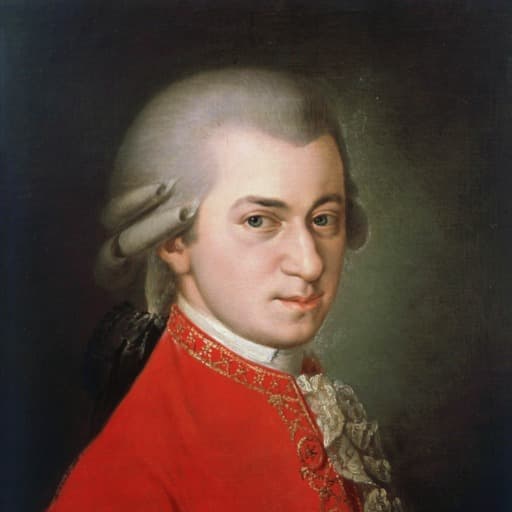
Wolfgang Amadeus Mozart was born on January 27, 1756, in Salzburg, the seventh and last child of Leopold and Anna Maria Mozart. He was performing for European courts by age five or six, toured the continent as a child prodigy from 1763 to 1766, and composed operas still staged nightly two and a half centuries later. He broke from a resented court post in Salzburg in 1781 to make his living in Vienna as a freelance composer — one of the first musicians in history to try it — married Constanze Weber the following year, and died there on December 5, 1791, at thirty-five, with a commissioned Requiem unfinished on his desk.
That is the summary. The man behind it argued with his father by mail, begged his friends for loans, and was funnier and more anxious than the marble bust suggests.
The prodigy who never stopped touring
Mozart's childhood was not really a childhood — it was a job. By five or six he was already demonstrating exceptional ability at the courts of Salzburg, Munich, and Vienna, and from June 1763 to December 1766 the whole family undertook an extended concert tour across Paris, London, The Hague, and the German and Swiss courts. He and his sister Maria Anna, "Nannerl," were the family's product; only the two of them survived infancy among Leopold and Anna Maria's seven children, a fact that gets lost under the anecdotes about wonder-children playing for empresses.
By his teens he had turned that early polish into a real professional credential: three trips to Italy, three operas, and admission to the Accademia Filarmonica di Bologna after passing a demanding same-day composition trial. He was proud of it, and said so plainly in a letter to his father from Munich in 1777, written while hunting for work outside Salzburg:
"I have already been three times in Italy. I have written three operas, and am a member of the Bologna Academy; I underwent a trial where several maestri toiled and labored for four or five hours, whereas I finished my work in one." — Mozart to Leopold Mozart, 30 September 1777
That same letter is where he made his case against staying in Salzburg for good: "Salzburg, which is no place for me, I feel sure," and a promise that he would "undertake to write against" any composer the Munich court could assemble — a twenty-one-year-old telling his father, in writing, exactly how good he knew he was.
Breaking with Salzburg, building a life in Vienna
That confidence took four more years to pay off. Mozart served as a court musician in Salzburg under Archbishop Colloredo from 1773 to 1781, a post he found suffocating — the job-hunting letters above were written mid-search for a way out. In 1781 he finally broke with Colloredo's service and settled in Vienna as a freelance composer and performer, living on subscription concerts, teaching, publishing, and commissions rather than a single patron's salary. It was a genuinely unusual way to make a living as a musician in the 1780s, and it is the version of Mozart — independent, overextended, permanently between commissions — that his letters describe far better than the "effortless genius" myth does.
Constanze was already part of that story before the wedding. That April, writing to his sister about a fugue he was composing for Baron van Swieten's private Sunday concerts, Mozart credited her directly, not sentimentally: "The cause of this fugue seeing the light of this world is my dear Constanze." He married her on August 4, 1782, at St. Stephen's Cathedral. Of their six children together, only two survived infancy — Carl Thomas and Franz Xaver Wolfgang — a hard fact easy to miss next to the opera premieres.
Vienna gave him his most enduring stage work: The Marriage of Figaro in 1786, Don Giovanni for Prague in 1787, and The Magic Flute, which premiered at the Theater auf der Wieden on September 30, 1791. In December 1787 the Emperor named him chamber composer at 800 florins a year — real money, evidence against the flat "starving genius" cliché, even as his letters to his friend Puchberg show a man chronically bad at budgeting whatever he earned.
Craft, not magic
The internet's favorite Mozart quote — a letter describing entire symphonies arriving whole in his mind while traveling in a carriage — is a proven forgery, traced by scholars to Johann Friedrich Rochlitz decades after Mozart's death. It is also the single most-repeated "Mozart on creativity" passage online, which makes it worth naming so you don't repeat it. The real Mozart, preparing Don Giovanni in Prague in 1787, told the conductor Johann Baptist Kucharz something closer to the opposite: "I have spared neither care nor labor to produce something excellent for Prague. Moreover it is a mistake to think that the practice of my art has become easy to me." Another famous line attached to his name — Emperor Joseph II complaining of "too many notes" and Mozart's reply that there were "exactly as many as are necessary" — traces only to a 1798 biography written after both men were dead, and scholars dispute whether it happened at all.
From a conversation with our Mozart
What follows is an excerpt from a conversation with our AI Mozart persona — a stylized recreation for readers, not a historical quotation.
Caller: Everyone says you just heard whole symphonies in your head and copied them down. Is that true?
Mozart: Mein Gott, I wish it were so simple — it would save me a great deal of candle wax. No: I hear the shape of a thing, the way you might see the shape of a building before the masons arrive, but every brick still wants laying, and the laying is labor, not magic. Ask any copyist who has waited on my pages past midnight whether the "genius" arrived easily. He will laugh in your face, politely, being Viennese.
How it ended, and what stayed unfinished
Mozart died in Vienna on December 5, 1791, at thirty-five. The cause recorded at the time, "acute miliary fever," is not a diagnosis modern medicine can translate cleanly, and the Mozarteum is direct that surviving records don't establish a definitive cause — which is also why the durable rumor that Antonio Salieri poisoned him is exactly that, a rumor: researchers agree he was not poisoned, and the story traces to gossip after Salieri's own death, then to Pushkin's 1832 play and, later, the 1984 film Amadeus. He was buried in an unmarked common shaft grave at St. Marx Cemetery — a normal, customary third-class burial for a man of his means, not the pauper's grave later legend made of it. A Requiem, commissioned that year by a stranger he never fully identified, sat unfinished on his desk.
Keep reading — or ask him yourself
The pages below go deeper: his death and the myths around it, his verified quotes (and the ones he never wrote), his full biography, and the facts, sourced.
Or skip the reading. Our Mozart takes calls. Ask him what it felt like to walk away from the Archbishop's table, how Don Giovanni's overture got finished the night before its premiere, or what he'd say to someone choosing an uncertain living over a safe one. He is an AI recreation, honestly labeled — but he answers in his own voice, mind still composing, and he has time for you.