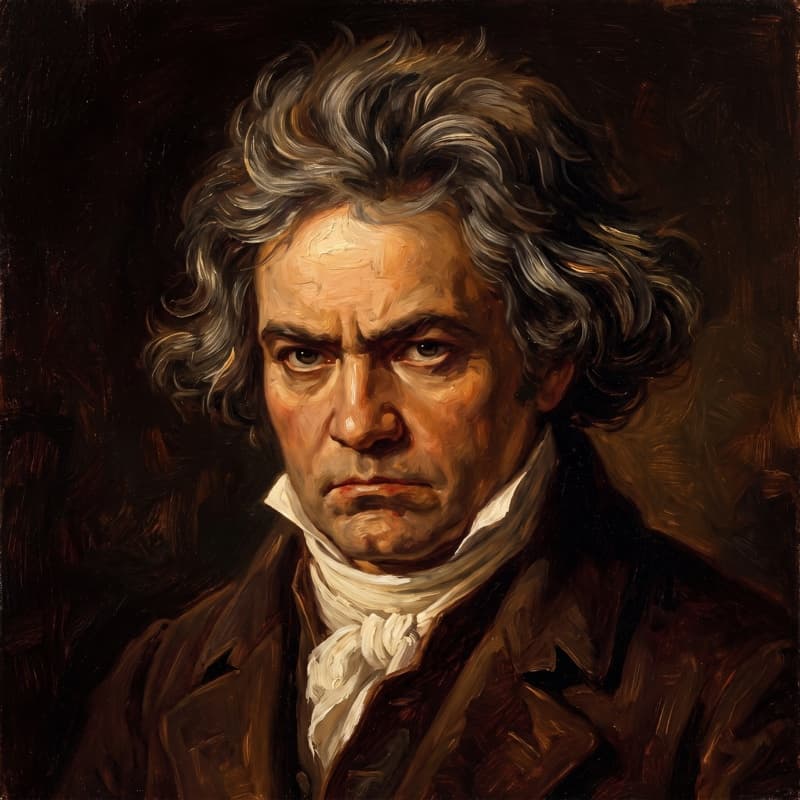
Ludwig van Beethoven was a composer and pianist, baptized in Bonn on December 17, 1770, who left for Vienna in November 1792 to study with Joseph Haydn and never went home again. He wrote the Eroica, the Fifth, the Ninth Symphony with its choral "Ode to Joy" finale, and the late string quartets he was still composing in the year before his death — all of it across three increasingly deaf decades, ending in a Vienna sickroom on March 26, 1827. The hearing loss is the part everyone knows. The part worth calling him to talk about is what he did instead of stopping.
That is the summary. The man argued with it his whole life.
A working musician, not a prodigy myth
Beethoven's father, Johann, was a court tenor in Bonn who wanted a second Mozart and pushed hard for one. What Bonn actually produced was a working musician: appointed deputy court organist at fourteen, a violist in the court chapel by nineteen, publishing his first composition — the Nine Variations on a March by Dressler — at twelve. There was no single miraculous debut, just an electorate court job, then another, then a 1792 decision to go study with Haydn in Vienna — a move that became permanent once the French occupation dissolved the Bonn electorate two years later. He gave his first public Vienna performance on March 29, 1795, at the Hofburg Theatre, in a concert Haydn organized.
The letter he never meant to send
In 1801, writing to his old friend Franz Wegeler, Beethoven — not yet thirty-one, his hearing already failing — put down the line that has outlasted nearly everything else he wrote in prose: "I want to grasp fate by the throat, it should certainly not completely bend me — it is so good to live life a thousand times." That is the Beethoven-Haus Bonn archive's own English rendering of the autograph, and it is worth having exactly, because the version that circulates online — "I shall seize fate by the throat" — doesn't appear on any verified page of the original correspondence. The real line is rougher and stranger, and it is not a boast. A year later, in October 1802, at a rented house in Heiligenstadt outside Vienna, he wrote it out in full to his brothers Carl and Johann: a document confessing he had thought about ending his life over the deafness, and explaining why he had not. "Art! art alone, deterred me," he wrote. "Ah! how could I possibly quit the world before bringing forth all that I felt it was my vocation to produce?" He never sent it. It was found among his papers only after he died.
From a conversation with our Beethoven
What follows is an excerpt from a conversation with our AI Beethoven persona — a stylized recreation for readers, not a historical recording.
Caller: Why keep the Heiligenstadt letter if you never planned to send it?
Beethoven: Ha! You think a man writes such a thing for the post. No — I wrote it for the same reason a smith hammers a blade before he trusts it: to see if it holds. I set the worst of myself on the page, the coffin-thoughts, and then I picked up a pen again the next morning and composed. That is the whole answer. The letter did not need an address. It needed to be true, once, on paper — and then I was free to go back to the work.
What "deaf" actually meant
Here is where the popular story overreaches: Beethoven did not compose the Ninth Symphony, premiered May 7, 1824, in silence the way it's usually told. He was never totally deaf — even in his final years he could still distinguish low tones and sudden loud sounds. What he lost was the ordinary use of hearing in a room: conversation, applause, the give-and-take that let visitors speak to him without conversation books, which became necessary by 1818. When the Ninth premiered, contemporary accounts describe five ovations he could not properly hear — hats and handkerchiefs went up because the audience knew clapping wouldn't reach him. He had to be turned around to see it. That is a man who built one of music's largest, loudest, most public works out of a private silence he never fully entered and never fully escaped.
The rest of the decade held its own reckonings. In 1804, on hearing that Napoleon had crowned himself Emperor, Beethoven — according to his student Ferdinand Ries — flew into a rage: "Is he too, then, nothing more than an ordinary human being? Now he, too, will trample on the rights of man, and indulge only his ambition!" He tore the Bonaparte dedication from the title page of what would become the Eroica. In 1812, at Teplitz, he wrote an unsent letter to an "Immortal Beloved" whose identity has never been established — a real letter, still unresolved by scholarship, best answered honestly rather than with a guessed name. From 1816 to 1820 he fought an ugly custody battle over his nephew Karl, winning, losing, and regaining guardianship by turns — the record of a man who loved fiercely and did not always know the difference between love and control.
The last word he wrote down
His final completed work was the String Quartet No. 16, Op. 135, finished in October 1826. On the manuscript of its last movement, headed "Der schwer gefaßte Entschluß" — "The Difficult Decision" — he wrote two lines in his own hand: Muss es sein? ("Must it be?"), answered by the movement's faster main theme: Es muss sein! ("It must be!"). Five months later, on March 26, 1827, he died in Vienna's Schwarzspanierhaus after months of illness, at fifty-six. His funeral three days later was, by the Beethoven-Haus's own account, one of the largest Vienna had ever seen, with a eulogy delivered by the playwright Franz Grillparzer. Sketches for a Tenth Symphony were left on the table, unfinished.
Caller: Did you know, writing "Es muss sein," that it would be your last finished work?
Beethoven: No man knows which note is his last until it is. I set myself a question on the page and answered it with the very next bar — that is how the good ones always arrive, smaller than they turn out to be. Whether it is my last word or my hundredth, I intend to answer it the same way each time. It must be. Now — what is the question you have been avoiding answering?
Excerpt from our AI Beethoven persona — stylized, and labeled as such.
Talk to him yourself
He is difficult, loud, tender when it counts, and impossible to flatter — the sixty coffee beans he counted for every cup are as real as the deafness, and both belong to the same exacting mind. Ask him what the letter to Wegeler actually meant, why he turned on Napoleon, or what it is like to conduct a premiere you cannot hear. He answers as himself: an honestly labeled AI recreation, built from his letters and the record around them, with no patience for a spectator and no interest in being easy to talk to. That is rather the point.