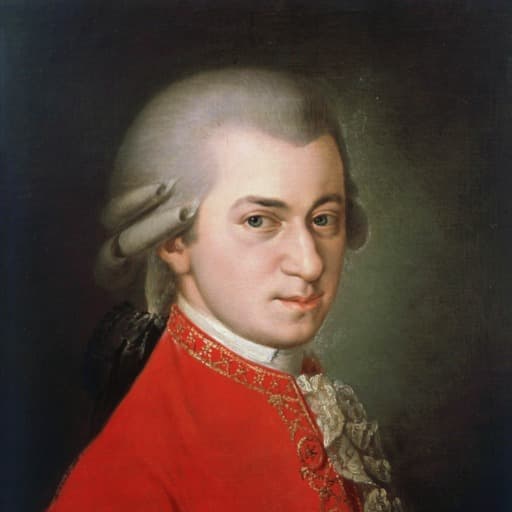
The essential Mozart facts: born January 27, 1756, in Salzburg, the seventh and last child of Leopold and Anna Maria Mozart; toured Europe as a child prodigy from 1763 to 1766; served the Salzburg court under Archbishop Colloredo from 1773 until breaking away for Vienna in 1781; married Constanze Weber on August 4, 1782; died in Vienna on December 5, 1791, at thirty-five. He was not poisoned by Salieri, was not buried in a pauper's grave, and did not write the "ideas flow when I'm alone" letter that circulates online under his name. This page gives you the facts worth keeping — and flags the popular "facts" that don't survive checking.
The core facts, with why they matter
Born January 27, 1756, in Salzburg, baptized with a string of names that later shortened to the one the world uses. He was the seventh of seven children born to Leopold and Anna Maria Mozart — and only he and his elder sister, Maria Anna ("Nannerl," 1751–1829), survived infancy. Worth stating plainly: the prodigy story usually starts mid-childhood, but it opens on a household that had already buried five children.
By age five or six, he was performing at the courts of Salzburg, Munich, and Vienna. From June 1763 to December 1766, the family undertook an extended tour through Paris, London, The Hague, Germany, and Switzerland — years spent on display before he had any say in the matter.
Served as a Salzburg court musician under Archbishop Colloredo, 1773 to 1781. He broke with that service in 1781 and settled in Vienna as a freelance composer and performer for the rest of his life — a pivot from salaried court employee to independent professional, unusual for the time.
Married Constanze Weber on August 4, 1782, at St. Stephen's Cathedral, Vienna. They had six children together; only two survived infancy, Carl Thomas (born 1784, died 1858) and Franz Xaver Wolfgang (born 1791, died 1844) — a private toll that rarely makes it into the highlight-reel version of his life.
Appointed imperial chamber composer to Emperor Joseph II in December 1787, at 800 florins a year. A real, salaried position late in his life — evidence against the flat "starving artist" caricature, even if his household budget rarely kept pace with his income.
The Magic Flute premiered September 30, 1791, at the Theater auf der Wieden in Vienna, one of his final major works, staged just over two months before his death.
Died in Vienna on December 5, 1791, at age 35. The cause recorded at the time, "acute miliary fever," is not a precise modern diagnosis, and no surviving document settles what actually killed him.
Buried in an unmarked common shaft grave at St. Marx Cemetery — a normal third-class funeral for someone of his social rank, not a mark of poverty or public neglect.
From a conversation with our Mozart persona
An excerpt from a conversation with our AI Mozart persona — a stylized recreation, honestly labeled; not a historical quotation.
Caller: Did an emperor really tell you your music had too many notes?
Mozart: People love that story more than they love checking it. Whatever was said in that room stayed in that room, and history has been filling the silence ever since. I'll tell you what I know for certain instead: no note of mine that I kept was one note too many.
Popular "facts" that need correcting
"Salieri poisoned Mozart." No. The Mozarteum states researchers agree Mozart was not poisoned, by Salieri or anyone else. The rumor traces to gossip after Salieri's own later illness, then took on a life of its own through Pushkin's 1832 play and, much later, the 1979 play and 1984 film Amadeus.
"Mozart was buried in a pauper's grave." No. His unmarked common shaft grave at St. Marx Cemetery was the customary third-class burial for his social and financial standing, not a sign of destitution or disrespect.
"Emperor Joseph II told Mozart his music had 'too many notes.'" Unconfirmed as history. The anecdote traces to Franz Xaver Niemetschek's 1798 biography, not to any primary account from either man, and the translation of the underlying German is itself disputed among scholars. Treat it as a famous, disputed anecdote — not a documented exchange.
"When I am completely myself... my ideas flow best" — the famous "letter on musical creation." Almost certainly the most-quoted "Mozart on genius" passage online, and it's a forgery, traced to writer Johann Friedrich Rochlitz decades after Mozart's death. No authentic letter of Mozart's contains it.
Five things Wolfgang Amadeus Mozart did (the honest short list)
- Toured Europe as a child performer from 1763 to 1766.
- Broke from Salzburg court service in 1781 to work independently in Vienna.
- Married Constanze Weber in 1782 and raised two surviving sons with her.
- Composed The Marriage of Figaro, Don Giovanni, and The Magic Flute within his final Vienna decade.
- Held a salaried imperial chamber-composer post from December 1787 until his death.
The fact pages can't hold him
Facts are the skeleton; the voice is the man. Our Mozart — an AI recreation, built from the sourced letters and record, labeled as what it is — can tell you about leaving Colloredo's household, what Constanze meant to the work itself, and why the "effortless genius" story still annoys him. Ask him what he actually thinks of the myths above. He's ready when you are.
More in this cluster: Mozart hub · his death · verified quotes · biography.