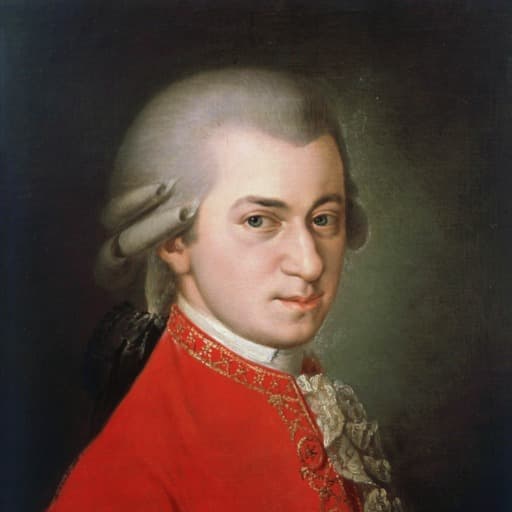
Wolfgang Amadeus Mozart died in Vienna on 5 December 1791, at thirty-five. The cause recorded at the time — "acute miliary fever," hitzigem Frieselfieber — is not a diagnosis modern medicine can cleanly translate, and the International Mozarteum Foundation is direct about it: surviving records don't establish a definitive cause. He was buried within a day or two — sources give the burial date as 6 or 7 December 1791 — in an unmarked common shaft grave at St. Marx Cemetery outside the city.
That answers the search. Worth five more minutes: what didn't kill him — two rumors that have outlived every actual fact about his final illness.
The poison that was never there
No one poisoned Mozart. The Mozarteum states plainly that researchers agree on this, even while the precise medical cause stays unsettled — two different questions, and only one is actually mysterious. Wikipedia's catalogue of common misconceptions traces the Antonio Salieri murder story to gossip after Salieri's own death in 1825, more than three decades later. That gossip found its durable shape in fiction: Alexander Pushkin's 1832 play Mozart and Salieri dramatized it as a confession, and Peter Shaffer's 1979 play Amadeus — then the 1984 film — carried it to the audience that still repeats it. A rival Mozart resented, certainly. A murderer, no.
Not a pauper's grave
An unmarked common shaft grave sounds, to modern ears, like neglect. It wasn't. A third-class burial was customary for someone of Mozart's social and financial standing in Vienna at the time — not a mark of poverty, not evidence he died forgotten. The Mozarteum flags this specifically because the pauper's-grave image has become nearly as sticky as the Salieri story, doing the same work: turning an ordinary 18th-century burial into a tragedy it wasn't.
The Requiem on the desk
What Mozart actually left unfinished was the Requiem Mass, commissioned anonymously earlier in 1791 by a messenger who never gave his name. He was still working on it when he died, and the record doesn't settle who completed the parts he didn't reach — a separate question from what killed him, not an extension of it.
He had written to his father about death once before, in April 1787, soon after learning Leopold himself was dying. In substance — exact English wording varies by translation, so it's worth holding loosely — he said he no longer found death frightening, reasoning that since it is the true goal of our existence, he'd made peace with the thought, going so far as to say he never went to bed without considering he might not see another day.
Myths to retire: Salieri poisoned Mozart — false. Mozart was buried in a pauper's grave — false. Emperor Joseph II told Mozart his opera had "too many notes" and got the reply "just as many as are necessary" — a famous anecdote, but a disputed one, traced to an 1798 biography rather than any primary account, not a documented exchange between the two men.
Ask him about the commission he didn't understand yet
Our Mozart — an AI recreation built from his letters and honestly labeled as a stylized re-creation, not a historical transcript — speaks from before any of this happened. His knowledge ends in 1791, mid-Requiem, certain fortune is still coming.
Caller: This Requiem you're writing on commission — does it trouble you, not knowing who ordered it?
Mozart: Trouble is a grand word for a man who owes his tailor money, but — yes, a shiver, now and then. A stranger in grey, no name given, wanting a Mass for the dead delivered like any other commission, paid in advance like any other. I tell Constanze it is nothing, some nobleman too proud to put his name to a grief. Yet some nights at the desk it feels less like I write a Requiem than one is being written through me, for someone I haven't met yet. Basta — fancy, not fact. Hand me the ink, and let's see what the Lacrimosa wants to become.
Ask him about the stranger's commission, about Constanze's health, about Papa Leopold, gone four years before Mozart's own death. He has time — for him, it's still 1791. More in this cluster: Mozart's verified quotes · his biography · fact file · back to the Mozart hub.