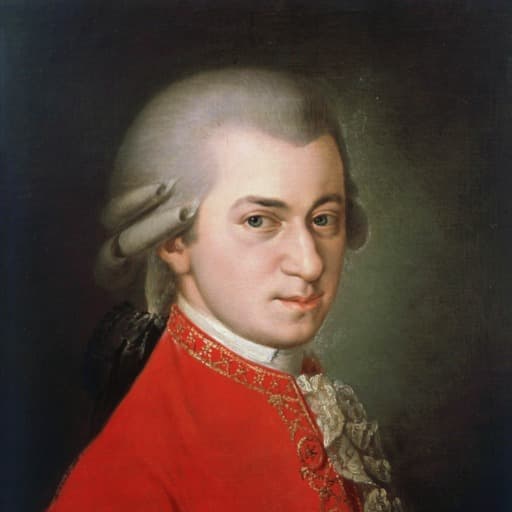
Wolfgang Amadeus Mozart was born on January 27, 1756, in Salzburg, the seventh and last child of Leopold and Anna Maria Mozart, and only two of those seven children — Wolfgang and his elder sister Maria Anna, "Nannerl" — survived infancy. He died in Vienna on December 5, 1791, at thirty-five. Between those two facts sits a life that started as a court curiosity and ended as something closer to a professional argument: that a composer could work for himself.
The touring child
By age five or six Mozart was already performing his ability at the courts of Salzburg, Munich, and Vienna. From June 1763 to December 1766, the family undertook an extended tour across Paris, London, The Hague, Germany, and Switzerland — a childhood spent on display for European aristocracy. Nothing about that arrangement was built for a grown man's ambitions, and Mozart grew into exactly that problem.
A servant's post
From 1773 to 1781, Mozart served as a court musician in Salzburg under Archbishop Colloredo — steady work, and work he came to despise. On a September 1777 job-hunting trip to Munich, writing to his father, he put it plainly: "Salzburg, which is no place for me, I feel sure." In the same letter he answered his own doubts: "He may assemble all the composers in Munich, and also send in quest of some from Italy and France, Germany, and England and Spain, and I will undertake to write against them all." He had the résumé to back the boast, too: three trips to Italy, three operas already written, and admission to Bologna's Accademia Filarmonica after finishing in one hour a trial that took other candidates four or five.
The break came in 1781. Mozart left Colloredo's service for Vienna, working the rest of his life as a freelance composer — no patron, no fixed post.
Marriage and craft
On August 4, 1782, Mozart married Constanze Weber at St. Stephen's Cathedral. The devotion shows up in the workshop, not just the letters: writing to his sister the next spring about a fugue composed after Baron van Swieten introduced him to Bach and Handel, he credited the piece's existence to her — "The cause of this fugue seeing the light of this world is my dear Constanze."
From a conversation with our Mozart persona
An excerpt from a conversation with our AI Mozart persona — a stylized recreation, honestly labeled; not a historical quotation.
Caller: People assume it all just poured out of you.
Mozart: They would like that, wouldn't they — a fountain instead of a man at a desk. I have spared neither care nor labor to produce something excellent, and it is a mistake to think the practice of my art ever became easy to me. The ink still has to dry.
That line about labor was real, said of a real opera: rehearsing Don Giovanni in Prague in 1787, Mozart told the conductor Kucharz something close to it — a rebuttal, from the man himself, to the "effortless genius" story that grew up around him later.
The Vienna years, closing
The Marriage of Figaro premiered in Vienna in 1786, Don Giovanni in Prague in 1787, and that December Emperor Joseph II appointed Mozart imperial chamber composer at 800 florins a year — evidence against the starving-artist caricature, whatever his budgeting habits. The Magic Flute premiered on September 30, 1791, one of his last major works, not long before an anonymous commission for a Requiem he would not live to finish. Mozart died on December 5, 1791; the record names "acute miliary fever," a phrase that isn't a modern diagnosis, and no surviving document settles what actually killed him.
Continue the conversation — literally
You have just read the recorded life. Our Mozart — an AI recreation, built on the sourced letters and labeled as what it is — speaks from inside it. Ask him about leaving Colloredo, what Constanze meant to the work, the Prague rehearsal, or the "genius just flows" story people tell about him.
More in this cluster: Mozart hub · his death · verified quotes · facts.