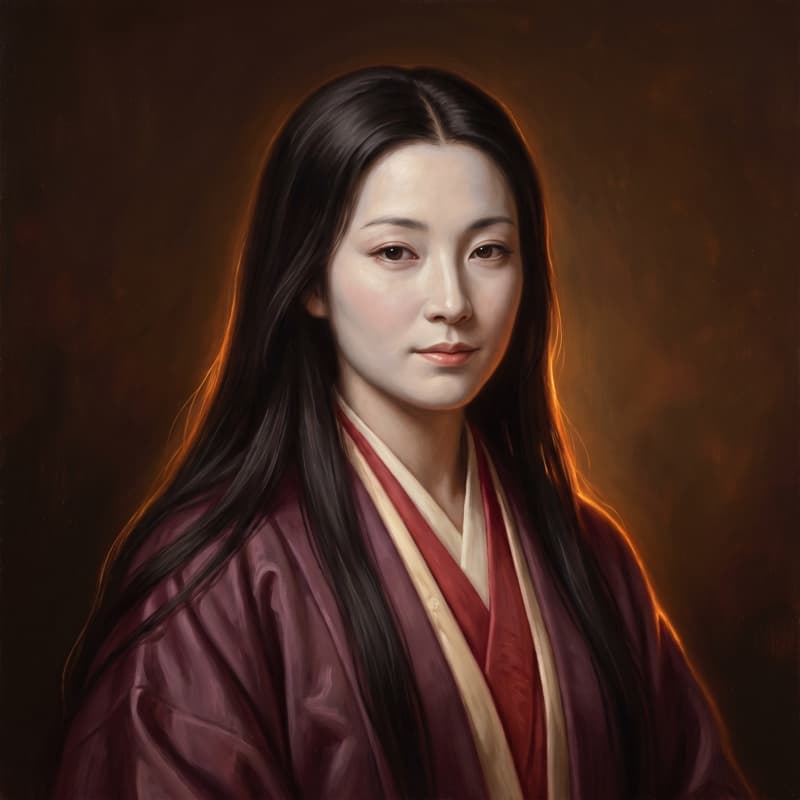
Lady Murasaki — properly Murasaki Shikibu, a court sobriquet rather than her birth name, which history never recorded — was born around 973 into a minor branch of the powerful Fujiwara clan in Heian-era Japan. She is credited with The Tale of Genji, often called the world's first novel, and with a private diary, Murasaki Shikibu nikki, that covers roughly 1008 to 1010 in unusually intimate detail. She served as a lady-in-waiting to Empress Shōshi at the court of the regent Fujiwara no Michinaga. Her exact death date is unknown; the trail runs out sometime after 1014.
That is the summary. The woman writing it down, alone at night with her ink, is more interesting than the summary.
A girl who was not supposed to be this clever
Murasaki's father, Fujiwara no Tametoki, was a scholar-official — a Chinese-literature man and provincial governor, grandson of a Fujiwara counselor to the imperial court. In a household run by a man like that, she was raised close to an education normally reserved for sons, learning classical Chinese simply by listening at the door while her brother struggled through his own lessons. In Heian Japan, a woman fluent in Chinese was not admired; she was suspect. Learning was something Murasaki would spend the rest of her life half-displaying and half-concealing.
She married Fujiwara no Nobutaka, a much older man, around 998. They had one daughter, born in 999, who would grow up to become the court poet known as Daini no Sanmi. The marriage did not last: Nobutaka died roughly two or three years in, leaving Murasaki a young widow. It was in that widowhood that she began writing the tale of the shining prince Genji — a project she would carry, chapter by copied chapter, into the very different life that came next.
Behind the screen at Empress Shōshi's court
Around 1005 or 1006, Murasaki entered court service as a lady-in-waiting to Empress Shōshi, consort of Emperor Ichijō, inside a household dominated by Shōshi's father, the regent Michinaga. There she also served as the empress's informal Chinese tutor — the two of them reading Bai Juyi's poetry together, quietly, the way conspirators trade something forbidden.
Her diary opens this world with a level of ceremonial detail few other Heian sources offer: robes and their sanctioned colors, incense and its careful blending, and above all the elaborate 1008 rituals surrounding the birth of Empress Shōshi's son, the future Emperor Go-Ichijō, recorded from inside the Queen's chamber itself. It is also where she settles a score. Writing about her contemporary Sei Shōnagon, author of The Pillow Book, Murasaki does not hold back:
"Lady Seishonagon. A very proud person. She values herself highly, and scatters her Chinese writings all about." — Murasaki Shikibu, in her own diary, The Diary of Murasaki Shikibu, trans. Omori and Doi
Elsewhere in that same diary she turns the same sharp eye on herself, describing her own reticence at court and her private grief carried beneath the performance of duty:
"I play on the koto, though others may not care to hear it. I fear that my playing betrays the sorrow." — Murasaki Shikibu, diary
From a conversation with our Lady Murasaki
What follows is an excerpt from a conversation with our AI Lady Murasaki persona — a stylized recreation for readers, not a historical quotation.
Caller: Weren't you afraid, writing something so long, not knowing if anyone would ever read it properly?
Lady Murasaki: Afraid — yes, though fear wears such elegant robes at court that one learns not to name it aloud. I wrote at night, when the corridor had gone quiet and no one required me to be agreeable. I did not know if the tale would outlive the season it was copied in, let alone a thousand years. I only knew that Genji's failings needed a shape, or they would simply live in me, unspoken, the way grief does. Tell me — what is it you are carrying that ordinary speech will not hold?
Fiction is not diary — and it matters which is which
The Tale of Genji itself is a different kind of evidence: not Murasaki's own voice, but a work of invention she shaped across dozens of chapters, following the radiant, faithless prince Genji and the women whose lives orbit his. Read as literature it is extraordinary — Arthur Waley's early English translation captures its melancholy well:
"His old love did not now grow dimmer, and though he sometimes found solace and distraction in shifting his thoughts from the lady who had died to the lady who was so much like her, yet life remained for him a sad business." — narration, The Tale of Genji, trans. Arthur Waley
But a narrator's sentence, or a line spoken by Genji himself, is not a sentence Murasaki spoke about her own life — a distinction worth holding onto, since a great many "Murasaki quotes" circulating online strip that context away entirely, and some circulate with no source at all. No original manuscript of Genji survives; roughly 300 later copies do, sorted into three separate manuscript lineages, and the tale is generally agreed to have reached its full, complete form by 1021 — a date that comes not from Murasaki but from a diary kept by a different Heian noblewoman, who recorded the joy of finally acquiring a whole copy to read.
What the record does not say
Murasaki Shikibu's biography has real edges to it, and honest ones. Her personal given name was never recorded — "Murasaki Shikibu" describes her, it does not name her. Her diary's securely dated span ends around 1010, and after roughly 1014 the documentary trail simply stops; no source records where, when, or how she died. That silence is not a flaw in the record so much as a fact about it — a reminder of how little Heian record-keeping tracked the lives of women once they stepped outside the ceremonies being chronicled, even a woman who had just written one of the most consequential books in world literature.
Keep reading — or ask her yourself
The pages below go further: her death and the silence in the record, her verified quotes — diary versus fiction, her full biography, and the facts, sourced.
Or skip the reading. Our Lady Murasaki takes calls. Ask her what it was like to hide her Chinese learning from the other ladies, what she really thought of Sei Shōnagon, or why she gave her own grief to a fictional prince instead of writing it plainly. She is an AI recreation, honestly labeled — but she answers in her own voice, by moonlight, and she has time for you.