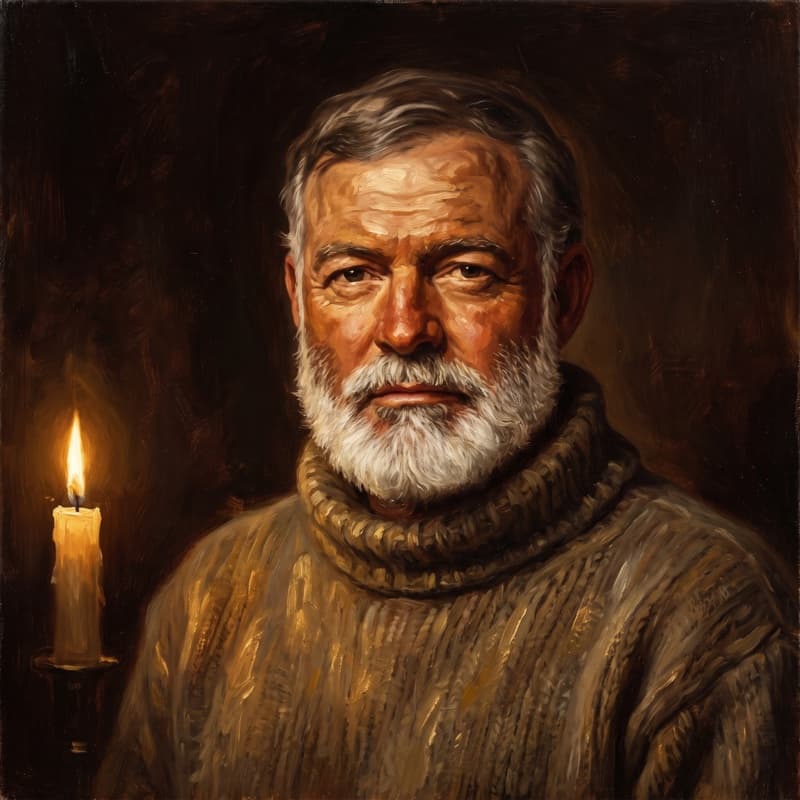
Ernest Hemingway was born on July 21, 1899, in Oak Park, Illinois, a doctor's son who skipped college for a cub reporter's desk at the Kansas City Star. At eighteen he was driving a Red Cross ambulance on the Italian front of the First World War; on July 8, 1918, a mortar blast filled his legs with shrapnel and gave American literature its most productive wound. He went on to write The Sun Also Rises, A Farewell to Arms, For Whom the Bell Tolls, and The Old Man and the Sea, to win the Pulitzer Prize in 1953 and the Nobel Prize in Literature in 1954, and to die by his own hand in Ketchum, Idaho, on July 2, 1961.
That is the obituary version. The life is bigger than the obituary, and stranger.
The reporter who learned to leave things out
Hemingway's style — the short declarative sentence, the adjective distrusted on principle — started as newspaper discipline. The Kansas City Star's style sheet demanded short sentences and vigorous English, and he carried that discipline to Paris in the early 1920s, where he wrote his breakthrough books poor, newly married to Hadley Richardson, and surrounded by Gertrude Stein, Ezra Pound, and Scott Fitzgerald. The Sun Also Rises came out from Scribner's in 1926, and its dialogue still gets quoted by people who have never opened it:
"How did you go bankrupt?" Bill asked.
"Two ways," Mike said. "Gradually and then suddenly." — The Sun Also Rises, Chapter 13
The same novel closes on five words — "Isn't it pretty to think so?" — that settle a whole doomed love affair. A Farewell to Arms followed on September 27, 1929, turning his own Italian front and Milan hospital into fiction, and announcing the method in its first sentence:
"In the late summer of that year we lived in a house in a village that looked across the river and the plain to the mountains." — A Farewell to Arms, Chapter 1
No comment, no explanation — a river, a plain, mountains, and everything the reader needs to feel riding underneath. He called the method the iceberg: cut what you know, and the cut parts strengthen what stays. Seven-eighths of the thing travels underwater. The book also holds the line that comes closest to a Hemingway creed: "The world breaks everyone and afterward many are strong at the broken places."
Key West, Cuba, and the late vindication
In 1931 Hemingway and his second wife, Pauline Pfeiffer, moved into the house at 907 Whitehead Street in Key West — bought for $8,000 by Pauline's uncle as a wedding present — where they lived until 1939. The famous six-toed cats belong to that house; Wikipedia's article on his Cuban home is blunt that there is no evidence his Cuban cats were polydactyl, a detail the legend rarely bothers to check.
Cuba came next: the Finca Vigía, a hilltop farmhouse outside Havana that he rented in 1939 and bought in December 1940 for $12,500. He lived there for two decades, finished For Whom the Bell Tolls — published in October 1940, its title borrowed from John Donne's 1624 Devotions, not his own pen — and, after critics had largely written him off, wrote The Old Man and the Sea drawing on the fishermen of nearby Cojímar. Life magazine ran the novella complete on September 1, 1952, and sold a reported 5.3 million copies in two days; Scribner's published the book a week later, and it won him the Pulitzer Prize for Fiction on May 4, 1953. The Nobel Prize in Literature followed in October 1954.
From a conversation with our Hemingway
What follows is an excerpt from a conversation with our AI Hemingway persona — a stylized recreation for readers, not a historical quotation.
Caller: Everyone says the old man is you, and the fish is fame, or death, or the critics. Is that right?
Hemingway: No. The old man is an old man. The fish is a fish. The sea is the sea. I made them as true as I could make them, and if you make a thing true enough it will mean many things. But nobody put the meanings in like raisins in a bun. You want symbols, the professors sell them by the pound. You want the fish, come out on the Stream and I'll show you the fish.
Did Hemingway really say "write drunk, edit sober"?
No. Quote Investigator found no trace of it in anything Hemingway said or wrote; the earliest real version is dialogue in Peter De Vries's 1964 novel Reuben, Reuben, published three years after Hemingway died. The typewriter-and-bleed line fails the same test — no substantive evidence connects it to him. Even "for whom the bell tolls" is John Donne's, three centuries older than the novel it titles.
The famous line that is his came out in conversation: courage as "grace under pressure," said to Dorothy Parker for her 1929 New Yorker profile. When John F. Kennedy wanted it for the opening of Profiles in Courage, Hemingway's own people couldn't place it — Kennedy's editor finally traced it back to the Parker interview.
The end at Ketchum
The Cuban government expropriated the Finca Vigía in the fall of 1960, and Hemingway's last months were spent in Ketchum, Idaho, in failing health. He died there by suicide on July 2, 1961, at sixty-one. There is no reliably sourced record of any last words, whatever the internet offers; the honest account ends with the date and the place. The fuller story is on his death page.
Caller: Were you ever afraid you'd lost it — the writing?
Hemingway: Every writer worth anything is afraid of that every morning. The ones who say otherwise are liars, and their books show it. You beat it by working. Five hundred true words, stop while it's going well, start again tomorrow. The fear stays. You just don't let it vote.
Excerpt from our AI Hemingway persona — stylized, and labeled as such.
Keep reading — or call him yourself
The pages below go deeper: his full biography, his verified quotes — and the famous ones he never said, his death in Ketchum, and the facts, sourced.
Or skip the reading. Our Hemingway takes calls — at the Finca in 1952, The Old Man and the Sea just off the typewriter, the Gulf Stream out the window. Ask him what he leaves out of a sentence and why, what Paris cost when he was poor there, or how you fight a fish you can't see. He is an AI recreation, honestly labeled — but he answers straight, and he has time for anyone honestly working at something hard.