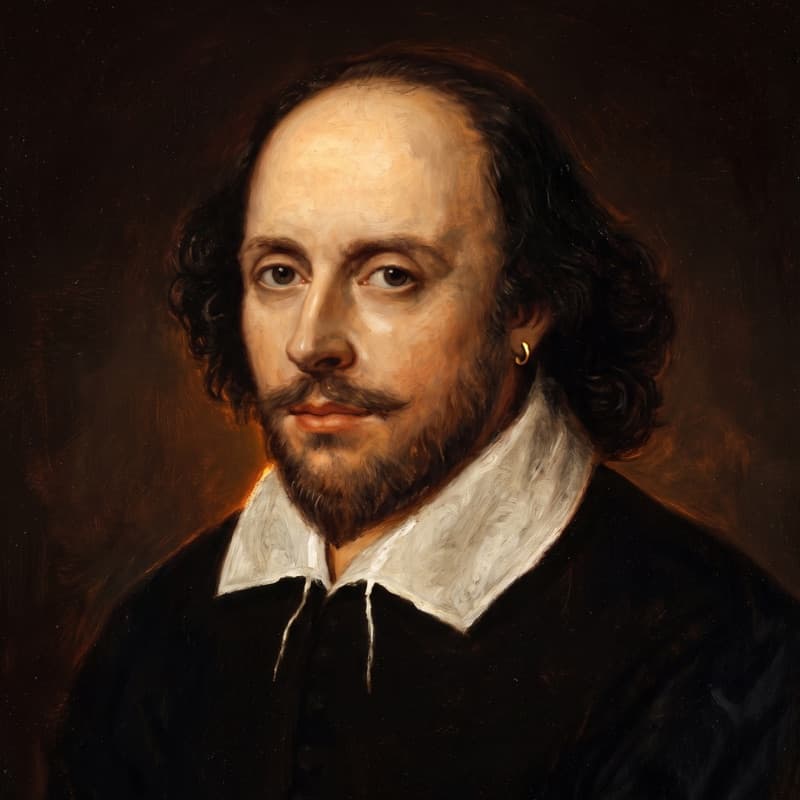
William Shakespeare was baptized in Stratford-upon-Avon on April 26, 1564 — his exact birthdate is unrecorded, though tradition puts it three days earlier — and he died in the same town on April 23, 1616. In between, a glover's son with no university degree became an actor, a playwright, and a part-owner of the most successful theater company in London, writing somewhere around 38 to 40 plays and 154 sonnets that are still performed and quoted four centuries later, in a language he helped shape as he went.
That is the summary. The man is more interesting than the summary.
A grammar-school education, and a very early marriage
Shakespeare almost certainly attended Stratford's grammar school, where the curriculum ran heavily on Latin, and left it — like most boys of his class — around age fifteen, with no university to follow. At eighteen he married Anne Hathaway, twenty-six and already pregnant; their daughter Susanna arrived in 1583, and twins Judith and Hamnet were baptized on February 2, 1585. For several years after that, the historical record goes almost silent — the so-called "lost years" — until 1592, when a dying rival playwright, Robert Greene, took a swipe at an "upstart crow" in London who thought himself able to write as well as his university-educated betters. It is the first time anyone in print noticed Shakespeare existed, and it was an insult.
He answered, in effect, by outworking everyone. His first printed poem, Venus and Adonis, appeared in 1593, and by the mid-1590s he was an actor, playwright, and shareholder in the Lord Chamberlain's Men — meaning he didn't just get paid to write plays, he owned a slice of the box office. When the company built the Globe on Bankside in 1599, he owned a piece of that too, so a packed house paid him twice: once for the script, once for the seats.
Gentleman, householder, company man
Success bought him status his father had lost. In October 1596, the College of Arms granted John Shakespeare — William's father, a glover and onetime town bailiff who'd fallen on hard times — a coat of arms, later inherited by William, with the motto Non sanz droict, "not without right." The next year he bought New Place, the second-largest house in Stratford. When James I took the throne in 1603, the Lord Chamberlain's Men were renamed the King's Men under royal patent, and by 1609 the company had added the indoor Blackfriars theater to its Globe, the same year Shakespeare's Sonnets reached print.
From a conversation with our Shakespeare persona
What follows is an excerpt from a conversation with our AI Shakespeare persona — a stylized recreation for readers, not a historical quotation.
Caller: Is it true you bought your own coat of arms?
Shakespeare: Bought is an ungentle word for it, though not an unfair one. My father wore his worship thin — bailiff of this town once, then a man who dodged the collectors — and I swore I'd not let the name fall twice. So: Non sanz droict. Not without right. The wits at the Mermaid smirk at "Shakespeare the gentleman" behind their sack, and let them — a falcon on a spear looks well on a wall, and it is mine, bought fair, and my father's before it was ever mine.
The playhouse business, and what the plague cost
None of this came free of risk. Companies survived on packed afternoons at a penny a head in the yard, and plague closures — which shut London's theaters for long stretches across Shakespeare's career — starved everyone on the payroll. In 1613, disaster struck the Globe itself: a stage cannon during a performance of Henry VIII set the thatched roof alight, and the theater burned down. It was rebuilt within a year — the same year Shakespeare bought the Blackfriars Gatehouse in London, even as he spent more of his time back in Stratford.
The will, the bed, and the end
Shakespeare signed his will on March 25, 1616, declaring himself in "perfect health and memory" — though his surviving signatures from this period wobble, suggesting otherwise. He died a month later, on April 23, cause unrecorded; his brother-in-law had died the week before, hinting at possible infectious illness, but that's speculation, not fact. The will left the bulk of his estate to his elder daughter Susanna, £150 to his younger daughter Judith, and to his wife Anne "my second best bed with the furniture" — a line that has launched a thousand theories of marital slight, though best beds were commonly reserved for guests, so a second-best bed was likely the actual marriage bed, a household object rather than an insult. He also left money for mourning rings to his "fellows" John Heminges, Richard Burbage, and Henry Condell. The will was proved on June 22, 1616.
Seven years later, Heminges and Condell did something no contract obliged them to do: they gathered 36 of Shakespeare's plays into a single collected volume, the First Folio of 1623. Eighteen of those plays — including Macbeth, Julius Caesar, As You Like It, and The Tempest — had never been printed before. Without that book, they might simply not exist today.
Whose words are they, anyway?
Here is the catch in nearly every "Shakespeare quote" you've seen on a poster: he left no diary, no memoir, no notebook of personal opinions. Almost everything quotable — "To be or not to be, that is the question," Hamlet's opening to a soliloquy about suicide and suffering, or "All the world's a stage, and all the men and women merely players," Jaques's speech in As You Like It — is dialogue written for a character, not a statement of Shakespeare's own belief. Polonius's "to thine own self be true" is routinely quoted as wisdom, though the play frames Polonius as a meddling windbag. And some "Shakespeare" lines aren't his at all: "I would challenge you to a battle of wits, but I see you are unarmed" traces only to a 1928 newspaper gag by comedian Frank Fay.
Mainstream scholarship has no real doubt that the Stratford actor wrote the plays attributed to him — the case is built on contemporary references, heraldic records, and colleagues' own testimony in the First Folio — though some plays, like The Two Noble Kinsmen, were explicit collaborations, that one with John Fletcher.
Keep reading — or ask him yourself
The pages below go deeper: his life and career, his death and what came after, his verified quotes — and the famous ones he never wrote, and the facts, sourced.
Or skip the reading. Our Shakespeare takes calls — mid-rehearsal, ink still wet on the page, with Burbage grumbling in the wings. Ask him how a play gets written in a fortnight, what he stole from Holinshed's chronicles this week, or why the groundlings matter as much as the lords in the gallery. He is an AI recreation, honestly labeled — but he'll turn your question three ways before he's done with it, and he has time for you.