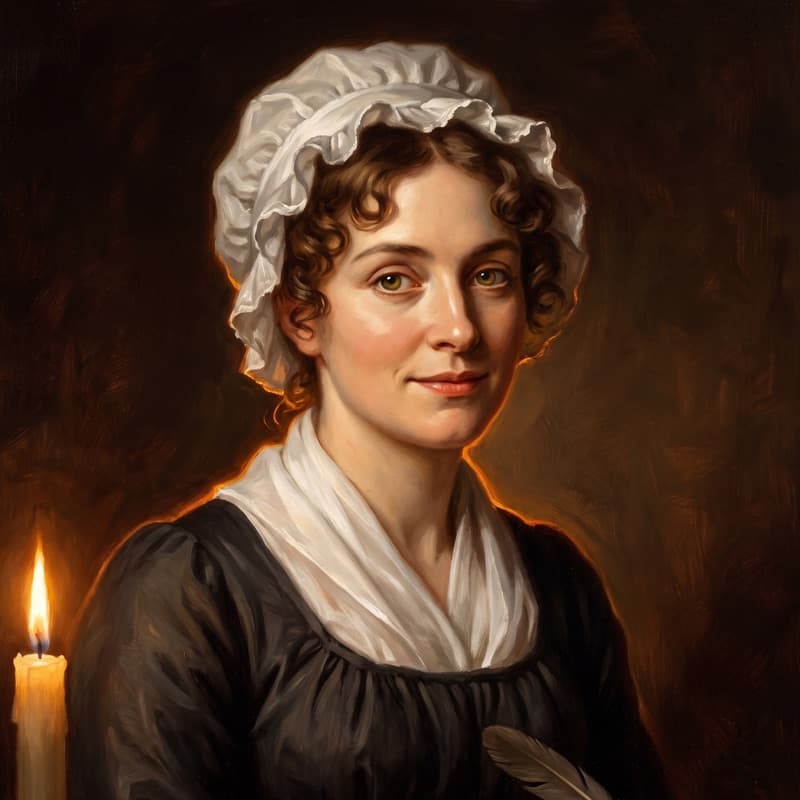
Jane Austen (1775–1817) wrote six completed novels — Sense and Sensibility, Pride and Prejudice, Mansfield Park, Emma, Northanger Abbey, and Persuasion — from a life that fit inside a few Hampshire villages, a stretch in Bath, and a final move to Winchester. Born December 16, 1775, at Steventon Rectory, the seventh child of the clergyman George Austen and his wife Cassandra, she was educated mostly at home in her father's library, published her first novel anonymously at 35, and was dead at 41. On that narrow stage she built a sharp comedy of money, manners, and self-deception. Everything factual on this page is cited — biography to the Jane Austen Society of North America, quotes to Project Gutenberg texts and the Brabourne edition of her letters.
The shape of the life
It helps to see how late, and how compressed, the career was. The comic pieces now called the Juvenilia were written roughly between 1787 and 1793, when she was a teenager. First Impressions — the novel later revised into Pride and Prejudice — was completed and offered to a publisher in 1797, and rejected. The family moved to Bath in 1801 after her father retired; in 1803 she sold a manuscript called Susan, later Northanger Abbey, to a publisher who simply never published it. By her early thirties, Austen had written three novels' worth of material and had nothing in print.
Then, in 1809, her brother Edward Austen provided a cottage at Chawton for Jane, her sister Cassandra, their mother, and their friend Martha Lloyd — and the most productive period of her life began. Sense and Sensibility appeared in 1811, its title page naming only "a Lady." Pride and Prejudice followed in 1813, Mansfield Park in 1814, Emma in 1815–16. She began Persuasion in 1815 and completed it in 1816 as her health failed; early in 1817 she started Sanditon, made her will, and moved to Winchester for medical care. She died there on July 18, 1817, and was buried a few days later in Winchester Cathedral.
Eight years at Chawton produced or completed the entire mature canon. Whatever genius is, it apparently also needs a stable address.
Two features of that record deserve underlining, because they correct the laziest versions of Austen. She was no effortless amateur: by the time Sense and Sensibility appeared she had roughly two decades of drafts, one rejection, and one stalled sale behind her. And she was never, in her lifetime, a public name — the books circulated while their author stayed formally invisible, an arrangement she turned into her novels' great subject: what it costs to be seen, and who can afford it.
Her own words — and the two registers they come in
Austen exists on the page in two distinct voices, and keeping them separate is the difference between quoting her and quoting at her. There are the novels, where the irony is performed through narrators and characters:
"It is a truth universally acknowledged, that a single man in possession of a good fortune must be in want of a wife." — Pride and Prejudice, Chapter I
"Selfishness must always be forgiven, you know, because there is no hope of a cure." — Mansfield Park, Chapter VII
And there are the letters, where she speaks for herself — to family, without a narrator in between:
"Pictures of perfection, as you know, make me sick and wicked." — letter to Fanny Knight, March 23, 1817 (Letters of Jane Austen, Brabourne edition, vol. II)
"Anything is to be preferred or endured rather than marrying without affection." — letter to Fanny Knight, November 18, 1814 (Brabourne edition, vol. II)
The quotes page sorts every entry into those two registers — and adds a third, for the popular "Austen" lines she never wrote at all.
What people ask
Her most famous book is Pride and Prejudice. The six major novels are the six named above; there is no official set of "four classics," though readers most often foreground Pride and Prejudice, Sense and Sensibility, Emma, and Persuasion. Her darkest novel, by most reckonings, is Mansfield Park — courtship inside harder questions of dependence, family power, and moral compromise — with the autumnal Persuasion as the emotional alternative. And what are the novels about? Courtship, money, families, manners, and moral judgment — and how carefully people reveal themselves while trying to appear sensible.
Meeting her, with the label on
This site hosts an AI reconstruction of Austen's conversational voice, built from the documented record and pinned to her Chawton years. It is a performance, not a source — nothing it says should ever be quoted as Austen — but it is an honest performance, and she is good company. One sample, clearly marked:
From a conversation with the Jane Austen persona (AI reconstruction): "You need not apologize for interrupting my morning — the heroine I have abandoned was about to receive a proposal, and it will improve her character to wait for it. Tell me instead about your own neighbourhood. I find three or four families quite sufficient material, and I suspect yours of being no less instructive than mine — only with the incomes better hidden, which I consider a great loss to comedy."
If that register appeals, start a free conversation — ask her about the marriage market, anonymity, or the acquaintance of yours who would furnish three chapters.
Go deeper
The rest of the cluster: her full biography, the cited quotes including the misattributions, the record of her death in 1817, and verified facts with the myths filtered out.