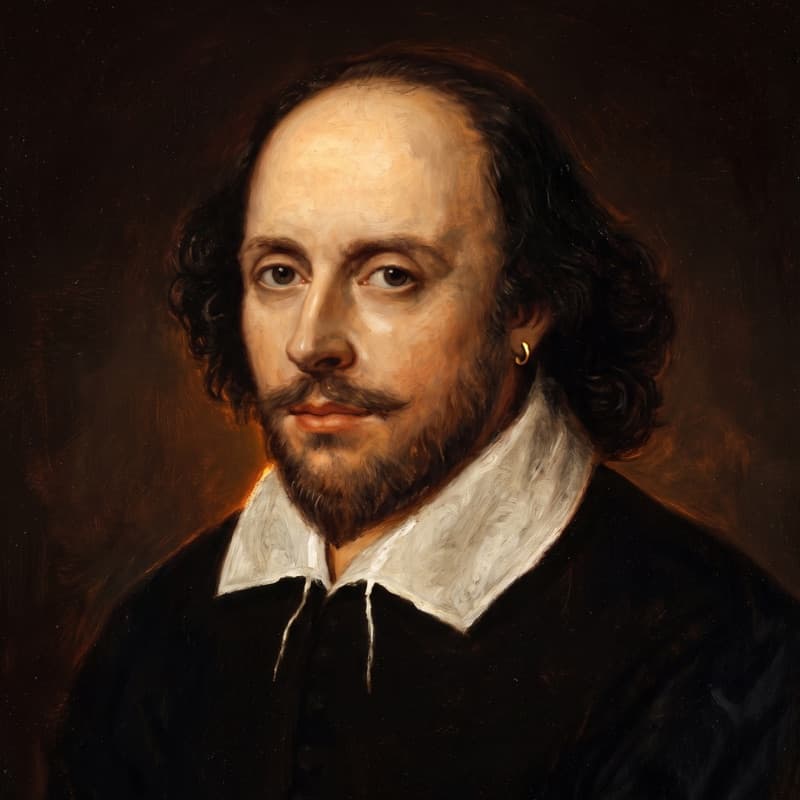
William Shakespeare was baptized in Stratford-upon-Avon on April 26, 1564 — his exact birthday isn't recorded, though April 23 is the traditional guess — and he died in the same town on April 23, 1616, cause unknown. Between those two uncertain dates sits one of the best-documented ordinary lives and one of the least-documented creative ones: baptism, marriage, house purchases, and a will down to the signature survive, but almost nothing of how he actually wrote.
A glover's son, briefly schooled
His father, John Shakespeare, was a Stratford glover and town bailiff; William almost certainly went through the grammar school's Latin curriculum until around fifteen, and no further — no university, unlike some London theater contemporaries. In late 1582, at eighteen, he married Anne Hathaway, twenty-six and already pregnant. Daughter Susanna arrived in 1583; twins Judith and Hamnet were baptized on February 2, 1585.
The years London can't quite account for
What happened between the twins' baptism and his emergence as a working playwright is genuinely unknown — historians call it the "lost years." The record picks him back up in 1592, when the writer Robert Greene took a jab at an "upstart crow" widely read as aimed at Shakespeare — the earliest printed acknowledgment that he was in the trade at all. A year later his first printed work, the poem Venus and Adonis, appeared. He was by then an actor, a playwright, and — the detail that set him apart from most working writers — a shareholder in the Lord Chamberlain's Men, holding an ownership stake in the company that performed his plays, first at the Theatre and, from 1599, at the purpose-built Globe on Bankside.
Rising fortunes, a family blow
Success arrived in overlapping, uneven ways. In October 1596 the Crown granted his father a coat of arms, later inherited by William, quietly moving a glover's family into "gentle" status. That same year his only son, Hamnet, died at eleven — a loss the record states flatly and explains not at all. The following year Shakespeare bought New Place, Stratford's second-largest house, planting his prosperity back in the town he had left.
The King's Men, and a second stage
When James I took the throne in 1603, the Lord Chamberlain's Men were renamed the King's Men under royal patent. By 1609 the Sonnets were in print and the company had added the indoor Blackfriars theater alongside the open-air Globe. In 1613 he bought the Blackfriars Gatehouse in London; that same year the Globe burned down during a performance of Henry VIII and was rebuilt within twelve months.
The will, and what outlived him
Shakespeare signed his will on March 25, 1616 and died about four weeks later; it was proved that June. He left the bulk of his estate to his elder daughter Susanna, £150 to Judith, and — the detail every reader remembers — his "second best bed with the furniture" to Anne. Seven years after his death, in 1623, two of his fellow actors, John Heminge and Henry Condell, gathered thirty-six of his plays into the First Folio. Eighteen of them, including Macbeth and The Tempest, had never been printed before; without that one book, they might simply be gone today.
Continue the conversation — literally
You've just read the recorded life — baptisms, bereavement, the business of running a theater company on Bankside. Our Shakespeare, an AI recreation built on that sourced record and labeled as what it is, speaks from inside it. Ask about the lost years, buying back into Stratford as a newly minted "gentleman," writing for a King's company, or the son he outlived by two decades.
Caller: Did you set out to be remembered like this?
Shakespeare: Remembered? I set out to fill a house on a Thursday and keep my share of the takings honest. A play wants an ending by Saturday, not a legacy. If anything of mine outlasts me, I'd wager it's by the accident of good friends with a printing press, not my own design.
The exchange above is a stylized recreation for our AI persona, not a historical quotation.
More in this cluster: Shakespeare hub · his death · verified quotes · facts.