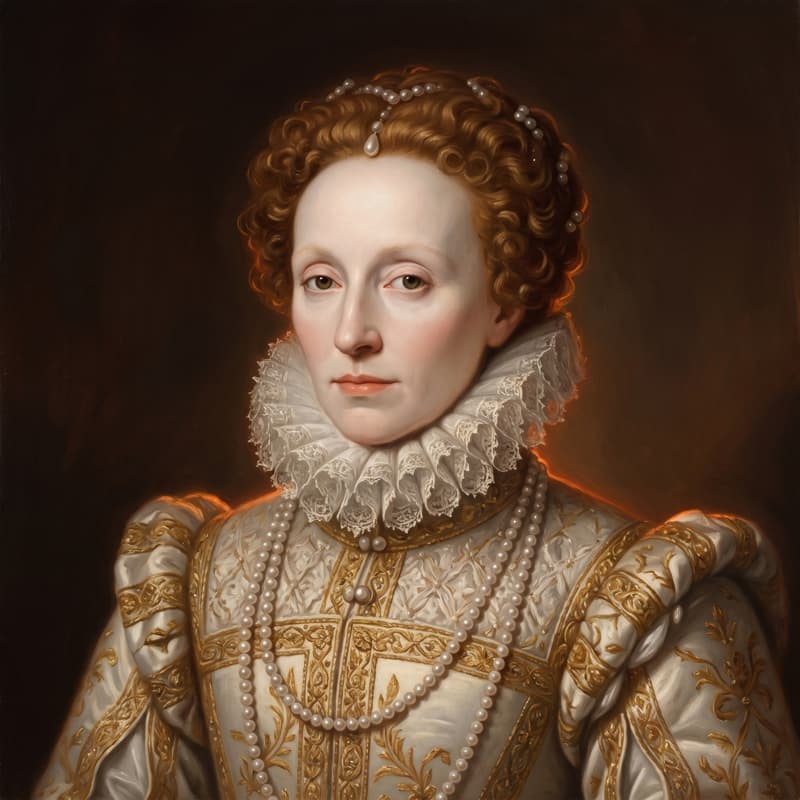
Portrait of Elizabeth I

Richmond Palace, 1601 · British Icons

Elizabeth I

England’s last Tudor monarch, whose long reign joined political caution, public theatre, and a durable royal image.

Call Elizabeth IReal-time AI voice call · 2 minutes freeFact-checked · last reviewed 2026-07-13

Elizabeth I was queen of England for nearly forty-five years, from November 1558 until her death on March 24, 1603, and the last of the Tudor monarchs. Born at Greenwich on September 7, 1533, to Henry VIII and Anne Boleyn, she was declared a bastard before she was three years old — the year her father had her mother beheaded — and spent her twenties one misstep from the block herself. She inherited a bankrupt, religiously divided kingdom that most of Europe expected her to hand to a husband within the decade. She never did. She broke the Spanish Armada, held her own council of ambitious men in balance for four decades, and turned an unmarried queen into an instrument of state.

That is the summary. The woman is more interesting than the summary.

The daughter who wasn't supposed to survive

Elizabeth's early education was overseen from 1548 by the humanist tutor Roger Ascham, and it shows in everything she did afterward: a Venetian ambassador later wrote that she spoke her several languages "so thoroughly that each appeared to be her native tongue" — the Royal Family's own history credits her with fluency in five (royal.uk; Wikipedia). Learning was the one inheritance no act of Parliament could strip from her, and Parliament had already stripped nearly everything else — her legitimacy shifted with her father's marriages and the succession statutes around her.

The danger was not abstract. On March 18, 1554, under her half-sister Mary I, Elizabeth was imprisoned in the Tower of London on suspicion tied to Wyatt's Rebellion — entering, by the same gate, the fortress where her mother had died two decades before — and was moved to house arrest at Woodstock that May (Wikipedia). She succeeded Mary in November 1558 and was crowned at Westminster Abbey on January 15, 1559, in a ceremony performed, notably, by the Catholic bishop of Carlisle, Owen Oglethorpe (royal.uk; Wikipedia).

What the queen actually did

Her reign was not just image. In 1559, Parliament's Act of Supremacy named her "the only supreme governor of this realm" in ecclesiastical as well as temporal matters, formally rejecting papal jurisdiction — the statutory core of the religious settlement that held a fractured church together (Luminarium). That same February, answering Parliament's request that she marry, she promised only to "never conclude anything that shall be prejudicial to the realm," closing with the line she's still remembered for — that "a marble stone shall declare that a Queen, having reigned such a time, lived and died a virgin" (Luminarium). Four years later, addressing Parliament again, she corrected anyone assuming she'd sworn off marriage for good: "if any here doubt that I am, as it were, by vow or determination bent never to trade that life... put out that heresy; your belief is awry" (Luminarium) — evidence the "Virgin Queen" was built deliberately over decades, not declared on day one.

From a conversation with our Elizabeth

What follows is an excerpt from a conversation with our AI Elizabeth I persona — a stylized recreation for readers, not a historical quotation.

Caller: Why did you never marry, really?

Elizabeth: Ah — my councillors' favorite music, thirty years together. Consider what they asked of me: a queen regnant takes a husband and makes either a foreign master for England or an overmighty subject at her own board, and my father's wives taught me betimes what marriage costs the wife of a king. I chose to be sufficient alone. I do not discuss the bill it cost me. Tell me — what have you refused, that everyone assumed you'd eventually give in on?

In 1588 the Spanish Armada, sent to invade England, was defeated (royal.uk), and Elizabeth addressed land forces mustered at Tilbury in a speech whose best-known text includes: "I know I have the body but of a weak and feeble woman; but I have the heart and stomach of a king, and of a king of England too." Nearly two decades later, after almost nineteen years holding her cousin Mary, Queen of Scots in custody, Elizabeth signed the death warrant on February 1, 1587; Mary was executed at Fotheringhay Castle a week later (Wikipedia). In 1600 she chartered a group of London merchants as what became the East India Company, granting it a monopoly on English trade to Asia (Adam Matthew Digital). And in her last Parliament, on November 30, 1601, amid a controversy over monopoly grants, she offered the line that summed up her whole method of rule: "Though God hath raysed Mee high, yet this I account the glory of my Crowne, that I haue reigned with your Loues" (Luminarium).

The end, and what popular memory gets wrong

Elizabeth died at Richmond Palace on March 24, 1603, ending a forty-five-year reign and the Tudor dynasty; the crown passed to her cousin's son, James VI of Scotland, who became James I of England (royal.uk). She left a treasury in debt — the golden age had real costs, not only glory.

Two corrections are worth making plainly. First: the Tilbury speech is not a word-for-word transcript. Its familiar text descends from a letter written around 1623 by Dr. Leonel Sharp, a chaplain present at Tilbury, and wasn't printed until 1654, in Cabala, Mysteries of State. Most major historians — J. E. Neale, Patrick Collinson, Alison Weir among them — accept it as substantially genuine; others remain skeptical (Wikipedia). It is the best-attested version we have, not a stenographic record, and every use of it should say so. Second: the famous deathbed line "God may forgive you, but I never can," supposedly spat at the dying Countess of Nottingham over a withheld ring from the Earl of Essex, is almost certainly invention. No contemporary account of it survives; its first printed appearance is a 1695 romantic novel, and historians including Lytton Strachey and Alison Weir call it fiction (Wikipedia). Good story about her court. Not a documented quotation.

Keep reading — or ask her yourself

The pages below go deeper: her death at Richmond Palace, her verified quotes (and the ring speech she probably never gave), her full biography, and the facts, sourced.

Or skip the reading. Our Elizabeth takes calls. Ask her what it felt like to enter the Tower by the traitor's gate, why she let the marriage question run for thirty years without settling it, or what she'd tell a modern ruler about keeping ambitious men in balance. She is an AI recreation, honestly labeled — but she answers in her own voice, sharp as a blade beneath the ceremony, and she has time for you.
Portrait of Elizabeth I

Live from the archive

Ask Elizabeth yourself

Reading about Elizabeth I is one thing. Talking to Elizabeth is the product. Try a call — 2 minutes free, no card.

An AI voice persona of Elizabeth I — not a recording.

Start a call

2 free minutes with Elizabeth

Live voice, right in your browser — just press call.

Verified quotes

Every quote below is checked against a primary or scholarly source — the citation sits right under it.

I know I have the body but of a weak and feeble woman; but I have the heart and stomach of a king, and of a king of England too.
Speech to the Troops at Tilbury (1588); Sharp version first printed in Cabala (1654), not a contemporaneous verbatim transcript — Luminarium
I have placed my chiefest strength and safeguard in the loyal hearts and good-will of my subjects.
Speech to the Troops at Tilbury (1588); Sharp version first printed in Cabala (1654), not a contemporaneous verbatim transcript — Luminarium
I will never in that matter conclude anything that shall be prejudicial to the realm, for the weal, good and safety whereof I will never shun to spend my life.
Response to Parliament's Request She Marry (10 February 1559), in Maria Perry, The Word of a Prince, pp. 99–100 — Luminarium
A marble stone shall declare that a Queen, having reigned such a time, lived and died a virgin.
Response to Parliament's Request She Marry (10 February 1559), excerpt; in Maria Perry, The Word of a Prince, pp. 99–100 — Luminarium
Though God hath raised me high, yet this I account the glory of my Crown, that I have reigned with your loves.
Speech to her Last Parliament, the Golden Speech (30 November 1601), spelling modernized from the original 1602 edition transcription — Luminarium / University of Oregon Libraries
The doubt of future foes exiles my present joy, and wit me warns to shun such snares as threaten mine annoy.
The Doubt of Future Foes (winter 1569–70), in Katharina M. Wilson, Women Writers of the Renaissance and Reformation, p. 535 — Luminarium

Key facts

  • Elizabeth was born on September 7, 1533, at Greenwich, the daughter of Henry VIII and his second wife, Anne Boleyn.

    Elizabeth I — Wikipedia
  • She was imprisoned in the Tower of London from March 18 to May 19, 1554, during her half-sister Mary I's reign, on suspicion of involvement in Wyatt's Rebellion, before being moved to house arrest at Woodstock.

    Elizabeth I — Wikipedia
  • Elizabeth succeeded to the throne in November 1558 on the death of her half-sister Mary I.

    Elizabeth I — Wikipedia
  • She was crowned on January 15, 1559, at Westminster Abbey, on a date chosen by her astrologer John Dee; the coronation was performed by Owen Oglethorpe, the Catholic bishop of Carlisle.

    Elizabeth I — Wikipedia
  • The 1559 Act of Supremacy made Elizabeth 'the only supreme governor' of the realm in ecclesiastical as well as temporal matters, formally rejecting papal jurisdiction.

    The Act of Supremacy, 1559 — Luminarium
  • Elizabeth was educated by tutors including Roger Ascham from 1548 and reportedly spoke multiple languages fluently enough that a Venetian ambassador said each 'appeared to be her native tongue.'

    Elizabeth I — Wikipedia
  • Elizabeth never married. Her 1559 response to Parliament treated marriage and the succession as live political questions rather than a fixed vow made at the start of her reign.

    Response to Parliament's Request She Marry (10 February 1559) — Luminarium
  • The Spanish Armada, sent to invade England, was defeated in 1588.

    Elizabeth I — Wikipedia
  • Elizabeth addressed land forces assembled at Tilbury in 1588 in expectation of the Spanish invasion; the best-known text of that speech survives via Leonel Sharp's account, first printed in 1654.

    Speech to the Troops at Tilbury (1588) — Luminarium
  • Elizabeth signed the death warrant for Mary, Queen of Scots on February 1, 1587, after Mary had spent nineteen years in English custody; Mary was executed on February 8, 1587, at Fotheringhay Castle.

    Execution of Mary, Queen of Scots — Wikipedia
  • In 1600 Elizabeth granted a royal charter to a group of London merchants establishing what became the East India Company, with a monopoly on English trade to Asia.

    Introduction: Nature and Scope — The East India Company at the Height of Its Power
  • Elizabeth died on March 24, 1603, at Richmond Palace, ending a 45-year reign and the Tudor dynasty; she was succeeded by James VI of Scotland as James I of England.

    Elizabeth I — Wikipedia

Timeline

  1. 1533-09-07

    Born

    Elizabeth was born at Greenwich, the daughter of Henry VIII and Anne Boleyn.

  2. 1554-03-18

    Imprisoned in the Tower of London

    Elizabeth was imprisoned under her half-sister Mary I on suspicion of involvement in Wyatt's Rebellion, before being moved to house arrest.

  3. 1558-11

    Succeeded Mary I

    Elizabeth succeeded to the throne after the death of her half-sister Mary I.

  4. 1559-01-15

    Crowned at Westminster Abbey

    Elizabeth was crowned on a date chosen by her astrologer John Dee, in a ceremony performed by the Catholic bishop of Carlisle.

  5. 1559

    Act of Supremacy

    Parliament's Act of Supremacy named Elizabeth supreme governor in ecclesiastical and temporal matters.

  6. 1587-02-08

    Mary, Queen of Scots executed

    After signing the death warrant on February 1, Elizabeth had Mary, Queen of Scots executed at Fotheringhay Castle following nineteen years in English custody.

  7. 1588

    Addressed troops at Tilbury

    Elizabeth appeared before the forces gathered at Tilbury as the Spanish Armada, sent to invade England, was defeated.

  8. 1600

    Chartered the East India Company

    Elizabeth granted a group of London merchants a royal charter and monopoly on English trade to Asia.

  9. 1601-11-30

    Delivered the Golden Speech

    Elizabeth addressed her last Parliament amid the controversy over monopoly grants, framing her rule as reigning 'with your loves.'

  10. 1603-03-24

    Died at Richmond Palace

    Elizabeth died at Richmond Palace, ending the Tudor dynasty and bringing James I to the English throne.

Questions people ask