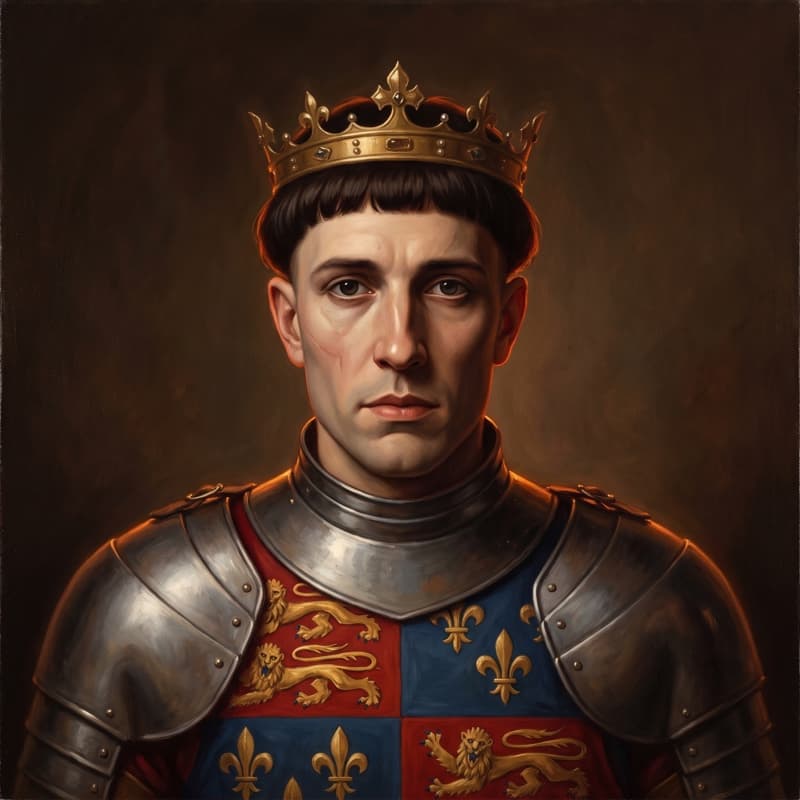
Henry V was King of England from 1413 to 1422 — the Lancastrian soldier-king who took Harfleur, won the Battle of Agincourt against heavy odds on 25 October 1415, conquered Normandy town by town, and secured the French crown for his heirs by treaty. He is not the same figure as Shakespeare's Henry V, written around 1599, nearly 180 years after the real king died. The play borrowed his campaigns and invented most of his best lines. This page is about the man, not the playhouse.
From wild prince to a king overnight
Henry was born at Monmouth Castle in Wales, most sources giving 16 September 1386, the son of Henry Bolingbroke — the future Henry IV — and Mary de Bohun (Wikipedia). His father seized the throne from Richard II in 1399, and Henry was invested Prince of Wales that October. He learned command early: fighting the Welsh rebel Owain Glyndŵr as a teenager, then at the Battle of Shrewsbury on 21 July 1403, aged sixteen, where an arrow struck him in the face and drove roughly six inches into his skull. The surgeon John Bradmore built a purpose-made instrument to draw the arrowhead out — Henry refused to leave the field, and carried the scar, and the habit of being painted in profile, for life.
The "wild prince" reputation — taverns, bad company, a father who didn't trust him — has some truth in it, tangled with later embroidery. What isn't in doubt is what came next. Henry was crowned at Westminster Abbey on 9 April 1413, during a severe blizzard, three weeks after his father's death, and contemporaries describe something close to an overnight transformation: the old companions put aside, a grave and exacting king in their place.
Harfleur, Agincourt, and the slow conquest of Normandy
In 1415 Henry revived England's dormant claim to the French crown and sailed for Normandy. He besieged Harfleur through August and into September; the town surrendered, and on 22 September 1415 Henry wrote home to London himself, reporting that "the keys of the town were then fully delivered and rendered into our hand," and that he had accepted the surrender terms "to avoid the effusion of human blood" (Henry V's Harfleur letter, Southampton Agincourt600). It's the best-documented sample of his own wording that survives — a king's dispatch, not a speech.
Six weeks later, on 25 October 1415, his army — small, sick with dysentery, and worn down by an eight-day march toward Calais — met a much larger French force at Agincourt. The eyewitness chronicle Gesta Henrici Quinti, written by a chaplain who marched with the army, records Henry answering a captain who wished aloud for ten thousand more archers from England: he "would not want to have even one more man" than he had, "for these are the people of God I have here" (Gesta Henrici Quinti, new translation, Southampton Agincourt600). That's the real, documented root of the "band of brothers" tradition — the king's recorded meaning, not his exact words, since the chronicle is Latin and this is a modern translation. England won the field. The same chronicle records something harder to romanticize: when the baggage train came under attack mid-battle, Henry ordered the killing of French prisoners — documented, morally serious, and not a later invention.
Agincourt didn't end the war. Henry spent 1417 to 1419 on the grinding work of conquest — Caen, Falaise, and a six-month siege of Rouen that starved the city's poorest, expelled between the walls and the English lines. It was administration and siegecraft more than valor, and Henry was good at both.
From a conversation with our Henry V persona
What follows is an excerpt from a conversation with our AI Henry V persona — a stylized recreation for readers, not a historical quotation.
Caller: How did you actually win at Agincourt, outnumbered like that?
Henry: My army was small, sick, hungry, and eight days marched; the French were many times our number and fresh. Some wished aloud for ten thousand more men out of England. I did not. Fewer men, greater share of honor — but more than that: wishing is not a discipline. We looked instead at what we had — the ground, the archers, the stakes — and used all of it.
The crown of France, won and never held
By 1420 Henry had fought his way to the negotiating table. The Treaty of Troyes, signed 21 May 1420, named him heir and regent of France under the mad King Charles VI — the next king of France, not the reigning one. Two weeks later, on 2 June 1420, Henry married Charles's daughter, Catherine of Valois, at Troyes Cathedral, as the treaty required (Westminster Abbey).
He never collected on it. Henry died of dysentery — reported by multiple sources as likely rather than certain — at the Château de Vincennes on 31 August 1422, having fallen ill after the siege of Meaux, aged thirty-five. Charles VI outlived him by seven weeks, dying on 21 October 1422, meaning Henry never reigned as King of France for a single day; the double crown passed instead to his infant son, Henry VI. Henry's body was returned to England and buried at Westminster Abbey on 7 November 1422 (Westminster Abbey; Wikipedia).
What Shakespeare gave him that history didn't
Two of the most famous lines attached to Henry V were never spoken by the historical king. "We few, we happy few, we band of brothers" is Shakespeare's writing for Act 4, Scene 3 of Henry V (Folger Shakespeare Library). "Once more unto the breach, dear friends, once more" belongs to Act 3, Scene 1 of the same play (Royal Shakespeare Company). Both were written around 1599, built loosely on the real Agincourt exchange in the Gesta, but the eloquence is the playwright's. The popular image of Henry walking incognito among his troops the night before the battle is also invention — the RSC notes plainly that neither chronicle Shakespeare drew on contains any such account; it's a stock device from disguised-ruler scenes common in 1590s plays.
The gap between the two is worth sitting with. The real Henry V left a formal letter about a siege, a translated battlefield reply to a nervous captain, and a long list of administrative decisions — sieges managed, treaties negotiated, prisoners killed, a starving city's poor turned into a ditch. He was harder and plainer than the poetry written about him a century and a half later.
Keep exploring — or ask him yourself
The pages below go deeper: his full biography, the death at Vincennes and what it cost his unfinished war, his verified quotes against the ones Shakespeare invented, and the sourced facts behind the legend.
Or skip the reading. Our Henry V takes calls. Ask him about the arrow at Shrewsbury, the order he gave at Agincourt when the baggage train was attacked, or what he thinks of the playhouse version of his own Crispin's Day. He is an AI recreation, honestly labeled — but he answers in a soldier-king's voice, and he has an hour that is his own.