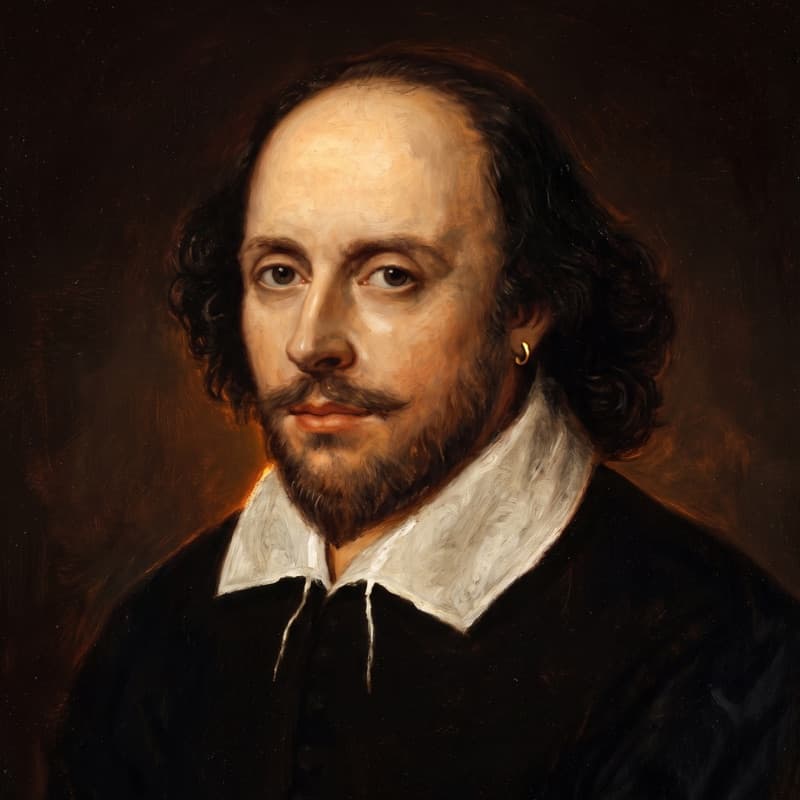
William Shakespeare died in Stratford-upon-Avon on April 23, 1616 (Folger Shakespeare Library) — traditionally treated as his birthday too, though his exact birthdate was never recorded; only his baptism, on April 26, 1564, survives in the parish register. The cause of death is not documented. Folger states it plainly: "We also do not know the cause of his death" (Folger). No inquest, no doctor's account, no contemporary letter names an illness. What survives instead is paperwork — a will — and it tells a stranger, more human story than any invented deathbed scene could.
A will signed a month before the end
Shakespeare signed his will on March 25, 1616, not quite a month before he died; it was proved on June 22, 1616, about two months after (Shakespeare Documented). The document opens with the era's standard formula describing the testator as being in good health and memory — legal boilerplate, not medical evidence — but Shakespeare's three surviving signatures on the will are visibly shaky compared to earlier specimens of his hand, which is the closest thing to physical evidence of decline that anyone has found.
The will's real content is where the story lives. Most of the estate went to his elder daughter, Susanna; £150 was set aside for his younger daughter, Judith; and to his wife, Anne, he left "my second best bed with the furniture" (Shakespeare Documented). That single line has launched centuries of speculation about a marriage gone cold — but it was an interlined afterthought, not necessarily a snub; best beds were often kept for guests or passed down as heirlooms, so a second-best bed may simply have been the marital one. Elsewhere in the will, Shakespeare left money for mourning rings to three fellow shareholders in the King's Men — Richard Burbage, John Heminges, and Henry Condell — naming them "my fellows" (Shakespeare Documented). Those two men would spend the next seven years assembling the First Folio.
The grief that came first
Twenty years earlier, in 1596, Shakespeare's son Hamnet had died at age 11 (Shakespeare Documented, Timeline) — the larger personal loss, arriving decades before Shakespeare's own death and long before the great tragedies were written. He was buried at Holy Trinity Church in Stratford, where a monument bust, in place by 1623, is one of only two contemporary portraits made by people who had actually seen him.
From a conversation with our Shakespeare
An excerpt from our AI Shakespeare persona — a stylized recreation, clearly labeled; not a historical quotation. His knowledge, like the man's own will, stops before the end.
Caller: If you knew your time were short, what would you want settled first?
Shakespeare: The house, friend, before the page. I'd see my girls provided for, and my fellows remembered — Burbage, Heminges, Condell, who stood beside me on boards that creaked long before the Globe ever burned. As for the plays, I confess I gave them less thought at the last than you'd expect. A play was a thing you sold to the company, not a thing you buried with. I did not know two of my friends would spend seven years gathering them up so they wouldn't be lost. That part I'd have liked to see.
The plays, saved after the fact
Nothing in the will mentions the plays — Shakespeare made no arrangement for them at all. That task fell to Heminges and Condell, who published the First Folio in 1623, seven years after his death, gathering 36 plays, 18 of which had never been printed before, including Macbeth, Julius Caesar, and The Tempest (Folger, First Folio). Without that volume, assembled by two actors settling a debt of memory rather than any instruction of his own, roughly half his surviving plays might not exist today.
Ask our Shakespeare about the part he did live to see — the will, the fellows he named, the daughter he trusted with his estate. His knowledge stops where the record does; what Heminges and Condell did next is a story he never got to hear.
More in this cluster: Shakespeare hub · verified quotes · biography · facts.