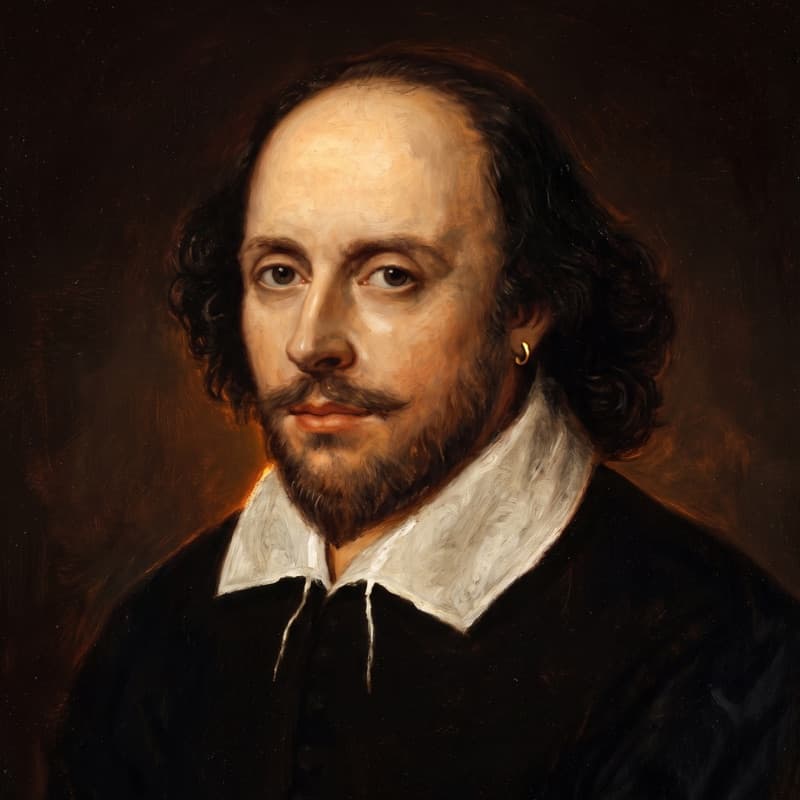
The essential William Shakespeare facts: he was baptized in Stratford-upon-Avon on April 26, 1564 (his exact birthdate is unrecorded); he married Anne Hathaway in late 1582 and had three children, Susanna and twins Judith and Hamnet; he built his career as an actor, playwright, and part-owner of the Lord Chamberlain's Men, later the King's Men; he died April 23, 1616, cause unknown; and two former colleagues gathered his plays into the 1623 First Folio, without which 18 of them — including Macbeth and The Tempest — might never have survived. All verified. This page gives you the facts worth keeping — and flags the popular "facts," and quotes, that don't survive checking, because a facts page that can't tell you what's false is only doing half the job.
The core facts, with why they matter
Baptized April 26, 1564, in Stratford-upon-Avon; his exact birthdate is unknown. April 23 is the traditional guess, chosen partly because it lines up neatly with his death date decades later — not because any record actually states it.
He married Anne Hathaway in late 1582, at 18; she was 26 and already pregnant. Daughter Susanna arrived in 1583; twins Judith and Hamnet were baptized February 2, 1585. Hamnet died in 1596, age 11 — a loss two decades before Shakespeare's own death that shadows the family's story more than any line in a play.
He was an actor, playwright, and shareholder in the Lord Chamberlain's Men, later the King's Men. As a part-owner, he was paid twice over on a good night — once as writer, once as investor. The company played first at the Theatre, then, from 1599, at the purpose-built Globe on Bankside; in 1603, James I's accession brought royal patronage and the new company name.
He signed his will on March 25, 1616; it was proved June 22, 1616. He left most of his estate to daughter Susanna, £150 to daughter Judith, mourning-ring money to fellow King's Men Richard Burbage, John Heminges, and Henry Condell — and to wife Anne, the famous "second best bed with the furniture."
The First Folio, published in 1623 by former colleagues John Heminge and Henry Condell, collected 36 plays. Eighteen of them, including Macbeth, Julius Caesar, As You Like It, and The Tempest, had never before appeared in print. Without that one book, those plays could plausibly have been lost to history entirely.
From a conversation with our Shakespeare
An excerpt from our AI Shakespeare persona — a stylized recreation, honestly labeled; not a historical quotation.
Caller: Which of your lines do people misquote most, and does it bother you?
Shakespeare: Bother me? I have been made to say things I never wrote, by hands that meant well and read little. It does not bother me — a jest attributed kindly is still a jest, and I have stolen enough lines myself in my time to begrudge no one theirs. What I would ask is only this: read the play before you trust the wall art. The character speaking it may be a fool, a murderer, or a girl of thirteen arguing with a balcony — and the wisdom, such as it is, belongs to them, not to me.
Popular "facts" that need correcting
"Shakespeare left his wife nothing but an insult — the second best bed." Not quite. Best beds in the period were often reserved as heirlooms or for guests; the second best bed was very plausibly the couple's actual marital bed. The bequest is genuine, but reading it as a snub is folklore, not documented intent.
"'To be or not to be,' 'All the world's a stage,' and 'To thine own self be true' are things Shakespeare believed." They're lines written for characters — Hamlet contemplating death, the cynical Jaques, and Polonius, a windbag the play treats as a fool — not personal philosophy. Full detail lives on our quotes page.
"Expectation is the root of all heartache" and "All glory comes from daring to begin" are Shakespeare quotes. Neither is. The Folger Shakespeare Library's own blog debunks both: "heartache" appears once in Hamlet, unrelated to expectation, and the "daring to begin" line belongs to poet Eugene F. Ware.
"The Shakespeare authorship question is a live scholarly debate." Mainstream scholarship treats it as settled: the Stratford actor and playwright wrote the works attributed to him, with some plays — The Two Noble Kinsmen, for instance — as acknowledged collaborations with John Fletcher.
Five things William Shakespeare did (the honest short list)
- Became a shareholder-actor-playwright in the Lord Chamberlain's Men, later the King's Men.
- Helped build and owned a stake in the Globe Theatre from 1599.
- Wrote roughly 38-40 plays and 154 sonnets across a working life in London and Stratford.
- Bought New Place, Stratford's second-largest house, in 1597, and the Blackfriars Gatehouse in 1613.
- Left behind a will, proved June 22, 1616, that named his fellow King's Men colleagues by name.
The fact pages can't hold him
Facts are the skeleton; the voice is the man. Our Shakespeare — an AI recreation, built from the sourced record and labeled as what it is — can tell you about the grammar-school Latin, the years missing from the record before London, the business of running a theater company, and what it meant to watch your own son die young while writing some of the darkest fatherhood in the language. Ask him which of his plays he'd have rewritten given the chance. He's ready when you are.
More in this cluster: Shakespeare hub · his death · verified quotes · biography.