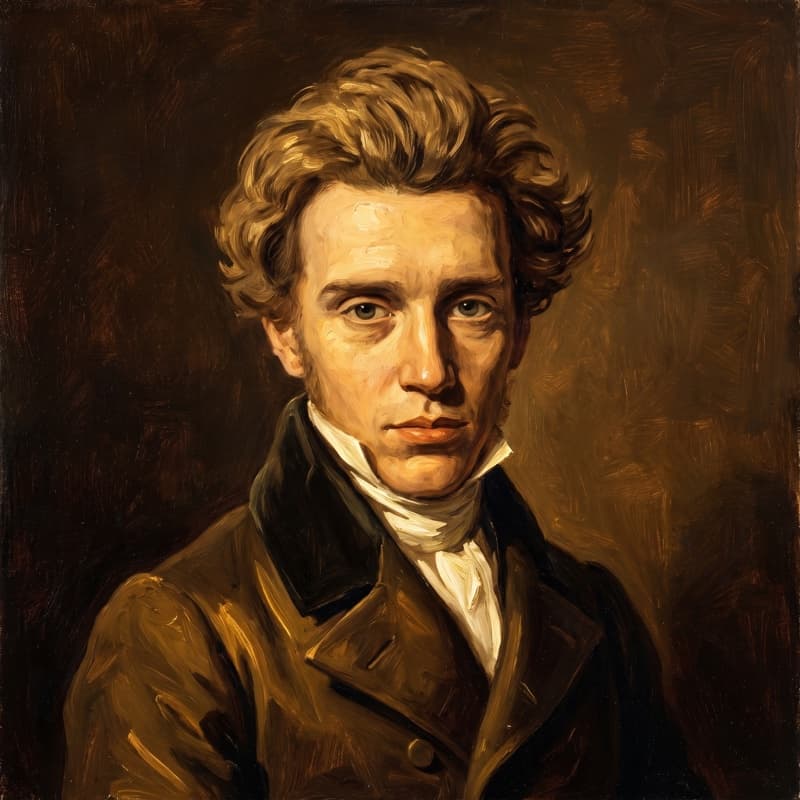
Søren Aabye Kierkegaard was born in Copenhagen on May 5, 1813, and died there on November 11, 1855, at forty-two (Kierkegaard Research Centre). In between he produced, mostly in a single feverish decade, one of the strangest bodies of work in philosophy: books signed by invented authors who disagree with each other, a broken engagement he never stopped writing about, a public feud with a satirical newspaper that made him the joke of his own city, and finally an open war against the church he was baptized into. He is often called the father of existentialism (Stanford Encyclopedia of Philosophy) — a label invented decades after his death, not one he claimed for himself.
A theology student who kept swerving
Kierkegaard was the youngest of seven children of Michael Pedersen Kierkegaard, a wool merchant whose piety shaded into dread. He attended Copenhagen's School of Civic Virtue and matriculated at the University of Copenhagen in 1830 to study theology (Stanford Encyclopedia of Philosophy). His father died in 1838; that year Kierkegaard published his first book. Three years later he defended a dissertation on Socratic irony and received his Magister degree — the closest he ever came to an academic career he then declined to pursue.
The engagement that became an authorship
In September 1840 Kierkegaard became engaged to Regine Olsen, ten years his junior. Within a year he broke it off, on October 12, 1841 (Kierkegaard Research Centre) — a decision biographers and Kierkegaard himself never fully resolved. What is not in dispute is what it produced: within eighteen months he wrote Either/Or, and the pseudonymous authorship that followed returns again and again to broken vows, resignation, and the gap between what a person feels and what a person can honestly promise. The two kept encountering each other on Copenhagen's streets for years afterward, exchanging glances and nothing else, until Regine sailed for the Danish West Indies with her husband in 1855.
A masquerade of pseudonyms
Between 1843 and 1846 Kierkegaard published at a rate that still startles scholars: Either/Or, Fear and Trembling, Repetition, Philosophical Fragments, The Concept of Anxiety, and Concluding Unscientific Postscript (Stanford Encyclopedia of Philosophy chronology). Most were signed not by Kierkegaard but by invented authors — Victor Eremita, Johannes de Silentio, Johannes Climacus — each holding a distinct view of life, so that no single doctrine could be extracted and credited to "Kierkegaard's philosophy." In Fear and Trembling, writing as Johannes de Silentio, he described the knight of faith this way:
"To be able to fall down in such a way that the same second it looks as if one were standing and walking, to transform the leap of life into a walk, absolutely to express the sublime in the pedestrian — that only the knight of faith can do, and this is the one and only prodigy." — Fear and Trembling, Walter Lowrie translation
The same pseudonym adds that this faith "is not an aesthetic emotion but something far higher, precisely because it has resignation as its presupposition" (same source) — faith, in other words, as something earned only after everything ordinary has already been given up.
From a conversation with our Kierkegaard
What follows is an excerpt from a conversation with our AI Kierkegaard persona — a stylized recreation for readers, not a historical record.
Caller: Why hide behind all these invented authors instead of just telling us what you think?
Kierkegaard: Because the moment I tell you what I think, you are relieved of the trouble of thinking it yourself — you simply agree or disagree with Søren Kierkegaard, as one votes at an election, and go home unchanged. Send Johannes instead, or Anti-Climacus, arguing a position I do not fully occupy, and you cannot vote; you must judge the argument on its own legs, which means judging yourself. I am not hiding, friend. I am refusing to do your existing for you.
Anxiety, despair, and the crowd
In The Sickness Unto Death, published under the pseudonym Anti-Climacus, Kierkegaard opens with a famously difficult definition of the self:
"The self is a relation which relates itself to its own self, or it is that in the relation [which accounts for it] that the relation relates itself to its own self." — The Sickness Unto Death, Walter Lowrie translation
The book's real argument is plainer than the sentence: that despair is not a mood a person passes through but a chronic misrelation to one's own self, and that the quietest, most invisible despair — the kind that keeps a job and a good coat — is the most common of all. Elsewhere in his journals Kierkegaard turned repeatedly to a related idea: that a crowd, precisely because no single person in it signs their name to anything, is a place where truth goes to die — a theme scholars trace across his late journals rather than to one clean sentence (Kierkegaard's Journals and Papers, vol. 2).
The Corsair, and the war on Christendom
In 1846 Kierkegaard publicly invited the satirical weekly The Corsair to criticize him rather than praise him. It obliged for months, running caricatures of him as a hunchback with mismatched trouser legs until street boys shouted his name at him for sport (Kierkegaard Research Centre). It cost him the anonymous daily walks through the city he depended on for thinking. In his final years he turned that same appetite for provocation on the Danish state church itself, publishing the pamphlet series Øjeblikket ("The Moment") against a Christianity he thought had been reduced to birth certificates and Sunday furniture. He collapsed in the street in October 1855 in the middle of that campaign and died at Frederik's Hospital on November 11, his father's inheritance nearly spent to the final coin.
What people get wrong
Two quotations widely pinned on Kierkegaard aren't his. "Life is not a problem to be solved, but a reality to be experienced" traces instead to Jacobus Johannes van der Leeuw, misattributed after a 1945 magazine piece (WIST Quotations). And the popular short line "life must be understood backward, but lived forward" compresses a real 1843 journal entry, but the exact English wording circulating online doesn't match any single scholarly translation — treat it as the idea, not a verified sentence. His pseudonyms cause a subtler error: "subjectivity is truth" and "boredom is the root of evil" are lines spoken by Johannes Climacus and by an unnamed aesthete, not positions Kierkegaard signed in his own name.
Go deeper — or ask him yourself
The full cluster: his biography · his death · verified quotes · the facts, sourced.
Or skip the reading. Our Kierkegaard takes calls — an honest AI recreation, built on the record cited here. Ask him about Regine and the ring he took back, what the leap of faith actually costs, or why he thought the crowd was the one thing an honest person had to walk away from. He answers in his own voice, irony first and then, without warning, the truth underneath it.