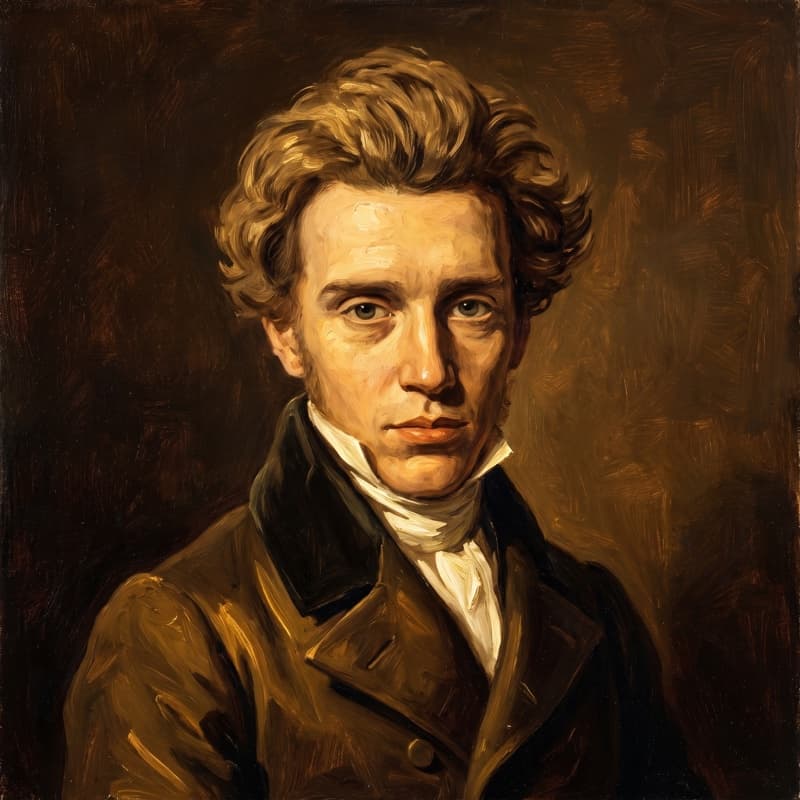
Søren Aabye Kierkegaard was born in Copenhagen on May 5, 1813, and died there on November 11, 1855, at age forty-two — the youngest of seven children of a wealthy, devout, melancholy wool merchant, later credited as a father of existentialism, a label he never claimed for himself. Between those dates sits one of philosophy's strangest careers: no professorship, no settled circle, just an inheritance spent almost entirely on self-published books written under a rotating cast of invented authors.
A melancholy inheritance
His father, Michael Pedersen Kierkegaard, had risen from poverty to comfortable wealth while carrying a private, brooding religious guilt that Kierkegaard later described as shaping his own imagination. Young Søren passed through Copenhagen's School of Civic Virtue from 1821 to 1830, then matriculated at the University of Copenhagen in 1830 to study theology. His father died in 1838; that year the son published his first book, From the Papers of One Still Living. The death was also a fortune: roughly 31,000 rigsdaler that would fund, and by the early 1850s nearly exhaust, a decade of self-financed authorship. Grief had bought him time to write.
Regine Olsen, and a dissertation on irony
In September 1840 Kierkegaard became engaged to Regine Olsen. By the next autumn he had broken it off, in the same season he defended his dissertation, On the Concept of Irony with Continual Reference to Socrates (September 29, 1841), and received his Magister degree three weeks later. The broken engagement charged nearly everything he wrote afterward — a private wound worked over from every angle, never quite named, never let go.
Pseudonyms as life-views
Between 1843 and 1846 Kierkegaard published at a pace that still startles: Either/Or in February 1843; Fear and Trembling and Repetition together that October; Philosophical Fragments and The Concept of Anxiety in 1844; Concluding Unscientific Postscript in February 1846. Most appeared under invented authors — Johannes de Silentio, Johannes Climacus, and others — each staging a distinct way of existing rather than delivering one philosopher's opinions secondhand. In 1846, after Kierkegaard publicly invited criticism, the satirical paper The Corsair obliged with months of caricatures — a hunchbacked figure, comically uneven trouser legs — that turned Copenhagen's best-known pedestrian into a running street joke. He kept walking the same streets anyway.
Turning to signed works, and a war on Christendom
His later books increasingly carried his own name: Works of Love (1847), then, under the pseudonym Anti-Climacus, The Sickness Unto Death (1849) — opening with the famously knotted claim that "the self is a relation which relates itself to its own self" — and Practice in Christianity (1850). In his final years he dropped pseudonymity for open polemic, attacking the Danish state church — a campaign he opened in the press in 1854 and carried into the pamphlet series Øjeblikket, nine issues published in 1855 (a tenth appeared after his death).
Kierkegaard collapsed in the street in October 1855 and died weeks later at Frederik's Hospital, mid-campaign, his inheritance nearly gone — having spent a fortune to say, under a dozen names and finally his own, that becoming a self is not a project anyone finishes for you.
From a conversation with our Kierkegaard
An excerpt from a conversation with our AI Kierkegaard persona — a stylized recreation, honestly labeled; not a historical quotation.
Caller: Why write under so many names instead of just telling people what you think?
Kierkegaard: Because "what I think" is the least interesting thing I could hand you. Tell a man the truth directly and he argues past it, goes home unchanged. So I built other men to hold the positions I could not hold at once — one for irony, one for faith beyond me — and let you meet them without my thumb on the scale.
Continue the conversation — literally
Our Kierkegaard — an AI recreation, built on the sourced record and labeled as what it is — speaks from inside this life. Ask about Regine Olsen and what the engagement cost his writing, why he let The Corsair make him a public joke, or why he spent his last strength attacking the church he was baptized into.
More in this cluster: Kierkegaard hub · his death · verified quotes · facts.