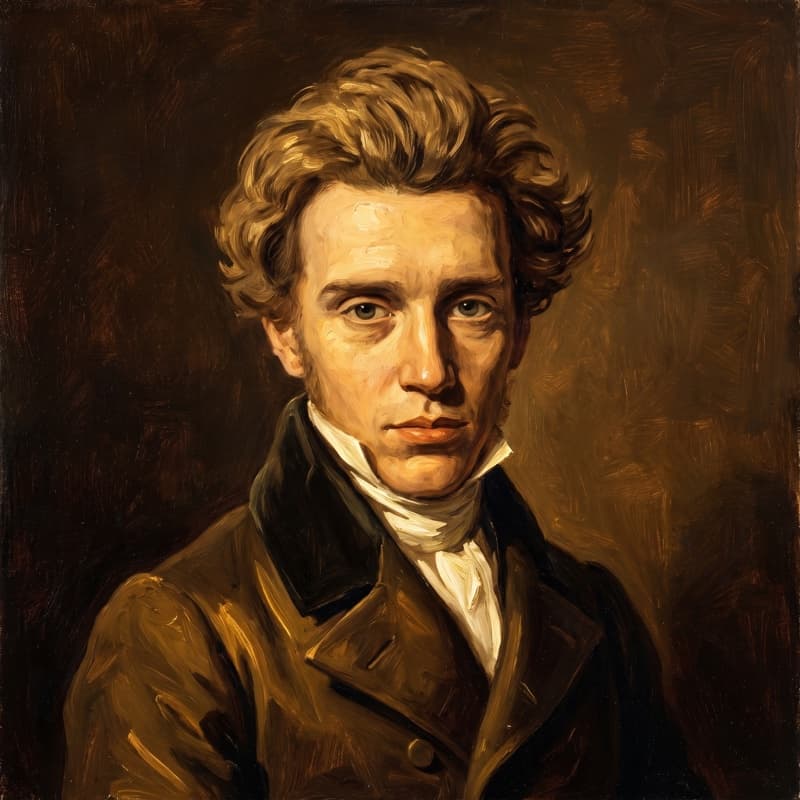
Søren Kierkegaard collapsed in the street in Copenhagen in October 1855. He was carried to Frederik's Hospital, and he died there on November 11, 1855, at age 42. He was, at the time, in the middle of publishing Øjeblikket ("The Moment"), a pamphlet series attacking the Danish state church — an ending that arrived mid-argument, not after it.
That answers the search. The fuller story is a life that closed in public combat, with its cause still argued over.
Collapse in the middle of a fight
Kierkegaard spent his final year in open, deliberately provocative war against what he called "Christendom" — the comfortable, state-sponsored Christianity he believed had replaced the demanding, individual faith he thought the New Testament actually asked for. Øjeblikket was his instrument: nine combative issues published in 1855 (a tenth left unpublished at his death), aimed squarely at the Danish church establishment. He collapsed before the campaign reached any resolution. There was no late reconciliation, no closing statement — the pamphlets simply stopped, because their author did.
What actually killed him
Historians do not agree on a single cause, and a page that claims certainty here would overstate the record. The competing explanations point either to complications from a fall he suffered earlier in life, or to Pott disease — spinal tuberculosis — which would also fit a slow physical decline. Both are treated as live possibilities rather than settled fact.
A funeral that argued with itself
The irony was hard to miss even at the time. Kierkegaard had spent his last productive year telling Danes that the state church had no real authority over a person's relationship to God — and then he was buried using that same church's rites, in Copenhagen, because there was no other customary way to do it. Accounts of the funeral describe exactly the tension you would expect: a ceremony performed by the institution he had spent his final energy attacking, watched by mourners who had followed the Øjeblikket fight in real time.
One detail closes an earlier chapter rather than his last year: his will named Regine Olsen, the woman he had been engaged to and then broken from in 1841, well over a decade before his death. His inheritance — roughly 31,000 rigsdaler left by his father in 1838, which had financed his entire writing life — was also nearly exhausted by then, largely spent self-publishing the books that made him. He died as he had spent most of his adult life: on his own terms, mostly on his own money, and mid-sentence.
From a conversation with our Kierkegaard
An excerpt from a conversation with our AI Kierkegaard persona — a stylized recreation, honestly labeled, not a historical quotation. Our Kierkegaard's knowledge ends before his final collapse.
Caller: You're in the middle of attacking the whole church. Doesn't it bother you that you might not get to finish?
Kierkegaard: Finish? Friend, I have never once mistaken myself for someone who finishes things — that is precisely the illusion "Christendom" sells you, that the task of becoming a self is a project with a closing chapter. It is not. It is a task for every single individual, renewed every single day, and it does not require my presence to continue after me. If I am struck down mid-sentence, so be it — the sentence was never really mine to complete. It belongs to whoever reads it next and takes it, at last, personally.
Ask him about the years that led here
Our Kierkegaard — an AI recreation, built from the historical record and labeled as what it is — can't describe his own collapse or the hospital room; his knowledge ends before that. But he can talk about everything that built toward it: the broken engagement to Regine Olsen, the humiliation of the Corsair caricatures, the pseudonyms he used to argue with himself in public, and exactly why he came to believe the Danish church had betrayed the faith it claimed to teach. Start the conversation whenever you're ready.
More in this cluster: Kierkegaard's verified quotes · his biography · fact file · back to the Kierkegaard hub.