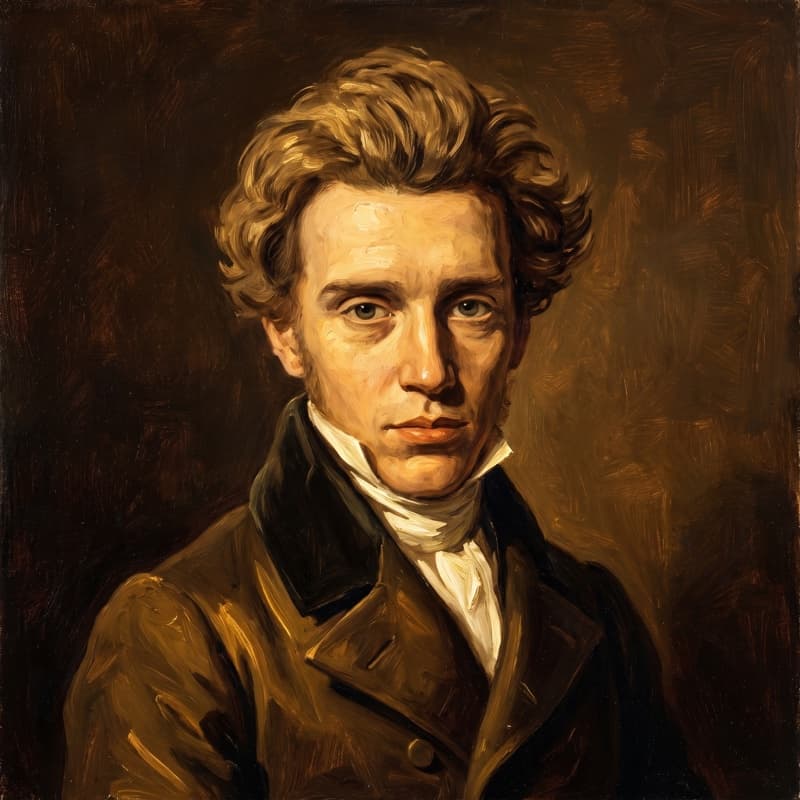
The facts about Søren Kierkegaard: born in Copenhagen on May 5, 1813, and died there on November 11, 1855, at age forty-two (Kierkegaard Research Centre); youngest of seven children of a wealthy Copenhagen wool merchant, Michael Pedersen Kierkegaard (Wikipedia); matriculated at the University of Copenhagen in 1830 and defended a Magister dissertation on Socratic irony in 1841 (Stanford Encyclopedia of Philosophy); author of Either/Or, Fear and Trembling, and The Concept of Anxiety, among a shelf of pseudonymous and signed works published between 1843 and 1850 (Stanford Encyclopedia of Philosophy). All cited, all checkable — the harder job of a facts page is naming what doesn't survive checking, since several of Kierkegaard's most-quoted lines belong to someone else entirely.
The facts, with the stories inside them
He wasn't one author — he was several, on purpose. Much of Kierkegaard's major work appeared under invented names — Johannes Climacus, Johannes de Silentio, Anti-Climacus, and others — each staging a distinct "life-view" rather than masking one lecture. Kierkegaard asked readers to attribute pseudonymous claims to their fictional authors, not to him directly (Stanford Encyclopedia of Philosophy). That matters for anyone quoting him: "Subjectivity is truth" is Johannes Climacus's line, spoken inside Concluding Unscientific Postscript, not a stray Kierkegaard aphorism.
The engagement that shaped everything has two slightly different timestamps. Kierkegaard became engaged to Regine Olsen and broke it off roughly a year later — the Kierkegaard Research Centre dates the engagement to September 10, 1840, and the breakup to October 12, 1841, while other accounts place the proposal on September 8, 1840, and the breakup in August 1841 (Kierkegaard Research Centre; Wikipedia). Scholars vary by weeks, not years — but the broken engagement runs underneath the entire pseudonymous authorship that follows.
He self-financed his own career. His father's death in 1838 left him roughly 31,000 rigsdaler, spent largely on publishing his own books and gone by the early 1850s (Wikipedia). No university post, no patron.
The Corsair affair turned Copenhagen's most visible pedestrian into a public joke. After Kierkegaard publicly invited criticism in 1846, the satirical weekly The Corsair answered with months of caricatures — a hunchback with uneven trouser legs — until street mockery became part of his daily life (Kierkegaard Research Centre).
His final years were an open war on the state church, not a quiet retirement. His campaign against the state church, opened in the press in 1854, culminated in 1855 in Øjeblikket ("The Moment"), nine pamphlets attacking what he called nominal "Christendom" (a tenth appeared posthumously) (Stanford Encyclopedia of Philosophy). He collapsed in the street that October and died at Frederik's Hospital on November 11, 1855; the cause is still debated — a youthful fall, or Pott disease and tuberculosis (Wikipedia).
Popular "facts" that need correcting
"The father of existentialism" is a label he never used for himself. It's a retrospective framing applied by twentieth-century readers to his analyses of anxiety, despair, and individual existence — useful shorthand, not Kierkegaard's own self-description (Kierkegaard Research Centre).
Several famous "Kierkegaard quotes" aren't his. "Life is not a problem to be solved, but a reality to be experienced" traces to Jacobus Johannes van der Leeuw (WIST Quotations); "Once you label me you negate me" has no located primary source. Full breakdown: our quotes page.
From a conversation with our Kierkegaard
An excerpt from our AI Kierkegaard persona — a stylized recreation, honestly labeled; not a historical quotation.
Caller: People keep handing you quotes you never said.
Kierkegaard: Of course — I handed them several authors instead of one voice, and the crowd prefers a single label to a difficult multiplication. Climacus said what Climacus needed to say; I answer for having written him, not for his every sentence. If a line flatters without unsettling you, be suspicious of it before you're suspicious of me.
Ask past the facts
The dates and titles above are the skeleton; the difficulty was the point. Our Kierkegaard — an AI recreation built from the sourced record and labeled as exactly that — can talk through the pseudonyms, the broken engagement, and why anxiety felt to him like freedom's dizziness. Ask him what backward-understanding actually asks of someone still living forward.
More in this cluster: Kierkegaard hub · his death · verified quotes · biography.