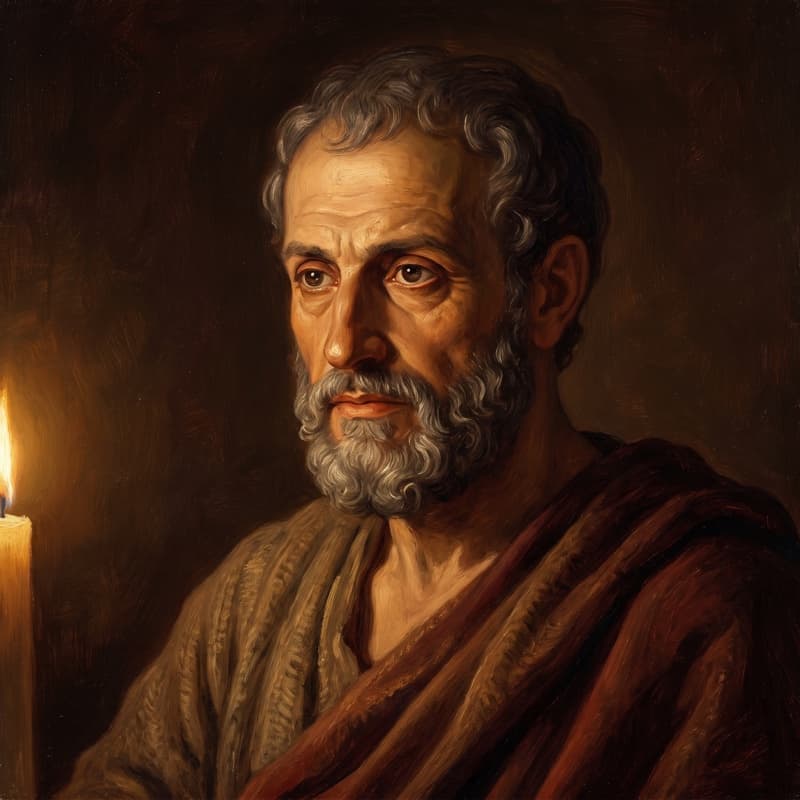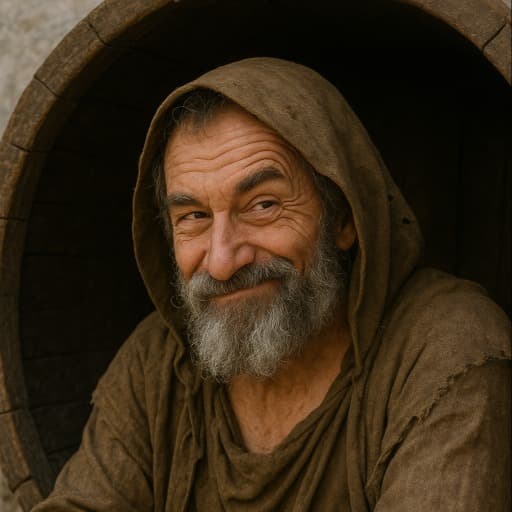
Diogenes of Sinope was the founding figure of Cynic philosophy in ancient Greece, a man later tradition remembers for living in a large ceramic storage jar, carrying a lit lamp through the Athenian agora at midday "looking for a man," and telling Alexander the Great to get out of his sunlight. He was reportedly exiled from his home city of Sinope over a coinage scandal, captured by pirates and sold into slavery in Crete, and died — by one account or another — at Corinth around 323 BCE, the same year commonly given for Alexander's own death.
That is the summary the internet already knows. What it usually leaves out is where the summary comes from.
One storyteller, five centuries later
Almost everything anyone knows about Diogenes — his sayings, his stunts, even the outline of his life — survives through one main source: Diogenes Laertius, a biographer writing his Lives of Eminent Philosophers roughly 500 years after Diogenes's conventional death. No contemporary press, no autobiography, no eyewitness transcript. The Internet Encyclopedia of Philosophy puts the limit plainly: evidence for the Cynics generally is "limited to apothegms, aphorisms, and ancient hearsay," and "none of the many Cynic texts have survived." — Internet Encyclopedia of Philosophy, "Cynics"
That doesn't make Diogenes less worth knowing. It means every anecdote below is reported tradition — a story later Greeks told about him, usually a good one — not a transcript.
From Sinope's ruined coinage to Athens's Cynic underground
Diogenes Laertius reports that Diogenes came from Sinope, a Black Sea trading city, born somewhere between roughly 412 and 400 BCE — the ancient sources disagree by a decade or more. His father Hicesias worked as a banker or money-changer there, and the coinage was adulterated, forcing Diogenes into exile — though in a wrinkle the ancient tradition never resolves, the same source elsewhere has Diogenes himself confessing to the offense. — Perseus, Lives, Bk VI
Exile brought him to Athens, where he attached himself to Antisthenes, a pupil of Socrates who taught that virtue was a matter of deeds, not doctrine — the seed of Cynicism. — Internet Encyclopedia of Philosophy, "Cynics"
In Athens, the stories turn physical. Diogenes took up residence in a pithos — a large ceramic storage jar, not the wooden barrel of popular imagination — near the Metroön, owning little beyond a cloak, a staff, and a beggar's wallet. He is said to have discarded even his drinking cup after watching a boy drink from cupped hands, saying the child had beaten him in plainness of living. Whether the scene happened exactly as told is unverifiable; what it captures — a philosophy tested by how little a person actually needs — is the point of every Diogenes story that follows.
From a conversation with our Diogenes persona
What follows is an excerpt from a conversation with our AI Diogenes persona — a stylized recreation for readers, not a historical quotation.
Caller: You really own nothing? Not even a cup?
Diogenes: I owned one, once. Then I watched a boy drink from his own two hands and realized I was carrying a luxury I'd mistaken for a necessity. I threw the cup in a ditch. My hands have worked since. Tell me what's in your pockets that a child could out-perform.
The sun, the slave market, and the lamp
Three scenes made Diogenes famous, and all three survive in wording close to the ancient page.
The first is Alexander the Great at Corinth. Diogenes Laertius reports Alexander stood over him, offered any favor he wished, and Diogenes answered: "Stand out of my light." — Perseus, Lives of Eminent Philosophers, Bk VI (Hicks translation) Other renderings phrase it differently — "cease to shade me from the sun" in one English edition, "stand a little out of my sun" in a summary of Plutarch's separate account — proof the story was already being retold, and reworded, in antiquity.
The second is the slave market. Captured by pirates en route to Aegina and sold in Crete, Diogenes reportedly told the auctioneer to sell him to a buyer who needed a master, answering "Govern men" when asked what he could do. — Perseus, Lives, Bk VI Xeniades of Corinth bought him, and the story inverts from there: the purchased man ran the household and tutored Xeniades's sons, technically owned and functionally in charge.
The third is the lamp: lit in broad daylight, carried through the agora, while Diogenes said, "I am looking for a man." — Perseus, Lives, Bk VI It's one of the rare Diogenes lines where two major English translations agree word for word — about as close as this figure gets to a fixed quotation.
Asked once what city he belonged to, he answered: "I am a citizen of the world" — Perseus, Lives, Bk VI, one of the earliest attestations of cosmopolitan self-identification in the Greek tradition. And when Plato's Academy defined a human being as "an animal, biped and featherless," Diogenes plucked a fowl, walked it into the lecture hall, and announced: "Here is Plato's man." — Perseus, Lives, Bk VI The Academy, the story goes, amended its definition to add "with broad flat nails." Cynicism's method in miniature: skip the argument, produce the chicken.
A death the sources can't agree on
Even Diogenes's death resists a single account. Diogenes Laertius preserves at least four incompatible versions: illness from raw octopus, voluntary death by holding his breath, an infected dog bite sustained while dividing raw octopus among strays, and simply being found dead, wrapped in his cloak, at the Craneum gymnasium in Corinth — no cause given at all. — Perseus, Lives, Bk VI The conventional date, around 323 BCE, is often noted as coinciding with Alexander's own death that year — a striking coincidence the ancient tradition liked to repeat, not a proven synchronism. — Wikidata
Asked how he wished to be buried, he is reported to have said: throw him outside the walls, unburied, for wild beasts to feed on, or drop him in a ditch with a little dust — what did it matter to a dead man? Admirers erected a bronze dog at his tomb anyway, with an epitaph praising him for teaching mortals "the lesson of self-sufficingness." — Perseus, Lives, Bk VI
Caller: Doesn't it bother you that no one knows what you actually said?
Diogenes: It bothers you. I never wrote a word down — words are for men who need an audience after they're gone. Worry about your own words. Yours, at least, you're still around to take back.
Excerpt from our AI Diogenes persona — stylized, and labeled as such.
Keep reading — or ask him yourself
The pages below go deeper: his full biography, how he died — and the sources that disagree, his verified quotes, translation variants included, and the facts, sourced.
Or skip the reading. Our Diogenes takes calls. Tell him what you own, and let him tell you what owns you back. He is an AI recreation, honestly labeled, built from what later tradition reports a man in a jar once said. He is not hard to reach. He is, after all, still looking.