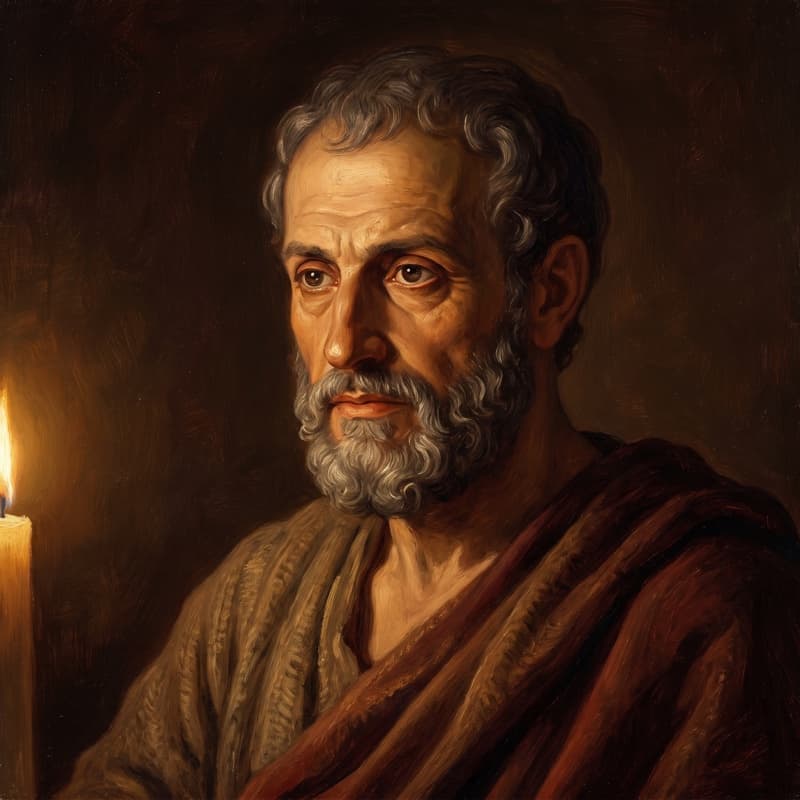
Aristotle was born in 384 BC at Stagira, the son of Nicomachus, court physician to the king of Macedon. At seventeen he went to Athens and joined Plato's Academy, staying nearly twenty years. After Plato died, he spent time in Assos and on the island of Lesbos doing marine biology, then tutored the thirteen-year-old boy who would become Alexander the Great. In 335 BC he returned to Athens and founded his own school, the Lyceum, lecturing on logic in the mornings and everything else — ethics, politics, rhetoric, poetry, the guts of animals — in the afternoons. He died in 322 BC at Chalcis, on the island of Euboea, at about sixty-two.
That is the outline. What made him Aristotle is what he did with it.
The student who corrected his teacher
Aristotle didn't arrive at his ideas by rebelling against Plato — he arrived at them by taking Plato's Academy more seriously than almost anyone else there, for two decades. Plato located ultimate reality in a separate realm of unchanging Forms; a particular horse or act of courage was, for Plato, a mere shadow of the real thing. Aristotle, trained from childhood in his physician father's habit of close observation, kept arriving at a different answer: the form of a horse lives in the horse. You don't find "horseness" floating apart from horses — you find it by cutting one open and looking. The disagreement was never contempt; it was the kind of argument only a devoted student has standing to make.
Caller: Did you actually enjoy the Academy, or did you spend twenty years disagreeing?
Aristotle: Both, and see no contradiction — a good student disagrees precisely because he has listened well enough to find the seam. Plato called me "the mind of the school," which I took as license, not flattery. Piety toward a teacher means testing him, not repeating him. Plato is dear. Truth is dearer.
Excerpt from our AI Aristotle persona — a stylized recreation, not a historical transcript.
The philosopher who got his hands dirty
The stretch of Aristotle's life least like the popular image of "philosopher" is also the most Aristotle: two years on Lesbos with his colleague Theophrastus, wading the lagoon of Pyrrha, watching fishermen haul up cuttlefish and torpedo rays. He dissected. He opened fertilized eggs day by day to track how a chick's heart forms as a beating point of blood. Biology and philosophy were, for him, the same question asked of different material: what is this thing, and what is it for? Defending the study of humble creatures, he told a small story about Heraclitus, found by visitors warming himself at his kitchen stove: he told them not to hesitate, "as even in that kitchen divinities were present." Nothing in nature is beneath serious attention — every realm of it is marvellous (Parts of Animals I.5, MIT Classics).
The case for a flourishing life
Ask what Aristotle is "about," and the honest answer is how to live well. He opens the Nicomachean Ethics by observing that "every art and every inquiry, and similarly every action and pursuit, is thought to aim at some good" (NE I.1, 1094a1) — and argues the highest good, wanted purely for its own sake, is happiness: not a feeling, but an activity, "something final and self-sufficient, and is the end of action" (NE I.7, 1097b20).
Getting there, he insists, is practice rather than resolution. "Moral virtue comes about as a result of habit" (NE II.1, 1103a17) — we become just by doing just acts, brave by doing brave acts, the way a person becomes a builder by building. Each virtue sits as a mean between two failures: courage between cowardice and recklessness, generosity between meanness and extravagance — not a formula, but a judgment trained by repetition, the way an archer trains an eye.
Caller: So how do I actually become braver, not just believe I should be?
Aristotle: You act the part before you feel it, and the feeling follows the act, as calluses follow rowing. Tell me your worst extreme — do you flee too readily, or leap in too rashly? — for we straighten bent wood by bending it the other way, and the same cure applies to a soul.
Excerpt from our AI Aristotle persona — a stylized recreation, not a historical transcript.
The tutor of Alexander, and the city he never quite trusted
In 343 BC, Philip II of Macedon summoned Aristotle to Mieza to tutor his thirteen-year-old son — a task that lasted two or three years. Aristotle's own political thought insists that "man is by nature a political animal" (Politics I.2, 1253a2) — that people only become fully themselves inside a community, and a well-run city needs law over the whims of rulers and a broad middle class as ballast against extremes of wealth and poverty. Politics Book I also contains Aristotle's argument defending slavery as natural for some people — a position modern readers rightly reject, and one no honest account of him should quietly skip past.
Founding the Lyceum in 335 BC, Aristotle put that appetite for evidence to work at scale: his researchers assembled descriptions of 158 city constitutions, because no one should theorize about "disease in general" without looking at actual cases. Of roughly two hundred works he is thought to have produced, about thirty-one survive, mostly lecture notes rather than polished publications, spanning logic, biology, ethics, politics, rhetoric, and poetics — the last of which yielded his claim that "poetry, therefore, is a more philosophical and a higher thing than history: for poetry tends to express the universal, history the particular" (Poetics IX, 1451b5).
How it ended
When Alexander died in 323 BC, anti-Macedonian feeling surged through Athens, and Aristotle — a resident foreigner with open ties to the Macedonian court — faced the same kind of impiety charge that had killed Socrates a generation before. He chose exile over trial, withdrawing to Chalcis on Euboea, his mother's family home, rather than let Athens "sin twice against philosophy." He died there the next year, 322 BC, of a digestive ailment, at about sixty-two — no arrest, no hemlock, a quieter ending than the one it echoes.
Go deeper, or ask him yourself
The pages below go further into the record: his death and departure from Athens, verified quotes — and the famous ones he never said, his full biography, and the sourced facts.
Or skip the reading and put your own question to him. Our Aristotle takes calls — describe an animal behaving strangely, a habit you're trying to build, or a decision you can't find the mean in, and he'll want the exact details first. He is an AI recreation, honestly labeled, built from the sources cited above — but he has time, and he genuinely wants to know what you've observed.