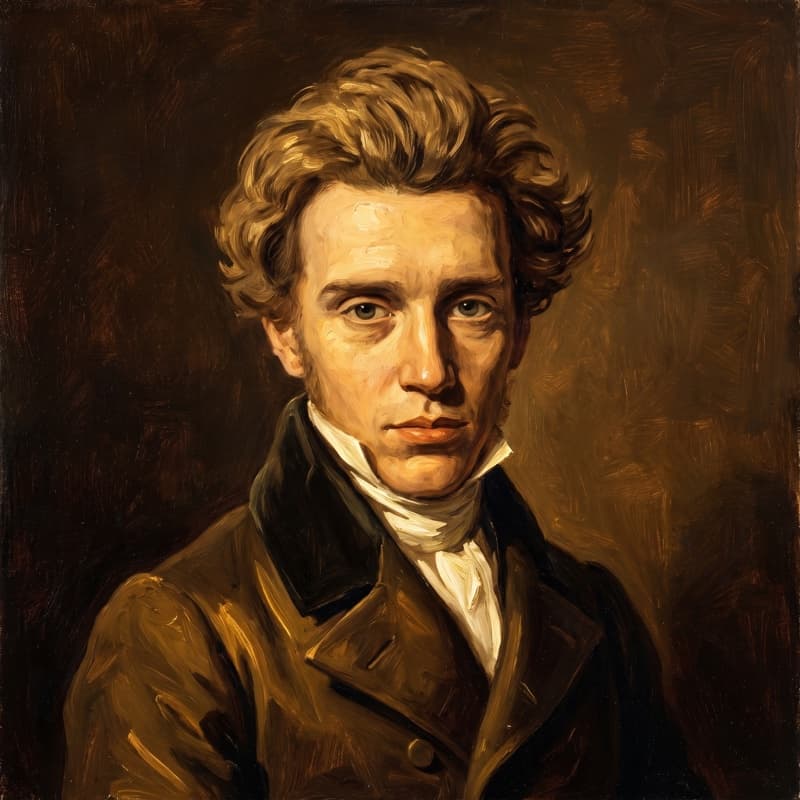
Most Kierkegaard quotes float around without a warning label, and that's a problem specific to him: he wrote most of his major books under invented authors — Johannes Climacus, Johannes de Silentio, Anti-Climacus — each staging a different way of living, not a mouthpiece for Kierkegaard's own opinion. He asked readers to keep that straight. Below, each quote carries its actual author and edition, plus a note on how confidently the wording matches the English translation cited.
The self as a task
In The Sickness Unto Death, published in 1849 under the pseudonym Anti-Climacus, Kierkegaard opens with a definition of selfhood that still gets quoted out of every context that made it make sense:
"The self is a relation which relates itself to its own self, or it is that in the relation which accounts for it that the relation relates itself to its own self."
It sounds like a knot on first read because it is one, deliberately — Anti-Climacus is defining the self as an active, ongoing relating rather than a fixed thing you simply have.
Faith, against the aesthetic
Fear and Trembling (1843), written under Johannes de Silentio, works through Abraham's binding of Isaac to ask what faith actually costs. Two lines from it hold up word for word against the Lowrie translation:
"Faith therefore is not an aesthetic emotion but something far higher, precisely because it has resignation as its presupposition."
"...to be able to fall down in such a way that the same second it looks as if one were standing and walking... that only the knight of faith can do — and this is the one and only prodigy."
The "knight of faith," in de Silentio's account, is not someone who feels certain. He's someone who has given up the thing he wants completely, and then, absurdly, gets to act as if he might still receive it.
Subjectivity, inwardness, and the crowd
The pseudonym Johannes Climacus, in Concluding Unscientific Postscript (1846), is usually credited with the line "subjectivity is truth" — how it's rendered varies by translation and printing, but the underlying claim is Climacus's, not Kierkegaard's own signed doctrine: that how a truth is inwardly appropriated matters as much as whether it's objectively demonstrable. Climacus frames faith itself the same way, "as the contradiction between the infinite passion of inwardness and objective uncertainty."
Kierkegaard's own signed voice shows up elsewhere. A recurring theme across his journals and papers, later summarized as "the crowd is untruth," argued that mass opinion dissolves individual responsibility rather than sharpening it — a conviction the Corsair affair's public mockery only deepened for him. And a journal entry from 1843 gives the line everyone half-remembers: "It is perfectly true, as philosophers say, that life must be understood backward. But they forget the other proposition, that it must be lived forward."
Love, without the feeling
Works of Love (1847), one of Kierkegaard's signed religious discourses, argues against reducing love to a mood: "Love is a matter of conscience and thus is not a matter of impulse and inclination, and not a matter of feeling."
Quotes Kierkegaard never wrote
Two lines circulate under his name with no real support. "Life is not a problem to be solved, but a reality to be experienced" belongs to Jacobus Johannes van der Leeuw, misattributed after a 1945 Cyril Connolly essay borrowed it. "The most painful state of being is remembering the future, particularly one you can never have" has no located source at all — sites that host it label it explicitly unsourced. Neither survives contact with an actual citation.
More in this cluster: Kierkegaard hub · his death · biography · facts.