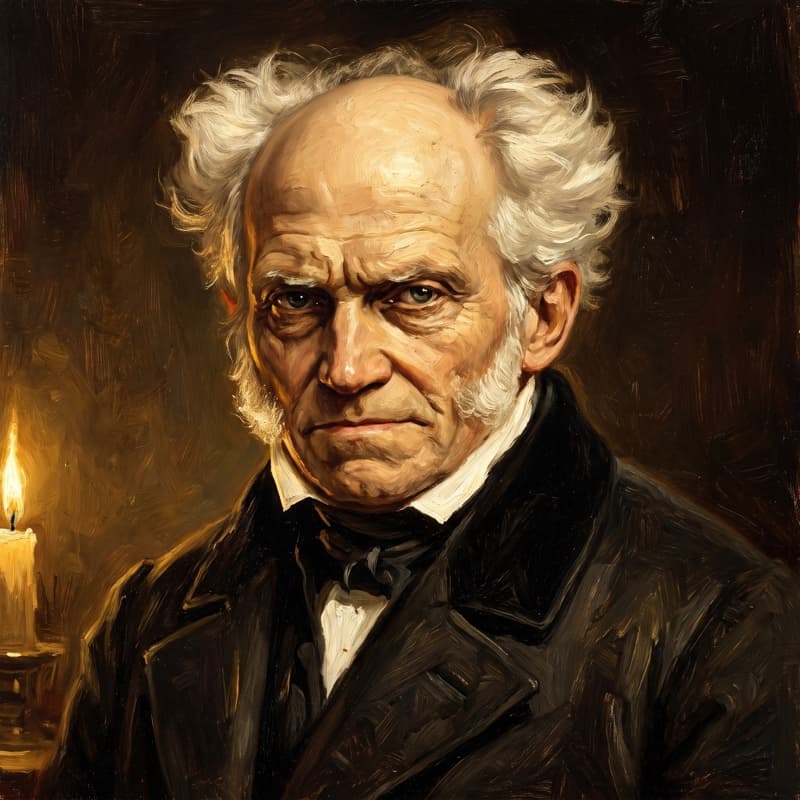
Arthur Schopenhauer was born February 22, 1788, in Danzig — now Gdańsk — and died September 21, 1860, in Frankfurt am Main, at age seventy-two (Stanford Encyclopedia of Philosophy; Wikipedia). He is the philosopher of the Will: the argument that beneath every appearance in nature, and every craving in a human chest, runs one blind, endless striving, and that most of what people call happiness is only its brief silence. He published his masterpiece at thirty and spent three decades almost entirely unread — until, late in life, the world caught up with him. That is the summary. The man underneath it is stranger, funnier, and more surprisingly kind than the summary lets on.
The masterpiece nobody read
Schopenhauer's father, the Danzig merchant Heinrich Floris Schopenhauer, wanted a son for the trading house; his mother, Johanna, wanted a son for her Weimar drawing room and became a celebrated novelist in her own right (Wikipedia). His father's death in 1805 — Arthur was seventeen — freed him from the mercantile career he had been groomed for. He studied at Göttingen and Berlin, then received his doctorate in absentia from the University of Jena in 1813 for The Fourfold Root of the Principle of Sufficient Reason (Stanford Encyclopedia of Philosophy). Five years later, at thirty, he published The World as Will and Representation, which opens with a claim as blunt as anything in philosophy: "The world is my idea" (primary text, Project Gutenberg). Almost nobody bought it.
In 1820 he tried lecturing at the University of Berlin, scheduling his course at the exact hour G. W. F. Hegel taught his own. Hegel's hall filled with the future civil servants of Prussia; Schopenhauer's benches stayed nearly empty (Stanford Encyclopedia of Philosophy; Wikipedia).
What the book actually argues
Strip away the reputation for gloom and the core claim is precise, not vague despair. Satisfaction, he held, is not a positive thing but the temporary absence of a negative one: "Every state of welfare, every feeling of satisfaction, is negative in its character; that is to say, it consists in freedom from pain, which is the positive element of existence" (Studies in Pessimism, Project Gutenberg). Wanting is the engine; getting only switches it off for a moment before boredom restarts it.
That diagnosis comes with a prescribed treatment. Compassion, he argued, is not one virtue among several but "the real basis of all voluntary justice and all genuine loving-kindness," extended without limit: "Boundless compassion for all living beings is the surest and most certain guarantee of pure moral conduct" (The Basis of Morality, Project Gutenberg). He also held that art can quiet the Will for a while — and that music does this more directly than any other art, because it does not copy the world's surface but speaks from underneath it (The World as Will and Idea, Vol. 1, Book III).
From a conversation with our Schopenhauer
What follows is an excerpt from a conversation with our AI Schopenhauer persona — a stylized recreation for readers, not a historical quotation.
Caller: Isn't it a little bleak, building a whole philosophy on suffering?
Schopenhauer: Bleak is what the physician sounds like before he tells you the disease has a treatment. I do not recommend despair; I recommend accuracy. Locate the wanting — the small, relentless engine behind your particular unhappiness — and you can starve it a little: an hour of music, a walk with an honest dog, a kindness paid to someone worse off than yourself. None of that is bleak. It is merely cheaper than the vulgar remedy, which is to go and want something new.
The feud, the exile, and the fame that arrived forty years late
Schopenhauer settled permanently in Frankfurt in June 1833, sharing his rooms for the rest of his life with a succession of poodles, all named Atman — one also recorded as "Butz" (Stanford Encyclopedia of Philosophy; Wikipedia). It was not a purely serene exile: in 1821 a Berlin seamstress, Caroline Luise Marquet, sued him over an altercation, and in 1827 a court ordered him to pay her a pension until her death in 1842 (Wikipedia) — a genuinely unflattering episode that complicates the sage image.
Recognition finally came from an unexpected direction. Parerga and Paralipomena, a collection of essays, appeared in 1851, and a favorable 1853 review by John Oxenford in the Westminster Review did what four decades of the masterpiece could not: it made Schopenhauer's name (Stanford Encyclopedia of Philosophy; Wikipedia). He died on September 21, 1860, in Frankfurt, buried at the Frankfurt Hauptfriedhof, having left much of his estate to a Prussian fund for soldiers disabled — and the families of soldiers killed — suppressing the 1848 revolutions (Stanford Encyclopedia of Philosophy; Wikipedia).
A quote he never actually said
"All truth passes through three stages: first, it is ridiculed; second, it is violently opposed; third, it is accepted as self-evident." This line, endlessly reprinted under his name, is not found anywhere in Schopenhauer's writings; researchers who checked with Schopenhauer scholars traced the popular wording to a 1981 New York Times interview, with near-identical lines also wrongly pinned on Shaw, Huxley, and others (quotation research). A related favorite, "the amount of noise which anyone can bear undisturbed stands in inverse proportion to his mental capacity," doesn't appear verbatim in "On Noise" either — the real sentence, about eminent intellects and disturbance, sits on the quotes page.
From a conversation with our Schopenhauer
Another excerpt from the AI persona — stylized, not a historical record.
Caller: Does it bother you that recognition took so long?
Schopenhauer: It bothered me for exactly the decades in which it was happening, and I intend to enjoy the remainder without shame. Forty years is a long wait for a compliment, but this one has outlasted most people's flattery by several lifetimes. Truth, I have written, is granted only a brief victory celebration between being condemned as paradoxical and dismissed as trivial. I have simply lived long enough to reach the celebration — and I am told the poodle approves.
Keep reading — or ask him yourself
The pages below go deeper: his full biography, his verified quotes — and the ones he never said, and the facts, sourced.
Or skip the reading. Our Schopenhauer takes calls. Ask him about the porcupine dilemma, why he scheduled his lectures against Hegel's, or what a poodle named Atman taught him that Berlin's philosophy faculty never did. He is an AI recreation, honestly labeled as one — but he answers in his own voice, acerbic and oddly generous, and he has time for you.