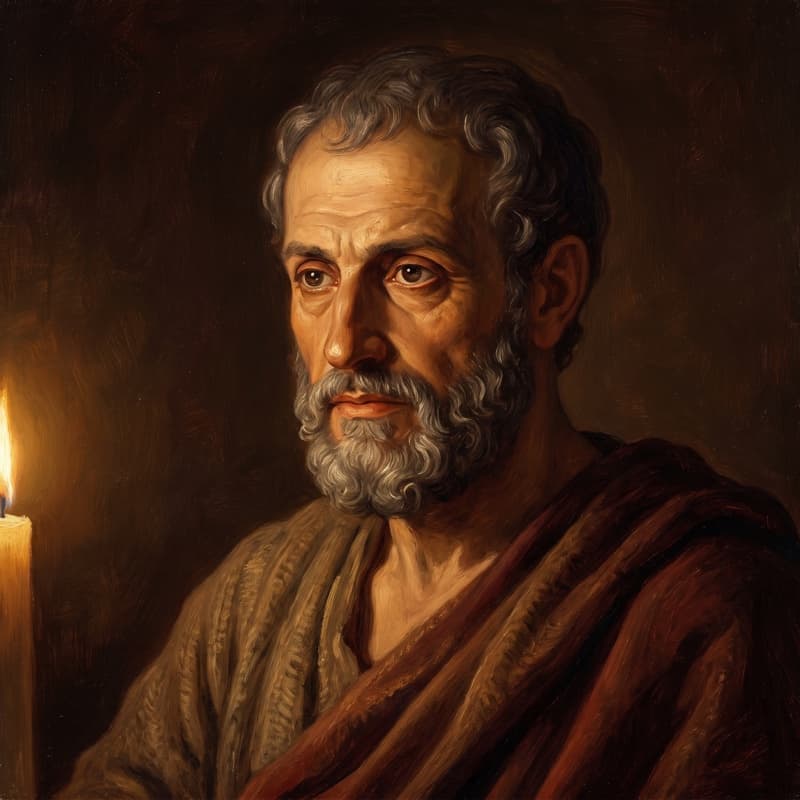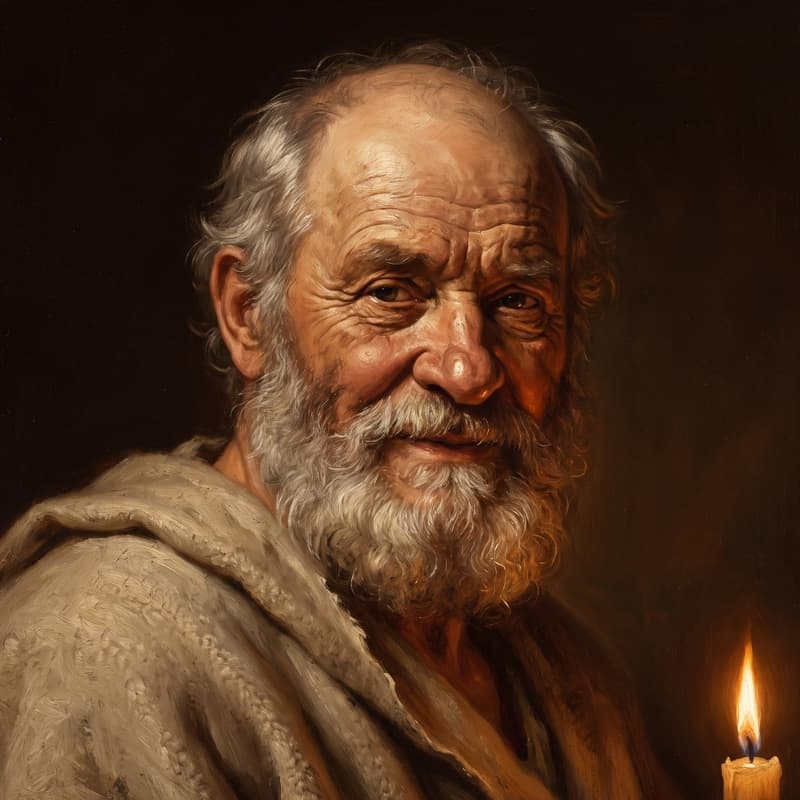
Socrates lived from about 469 to 399 BCE in Athens, the son of a stonemason and a midwife, and he wrote nothing down (Stanford Encyclopedia of Philosophy). He served as a hoplite in three campaigns, defied two different Athenian governments on points of law, was tried and convicted on charges of impiety and corrupting the young in 399 BCE, and died by drinking hemlock rather than accept exile or escape. Nearly everything we know about him passes through three other writers — Aristophanes, Xenophon, and Plato — whose portraits of him disagree with each other. Every claim on this page carries a citation to a primary or institutional source; where the popular version is wrong, we say so.
The documented life
Socrates' father, Sophroniscus, was a sculptor or stonemason; his mother, Phaenarete, was a midwife — a trade Socrates later borrowed as a metaphor for his own method of drawing ideas out of other people (Diogenes Laertius, Lives of the Philosophers II.5). He married Xanthippe, who bore him a son, Lamprocles; the same source records a disputed tradition of a second wife, Myrto, who bore him two more sons, Sophroniscus and Menexenus. He fought as an Athenian citizen-soldier at Potidaea in 432 BCE, at Delium in 424 BCE, and at Amphipolis in 422 BCE (Internet Encyclopedia of Philosophy).
Twice, Socrates put his own safety behind a point of law. In 406 BCE, serving on the Athenian Council, he was reportedly the lone member who opposed the illegal mass trial of the generals after the Battle of Arginusae (Stanford Encyclopedia of Philosophy). In 404 BCE, under the oligarchic Thirty Tyrants, he refused an order to help arrest a man named Leon of Salamis for summary execution — a refusal he later described to the jury at his own trial: "I must run the risk to the end with law and justice on my side" (Plato, Apology 32c–d).
None of this survives in his own hand. As the Stanford Encyclopedia of Philosophy puts it bluntly, "all our information about him is second-hand and most of it vigorously disputed" — Aristophanes caricatured him as a comic type in Clouds while he was still alive, Xenophon's memoirs read as tidy set pieces rather than transcripts, and even Plato, who knew him personally, may have shaped "the character Socrates" to make his own philosophical arguments (Stanford Encyclopedia of Philosophy).
The trial and the death
In 399 BCE, Socrates was tried in Athens on charges of not recognizing the city's gods and corrupting the youth; his principal accuser was Meletus (Stanford Encyclopedia of Philosophy). The jury convicted him — Diogenes Laertius records the margin as 281 votes — and at sentencing Socrates proposed, instead of a fine or exile, that the city reward him with free meals in the Prytaneum, a counter-penalty the jury took as provocation rather than wit (Diogenes Laertius II.41–42). That specific vote count comes from a source writing roughly six centuries after the fact, drawing on earlier material that no longer survives — solid enough to repeat, but worth flagging as later and secondary rather than a contemporary court record.
Offered a chance to escape prison before his execution, Socrates refused. In Plato's Crito, he argues that a wronged man may never wrong back: "we must injure no one at all... we ought not to retaliate or render evil for evil to anyone, whatever evil we may have suffered from him" (Plato, Crito 49b–d). He drank hemlock and died, and Plato's Phaedo gives him a famously composed final instruction to his friend Crito: "Crito, we owe a cock to Aesculapius. Pay it and do not neglect it" — reportedly his last words, asking that a routine debt to the god of healing be settled (Plato, Phaedo 118a). It is worth remembering that the Phaedo is a philosophical dialogue Plato composed after Socrates' death, not a witness transcript — indispensable evidence for how his students wanted him remembered, not a court stenographer's record.
Corrections to the popular record
"Socrates said, 'I know that I know nothing.'" Not in those words. The line usually traced to him is a comparison, not a slogan: "I am wiser than this man; for neither of us really knows anything fine and good, but this man thinks he knows something when he does not, whereas I, as I do not know anything, do not think I do either" (Plato, Apology 21d). The familiar one-liner is a much later compression of that idea.
"Be kind, for everyone you meet is fighting a hard battle" — Socrates. Not his. Quote Investigator traces the modern wording to the Scottish writer Ian Maclaren (the pen name of Rev. John Watson), who sent readers of The British Weekly the line "Be pitiful, for every man is fighting a hard battle" around 1897–98 — roughly 2,300 years after Socrates died (Quote Investigator). Our quotes page documents this and other lines wrongly hung on him.
"His last words were about Asclepius." Close, but the spelling and the framing both need care. Plato's Greek names the god Fowler renders "Aesculapius"; more importantly, the line is Socrates settling a small, ordinary debt in his final moment, not a grand philosophical statement — the composure is the point, not the content.
Why he still matters
Socrates left no books, no school building, and no system — only a habit of asking the next honest question until a confident answer came apart. That habit is why "the unexamined life is not worth living," his defense to the jury that convicted him, still gets quoted by people who have never read the Apology it comes from (Plato, Apology 38a). He turned a capital trial into an argument for philosophy itself, telling the jury he would "never give up philosophy or stop exhorting" anyone he met, verdict or no verdict — and then, offered escape, kept his word by staying and drinking the hemlock (Plato, Apology 29d).
Go deeper
Sourced spoke pages: the trial and death · verified quotes and misattributions · full biography · fact file.
This site also hosts a conversational AI recreation of Socrates, built from the same documented record cited above. He answers the way he always did — with a question aimed straight back at you. Ask him why he refused to escape, what the daimonion actually told him, or whether he really believed he knew nothing, and see how long you last before he has you defining your own words back to yourself. It is a labeled AI persona, not the man; the citations on this page are the man.