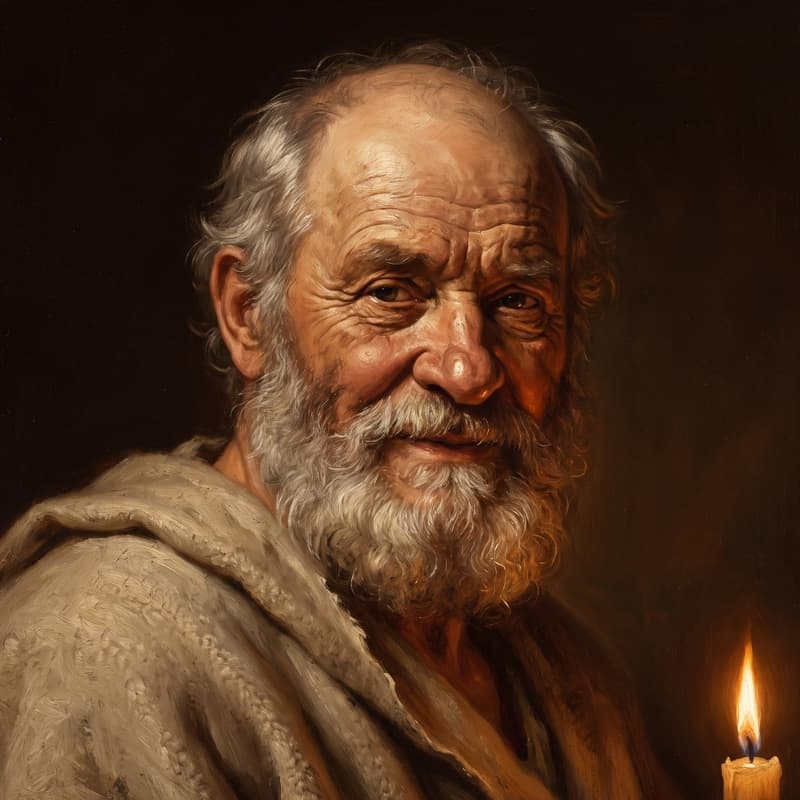
Socrates wrote nothing down. Every line attributed to him survives only because someone else reported it — chiefly Plato, sometimes Xenophon, and once, much later, Diogenes Laertius. That makes a "Socrates quote" a different kind of object than a Lincoln letter or a Twain aside: even the best-sourced lines are one writer's record of what he said, not his own hand. This page marks each one that way, names the reporter, and flags the two lines that are not his at all.
The trial speech: the line everyone knows
Standing before the Athenian jury that would convict him, Socrates gave philosophy its most famous one-liner:
"The unexamined life is not worth living."
Plato places it at Apology 38a, after the guilty verdict, as Socrates argues for his right to keep questioning people rather than accept silence as his penalty (Perseus Digital Library).
The real "I know nothing" — and the fake one
The line usually rendered as "I know that I know nothing" is not a sentence Socrates says anywhere in Plato or Xenophon. What he actually says, at Apology 21d, is a comparison:
"I am wiser than this man; for neither of us really knows anything fine and good, but this man thinks he knows something when he does not, whereas I, as I do not know anything, do not think I do either."
That is the genuine textual anchor (Perseus Digital Library); the tidy slogan is a much later compression of it.
The calling, and the wonder behind it
Told he could walk free if he stopped philosophizing, Socrates refused the deal outright:
"I shall never give up philosophy or stop exhorting you and pointing out the truth to any one of you whom I may meet." (Apology 29d, Perseus)
Elsewhere, talking with the young Theaetetus, he names the feeling that starts the whole enterprise:
"For this feeling of wonder shows that you are a philosopher, since wonder is the only beginning of philosophy." (Theaetetus 155d, Perseus)
On not returning wrong for wrong
In Plato's Crito, arguing against an escape plan, Socrates works out an ethical position that condenses to a single rule: one must never do wrong, nor return a wrong for a wrong, no matter what one has suffered (Plato, Crito 49b–d). It is a paraphrase of an extended exchange, not one continuous sentence, but it is the clearest statement of why he would not run.
Two farewells
The Apology ends with Socrates' own parting words to the jury:
"But now the time has come to go away. I go to die, and you to live; but which of us goes to the better lot, is known to none but God." (Apology 42a, Perseus)
Then, in Plato's Phaedo, the actual last words, spoken as the hemlock took effect:
"Crito, we owe a cock to Aesculapius. Pay it and do not neglect it." (Phaedo 118a, Perseus)
A small, ordinary debt, settled calmly — the composure is the point, not any hidden doctrine.
From a conversation with our Socrates
An excerpt from our AI Socrates persona — a stylized recreation, clearly labeled; not a historical quotation.
Caller: Everyone quotes you saying you know nothing. Is that fair?
Socrates: Tell me first, friend — what would it mean to know a thing "fine and good," the way a craftsman knows his trade? I never claimed bare ignorance; I claimed the other men did not know what they thought they knew, and I at least knew that much about myself. A slogan flattens it into false modesty. The real trouble was never mine — it was theirs, and they did not care for the news.
Quotes Socrates never said
- "I know that I know nothing." As above — a compression of Apology 21d, not a line in the text.
- "Be kind, for everyone you meet is fighting a hard battle." Quote Investigator traces this to the Scottish writer Ian Maclaren (Rev. John Watson), who published a close variant around 1897–98 — some 2,300 years after Socrates died (Quote Investigator).
More in this cluster: Socrates hub · his death · biography · facts.