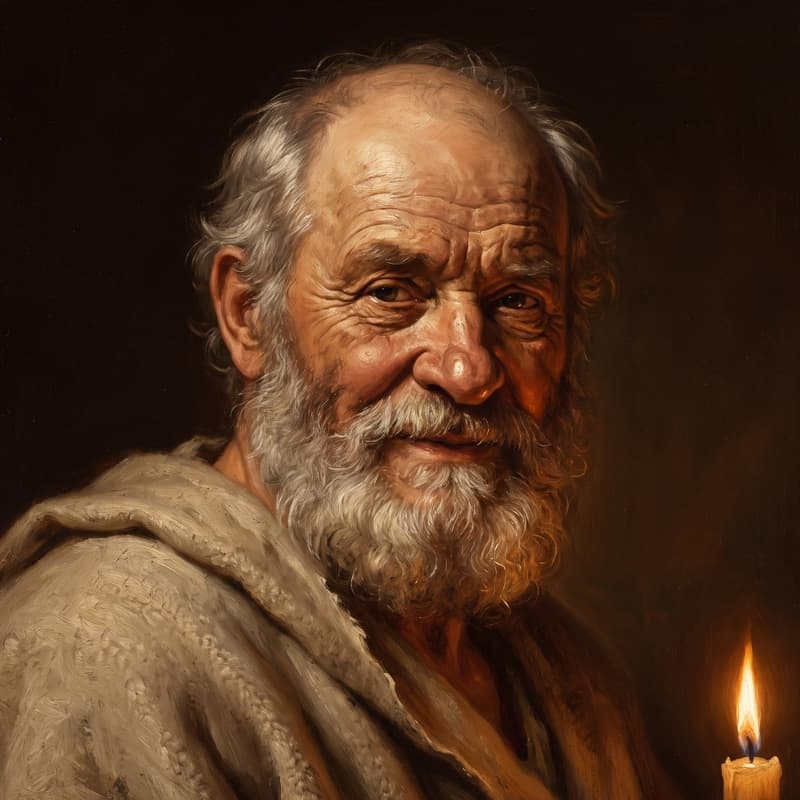
Every fact below traces to a primary ancient source (Plato, Xenophon, or Diogenes Laertius, via Perseus) or an institutional overview (Stanford Encyclopedia of Philosophy, Internet Encyclopedia of Philosophy), cited inline. Short version: born around 469 BCE in Athens to a sculptor and a midwife; wrote nothing himself; married Xanthippe, with a disputed tradition of a second wife and two more sons; fought in three campaigns; twice defied a government on a point of law; was tried and sentenced to death in 399 BCE; died by drinking hemlock. Details below, then a "fact" about him that doesn't survive checking.
Eight verified facts
- Born around 469 BCE in Athens, to a sculptor father and midwife mother — Sophroniscus and Phaenarete — a trade Socrates later borrowed as a metaphor for drawing ideas out of people (Stanford Encyclopedia of Philosophy; Diogenes Laertius II.5).
- He wrote nothing himself. Every surviving portrait is someone else's account — chiefly Aristophanes, Xenophon, and Plato, whose versions disagree with each other (Stanford Encyclopedia of Philosophy).
- He married Xanthippe, who bore him a son, Lamprocles; the same source records a disputed tradition of a second wife, Myrto, who bore him two more sons, Sophroniscus and Menexenus (Diogenes Laertius II.26).
- He fought as an Athenian hoplite in three campaigns: Potidaea (432 BCE), Delium (424 BCE), and Amphipolis (422 BCE) (Internet Encyclopedia of Philosophy). At Potidaea, Diogenes Laertius reports, he "is said to have remained a whole night without changing his position, and to have won the prize of valour" (Diogenes Laertius II.23).
- In 406 BCE he alone opposed an illegal mass trial, refusing, as an Athenian councilor, to join in trying the Arginusae generals as a group in violation of the law (Stanford Encyclopedia of Philosophy).
- In 404 BCE, under the oligarchic Thirty Tyrants, he refused an order to help arrest Leon of Salamis for summary execution, later telling his own jury he would "run the risk to the end with law and justice on my side" (Plato, Apology 32c–d).
- Tried in 399 BCE on charges of impiety and corrupting the young, convicted by a margin Diogenes Laertius records as 281 votes, he then proposed free Prytaneum meals as his own penalty rather than a fine or exile — provocation, in the jury's eyes (Stanford Encyclopedia of Philosophy; Diogenes Laertius II.41–42). That vote count is from a source writing six centuries later — flagged here as later and secondary, not a contemporary record.
- He died in 399 BCE by drinking hemlock, at age seventy by Diogenes Laertius's count, following his conviction (Diogenes Laertius II.44–45; narrative in Plato, Phaedo 118a).
A myth, and its real source
"Socrates said, 'I know that I know nothing.'" Not in those words, anywhere in Plato or Xenophon. What he actually says is a comparison, not a slogan: "I am wiser than this man; for neither of us really knows anything fine and good, but this man thinks he knows something when he does not, whereas I, as I do not know anything, do not think I do either" (Plato, Apology 21d). The tidy one-liner is a much later compression of that passage — and it's not the only line wrongly hung on him; our quotes page documents more, including "Be kind, for everyone you meet is fighting a hard battle," which traces to a 19th-century Scottish writer, not Socrates (Quote Investigator).
Frequently asked, quickly answered
Was Socrates a soldier? Yes — a citizen-hoplite at Potidaea, Delium, and Amphipolis (Internet Encyclopedia of Philosophy).
Did Socrates try to escape his execution? No. His friend Crito arranged an escape and urged him to take it; Socrates refused, arguing "we ought not to retaliate or render evil for evil to anyone, whatever evil we may have suffered" (Plato, Crito 49b–d).
Why was Socrates put on trial? Charges of "not recognizing the gods the city recognizes" and corrupting the youth — the impiety count tied to his daimonion, an inner sign he described as warning him away from certain actions (Stanford Encyclopedia of Philosophy).
Related pages
Socrates hub · the trial and death · verified quotes · full biography.
For what a fact list can't settle — how he argued, why he stayed, what the daimonion actually told him — this site hosts a conversational AI recreation of Socrates, built from the same sourced record cited above and labeled plainly as an AI persona. The facts are here; the questions are a conversation away.