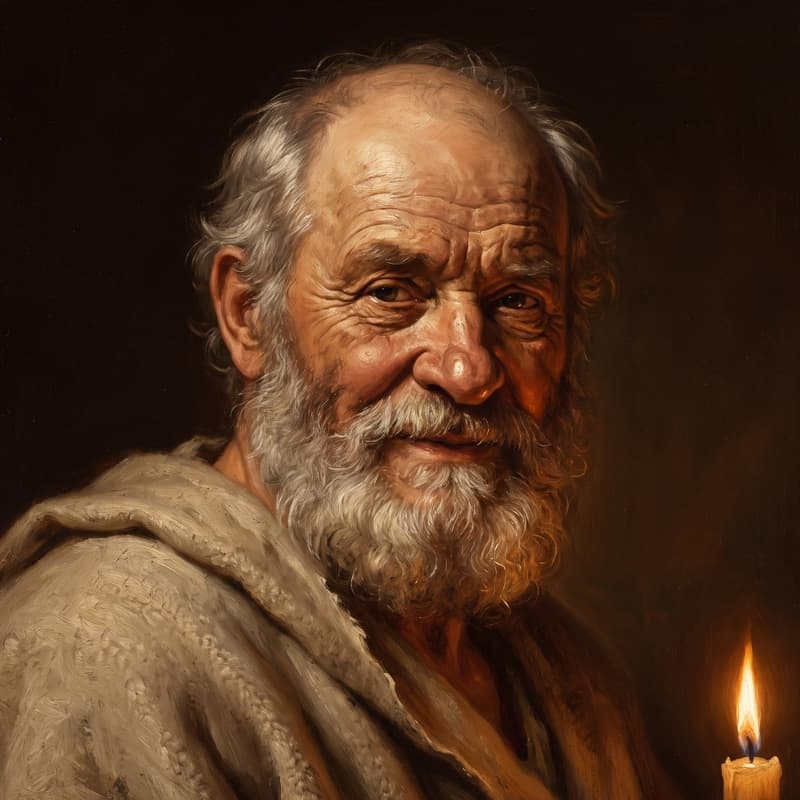
Socrates left no writings of his own, so every biography of him — this one included — is built from what other people wrote about him after the fact: chiefly Aristophanes, Xenophon, and Plato, whose portraits of the same man diverge substantially (Stanford Encyclopedia of Philosophy). That caveat belongs at the front, not the end: nothing below is a transcript, only the best-attested version of a heavily reported life.
Family and background
Socrates was born in Athens around 469 BCE, the son of Sophroniscus, a sculptor or stonemason, and Phaenarete, a midwife (Diogenes Laertius, Lives of Eminent Philosophers II.5, via Perseus) — a trade ancient writers connected to his own description of questioning as a kind of intellectual midwifery. He married Xanthippe, who bore him a son, Lamprocles; the same source records a disputed tradition of a second wife, Myrto, who bore him two more sons, Sophroniscus and Menexenus (Diogenes Laertius II.26). Aristophanes' comedy Clouds, staged in 423 BCE, is an early — comic — contemporary source for his public reputation (Stanford Encyclopedia of Philosophy).
A soldier before a teacher
Before he was known as a questioner, Socrates was known as a fighter. Athenian sources place him as a hoplite at Potidaea in 432 BCE, at Delium in 424 BCE, and at Amphipolis in 422 BCE (Internet Encyclopedia of Philosophy) — three campaigns across the Peloponnesian War's first decade, the same endurance later writers folded into anecdotes of him standing motionless in thought for a full night at Potidaea (Diogenes Laertius II.5).
Two acts of refusal
Twice, under opposite regimes, Socrates is recorded refusing an order on principle. In 406 BCE, on the Athenian Council after the battle of Arginusae, he alone reportedly opposed the illegal move to try the victorious generals as a group rather than individually (Stanford Encyclopedia of Philosophy). Then in 404–403 BCE, under the oligarchic Thirty Tyrants, he refused an order to help arrest Leon of Salamis for summary execution, saying — as Plato's Apology has him tell the jury — that he "must run the risk to the end with law and justice on my side" (Plato, Apology 32c–d). Democracy and oligarchy each asked something of him he would not give.
The trial of 399 BCE
That habit of refusal, layered onto decades spent questioning prominent Athenians in the agora, caught up with him in 399 BCE. He was tried on charges of impiety and corrupting the young, with Meletus as principal accuser (Stanford Encyclopedia of Philosophy). Plato's Apology stages his defense, including his argument that he is wiser than a reputedly wise man in one respect only — "this man thinks he knows something when he does not, whereas I... do not think I do either" (Plato, Apology 21d). The jury was not persuaded; Diogenes Laertius records the conviction margin as 281 votes, worth some caution given a source writing roughly six hundred years later (Diogenes Laertius II.41). At sentencing, rather than propose exile, he suggested a token penalty — Prytaneum meals at public expense, by Diogenes Laertius' account — which the jury took as provocation (Diogenes Laertius II.41–42). The death sentence that followed has its own page on this site.
What this biography deliberately does not claim
That "the unexamined life is not worth living" is a courtroom transcript. Plato's Apology is a dramatized composition written after Socrates' death, not a stenographic record, even where the wording checks out against the Greek at Apology 38a (Perseus Digital Library).
That "I know that I know nothing" is something Socrates said, or that Xanthippe was the nagging wife of later legend. No surviving text has him say those exact words — the real anchor is the Apology 21d comparison quoted above (see the quotes page for the full accounting) — and Diogenes Laertius records only the marriage and children plainly (one son by Xanthippe, two more by a disputed second wife, Myrto), not the "difficult wife" color that comes from far less reliable anecdote layers.
Related pages
Socrates hub · his death · verified quotes · fact file.
This site also hosts a conversational AI recreation of Socrates, built on the record above and labeled as exactly that. Ask him about standing watch at Potidaea, refusing the Thirty Tyrants, or defending a life of questioning to a jury already decided not to listen.