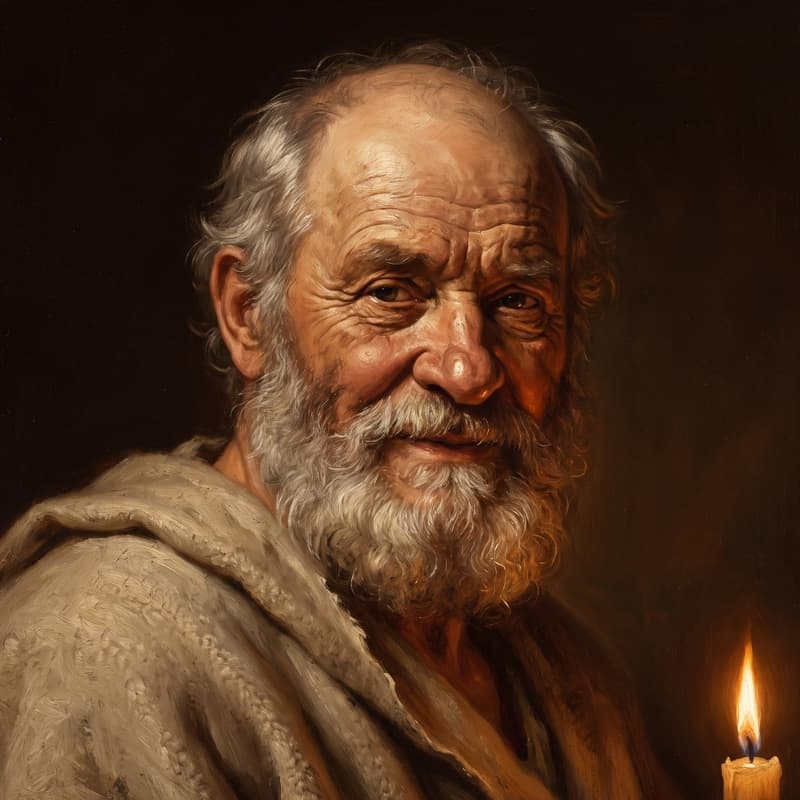
Socrates died in 399 BCE in an Athenian prison, having drunk hemlock after his conviction on charges of impiety and corrupting the young (Plato, Phaedo 118a). He had the means to escape beforehand and chose not to. What survives of that day comes entirely through Plato, a philosopher building an argument about the soul, not a court reporter — worth holding through everything below.
A conviction, and a penalty that made it worse
An Athenian jury convicted Socrates in 399 BCE on charges of not recognizing the city's gods and corrupting the youth. Diogenes Laertius records the margin as 281 votes — worth citing with care, since he was writing roughly six centuries after the trial, drawing on earlier material that no longer survives on its own (Diogenes Laertius, Lives of the Philosophers II.41–42). Athenian procedure let the convicted propose his own counter-penalty. Socrates offered free meals in the Prytaneum, the honor reserved for the city's benefactors, rather than a fine or exile — a response the jury seems to have read as contempt, and one that likely hardened the sentence.
Crito's offer, and the argument for staying
Before the execution, Plato's Crito has Socrates' friend Crito arrive at the prison with an escape already arranged — money paid, guards squared away, exile waiting outside Athens. Socrates turns it down, not from fear of getting caught but from a principle he had held to all along: a wronged man may never wrong back. "We must injure no one at all," he tells Crito, rejecting the idea that answering the city's injustice with his own lawbreaking could ever be just (Plato, Crito 49b–d). Having argued his whole life that doing wrong is worse than suffering it, he treated a quiet escape as the one move that would make the argument a lie.
The final hours, and the last words
Plato's Phaedo stages the execution day as a long conversation among Socrates and his students on whether the soul survives the body — Socrates arguing philosophy is itself a rehearsal for death, calm enough to reason through counterarguments while the hemlock was prepared down the hall. When the moment came, he drank it without visible distress. His last recorded words went to Crito, and they were startlingly ordinary: "Crito, we owe a cock to Aesculapius. Pay it and do not neglect it" — a routine debt to the god of healing, settled like a small errand rather than a final statement (Plato, Phaedo 118a). The name appears as "Aesculapius" here and "Asclepius" in other translations — a difference of translator, not substance — but the plainness of the request is the real content, not a hidden message.
It was not, strictly, his only farewell. Weeks earlier, closing his defense speech at the trial, he had already said goodbye to the jury that convicted him: "But now the time has come to go away. I go to die, and you to live; but which of us goes to the better lot, is known to none but God" (Plato, Apology 42a). The courtroom farewell and the execution-room farewell bookend the same weeks, one composed for a jury, the other for a single friend.
What the Phaedo is, and isn't
None of this is eyewitness reporting. The Phaedo is a philosophical dialogue Plato composed after Socrates' death, built to argue for the soul's immortality — invaluable as a record of how his students wanted him remembered, but not a transcript of the room. The composure it describes may be exactly as remembered, or it may be Plato's argument wearing his teacher's voice. Either way, it is the only door historians have into that day.
More in this cluster: verified quotes and misattributions · full biography · fact file · back to the Socrates hub.