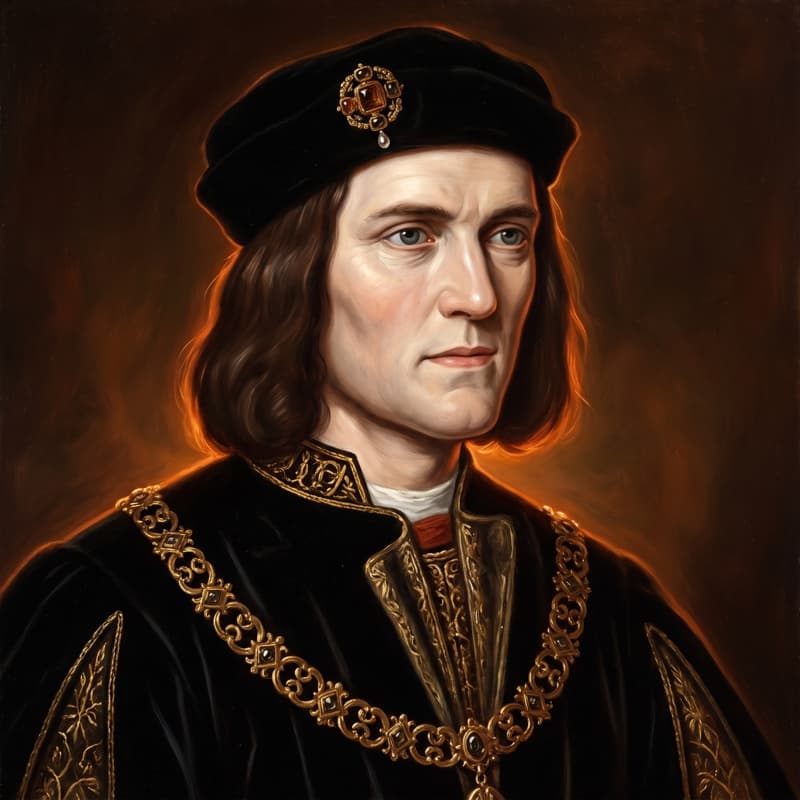
Richard III (born October 2, 1452 — killed August 22, 1485) was King of England from June 1483 until he fell at the Battle of Bosworth Field, the last English king to die in combat (The National Archives; Bosworth Battlefield Heritage Centre). He governed the north of England for over a decade before he governed the country, took the crown through a parliamentary act rather than open conquest, passed a single session of notably progressive law, and has been the chief suspect in one of English history's oldest unsolved cases ever since. Almost everything the public "remembers" him saying is Shakespeare's invention, written more than a century later. This page separates the documented king from the dramatic character.
The documented life
Richard was born at Fotheringhay Castle in Northamptonshire, the youngest surviving son of Richard, Duke of York, and Cecily Neville, and was made Duke of Gloucester in October 1461 when his brother became Edward IV (The National Archives). He fought at the Battle of Barnet in 1471 — "probably Richard's first experience of combat," per the National Archives — helping restore Edward to the throne, and afterward received the northern estates of Middleham, Sheriff Hutton, and Penrith (University of York, Richard III: Rumour and Reality). From Middleham he governed the north for over a decade, and in 1482 he led the English invasion of Scotland that recovered Berwick-upon-Tweed (The National Archives).
His personal motto, first attested in 1483 on a scrap of paper bearing his signature alongside Edward V's and Buckingham's, was Loyaulté me lie — "Loyalty binds me" (Richard III Society).
The documented reign
Edward IV died suddenly in April 1483, and Richard — his surviving brother — was named Protector for the twelve-year-old Edward V. Within weeks, the protectorship hardened into a crisis: in a June 1483 letter urging York to send armed men against the queen's family, Richard wrote of those "which have intended, and daily doth intend, to murder and utterly destroy us and our cousin the duke of Buckingham" (Wikiquote, citing Paul Murray Kendall, Richard the Third, 1956). Bishop Stillington's testimony that Edward IV's marriage was invalid by a prior precontract led Parliament's three estates to declare Edward IV's children illegitimate; the resulting act, Titulus Regius, proclaimed Richard "the true and undoubted king of this realm of England," and was ratified by Parliament in early 1484 (Richard III Society). He was crowned at Westminster Abbey on July 6, 1483, alongside Queen Anne Neville.
His one Parliament, in January 1484, is his least contested legacy: it required goods not be seized from the accused before conviction and empowered Justices of the Peace to grant bail more readily, it barred the forced loans known as "benevolences" so that subjects "shall in no way be burdened" by them again, it set a property qualification for jurors to curb bribery, and its statutes were the first recorded entirely in English rather than French or Latin (Richard III Society).
That October, Richard learned that his ally the Duke of Buckingham had turned against him; on a letter to his Chancellor he scrawled, in his own hand, that Buckingham was "the most untrue creature living" — arguably the single most personally revealing fragment that survives from him (Wikiquote, citing Kendall).
The princes in the Tower
Edward V and his younger brother were lodged in the Tower of London in 1483 and, after Buckingham's revolt, vanished from public sight. What happened to them is not a settled fact. The National Archives states plainly that "on the key issues, such as the true fate of the Princes in the Tower, we await the discovery of crucial new evidence" (The National Archives), and the Richard III Society, reviewing the recent archival scholarship, concludes that "never again can it be stated with confidence that the 'Princes in the Tower' were killed by Richard III" (Richard III Society). Richard had custody of the boys and remains history's leading suspect; he is not, on the documented record, a convicted one.
Corrections to the popular record
"Now is the winter of our discontent" and "I am determined to prove a villain" are Shakespeare's dramatized Richard, not the historical king — both spoken by the character in the opening soliloquy of Richard III, written roughly a century after Richard's death (Folger Shakespeare Library).
"A horse, a horse, my kingdom for a horse!" is likewise Shakespeare's invention for the character's final moments at Bosworth, spoken twice in Act 5, Scene 4 — no historical source has the real Richard saying it (Folger Shakespeare Library).
"Off with his head! So much for Buckingham" isn't even Shakespeare's; it comes from actor-playwright Colley Cibber's 1699 stage adaptation, one of "Cibber's most famous lines," later folded into performance tradition until audiences assumed it was always there (Wikipedia, Richard III (1699 play)).
The "hunchback" wasn't fiction from nowhere. When archaeologists examined his skeleton, they found severe scoliosis — a sideways spinal curve leaving one shoulder higher than the other — but no evidence of a withered arm (Nature Communications via PMC). The exaggeration is dramatic; the underlying condition was real and, by every account of his soldiering, did not stop him fighting in full harness.
Death and rediscovery
At Bosworth on August 22, 1485, Richard rallied his mounted knights in a direct charge at Henry Tudor, vowing to fight or die as king rather than leave the field; he was surrounded and killed "fighting in the thickest press of his foes" (Bosworth Battlefield Heritage Centre). The next day, York's own civic record mourned him: "King Richard, late mercifully reigning upon us, was...pitiously slane and murdred to the grete hevynesse of this citie" (University of York, Richard III: Rumour and Reality) — a city that had known him as its governor, not its villain.
His grave at Leicester's Grey Friars friary was lost for over five centuries until an August 2012 excavation, led by the University of Leicester with the Richard III Society and Leicester City Council, uncovered a battle-scarred skeleton with spinal curvature beneath what had become a car park; the identification was announced on February 4, 2013 (University of Leicester). Genetic, genealogical, and osteological analysis put the likelihood ratio at 6.7 million, concluding the evidence was "overwhelming" (Nature Communications via PMC). His remains were coffined on March 15, 2015, and reinterred at Leicester Cathedral eleven days later, on March 26, 2015 (University of Leicester).
Go deeper — or ask him yourself
Sourced spoke pages: his full biography · the battle and death at Bosworth · verified quotes and misattributions · fact file.
This site also hosts a conversational AI recreation of Richard, built from the same documented record cited above — set at Nottingham Castle in the summer of 1485, in the weeks before he knows Bosworth is coming. Put the princes question to him directly. He won't confess to a crime he denies, and he won't claim clean hands either; he'll argue the record — the precontract, Titulus Regius, the statutes of his one Parliament — and leave the verdict to you. It is a labeled AI persona, not the man; the citations on this page are the man.