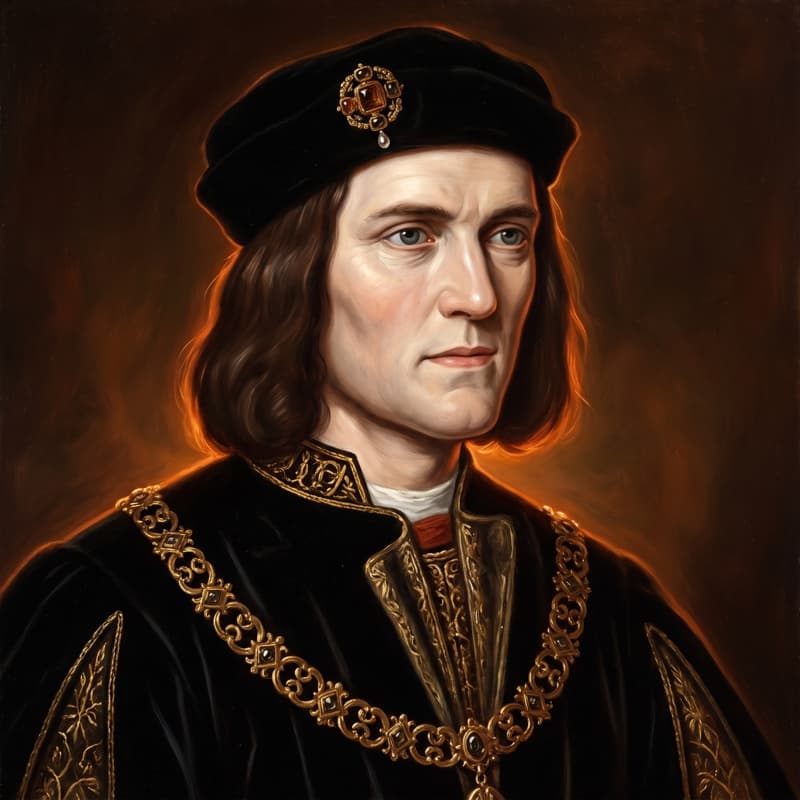
Richard III is one of the hardest figures on this site to give an honest quotes page, because he almost never gave the world a quotable line. He left no diary, no memoir, no collection of sayings. What survives instead is a motto, a handful of urgent letters written during the worst weeks of his life, one furious marginal note, and a parliamentary act. Nearly everything the public actually remembers him "saying" — the winter of discontent, the villain speech, the horse — is Shakespeare's invention, written a century after Richard died. This page keeps the two apart.
The motto
Richard's personal motto, first attested in 1483 alongside his signature:
"Loyaulte me lie" — "Loyalty binds me."
It later appears on a Wax Chandlers' Company charter dated 16 February 1484. Whatever else is disputed about Richard, this phrase and its dating are not.
Crisis letters, June 1483
As Lord Protector during the succession crisis, Richard wrote in his own urgent hand. To Sir William Stonor, he reported the political collapse plainly:
"...much trouble and doubt."
Around the same weeks, writing to the city of York for armed support against the Woodville faction, his letter — sourced to Paul Murray Kendall's biography and cross-checked against independent transcriptions — described those "who intend to murder and utterly destroy us and our cousin, the Duke of Buckingham and the old royal blood of this realm."
The marginal note
The single most personally revealing fragment is a note Richard is said to have scrawled after Buckingham's rebellion that October — not a speech, a private reaction to betrayal by a man he had trusted:
"...the most untrue creature living."
Titulus Regius: his "official" claim
Titulus Regius, the 1484 act of Parliament settling the crown on Richard, is the closest thing to a personal statement of his right to rule — though it is a legal document drafted by Parliament, not a line Richard spoke:
"...true and undoubted king of this realm of England...by right of consanguinity and inheritance as well as by lawful election, consecration and coronation."
Henry VII later had it annulled unread and copies destroyed; the enrolled Parliament Roll survived and wasn't printed until 1611.
How his own city mourned him
Not Richard's words, but a rare dated record of how York spoke of him the day after Bosworth, 23 August 1485:
"King Richard late mercifully reigning upon us was thrugh grete treason...pitiously slane and murdred to the grete hevynesse of this citie."
Quotes Richard III never said
Everything below is Shakespeare's dramatic character, or later still — never the historical king:
- "Now is the winter of our discontent / Made glorious summer by this son of York." Richard's opening soliloquy, Richard III, Act 1, Scene 1 — written roughly a century after Richard died.
- "I am determinèd to prove a villain." Same soliloquy, same scene.
- "A horse, a horse, my kingdom for a horse!" Act 5, Scene 4 — no historical record has Richard saying this at Bosworth; it is Shakespeare's invention for the battle.
- "Off with his head! So much for Buckingham." Not even Shakespeare's — actor-playwright Colley Cibber wrote this for his 1699 adaptation, and it later got absorbed into performance tradition (including Laurence Olivier's 1955 film) as if it were the original text.
Hear him argue it himself
Reading Richard's fragments is one thing; asking him directly is another. Our Richard — an AI recreation, honestly labeled — will tell you what "Loyaulte me lie" meant to a man who watched his own allies turn, why he signed a letter accusing his own government of treason weeks before he wore the crown, and what he makes of a play that turned him into its most famous villain.
More in this cluster: Richard III hub · his death · biography · facts.