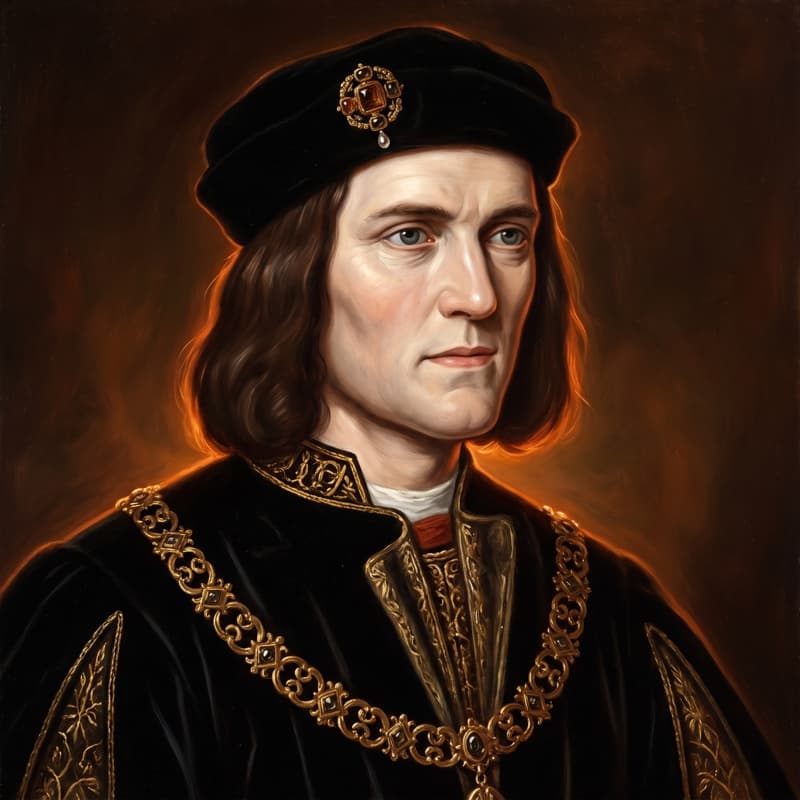
Richard III was killed at the Battle of Bosworth Field on 22 August 1485, cut down while fighting Henry Tudor's forces rather than fleeing (Bosworth Battlefield Heritage Centre). He was the last English king to die in battle. His body was lost to public memory for more than five centuries, then identified in 2013 through archaeology, genealogy, and DNA analysis, and reinterred at Leicester Cathedral in 2015 (University of Leicester).
The battle, 22 August 1485
By the summer of 1485, Henry Tudor had returned from exile to challenge Richard for the crown, and the two armies met near Market Bosworth in Leicestershire. Richard led a mounted charge toward Henry's position, but his horse, White Surrey, became stuck in marshy ground. Unhorsed, he chose to keep fighting rather than retreat — he "vowed to fight or die as the King of England rather than to leave the field," and was killed "fighting in the thickest press of his foes" (Bosworth Battlefield Heritage Centre). He was around 32.
Note on the famous line: Richard did not historically cry "A horse! A horse! My kingdom for a horse!" That line belongs to Shakespeare's Richard, invented for the play's battle scene more than a century after Bosworth (Folger Shakespeare Library, Richard III, Act 5, Scene 4). No contemporary record has the historical king saying anything like it.
York's lament, the day after
The clearest first-person reaction to Richard's death survives not from a chronicler at court but from a city that had backed him through his reign: York. Its official House Books recorded, on 23 August 1485 — the day after Bosworth — that "King Richard, late mercifully reigning upon us, was thrugh grete treason...pitiously slane and murdred, to the grete hevynesse of this citie" (University of York, Richard III: Rumour and Reality). It is a civic record, not Richard's own words, but a dated measure of how at least one city received the news.
Burial, and five centuries lost
After the battle, Richard's body was taken to Leicester and buried at the church of the Grey Friars, a Franciscan friary. The friary was later dissolved and built over; the grave's exact location was lost to public knowledge for more than 500 years, ending up, unremarkably, under a council car park.
Rediscovery under a car park
In August 2012, the University of Leicester, working with the Richard III Society and Leicester City Council, launched a targeted excavation of the former Grey Friars site specifically to search for Richard's grave (University of Leicester). It was a planned dig based on documentary research into where the friary had stood, not a lucky accident stumbled onto during roadworks. On 4 February 2013, the University announced to the world's press that the remains found were Richard III's.
What the science actually showed
The identification rested on more than one line of evidence: a skeleton matching Richard's age and physique, radiocarbon dating consistent with a mid-to-late-1400s death, perimortem battle wounds, and DNA. A mitochondrial DNA match against living maternal-line relatives, combined with the archaeological and genealogical case, produced a likelihood ratio of 6.7 million — enough for the peer-reviewed study to call the identification established "beyond reasonable doubt" (Nature Communications, via PMC). The skeleton showed severe scoliosis — a real physical difference, but not the "withered arm" of Shakespeare's Richard, for which the remains offer no support.
Reinterment, 2015
Richard's remains were coffined at the University of Leicester on 15 March 2015, ahead of reinterment at Leicester Cathedral on 26 March 2015 (University of Leicester) — closing, five centuries later, a story that began on marshy ground near Bosworth.
Related pages
Richard III hub · verified quotes and misattributions · biography · fact file.
This site also offers a conversational AI recreation of Richard III, built on the same cited record — clearly separated from Shakespeare's version of him. Its knowledge does not extend past Bosworth, but it can discuss the crisis of 1483 and what "Loyaulte me lie" meant to him. You can put the question to him directly.