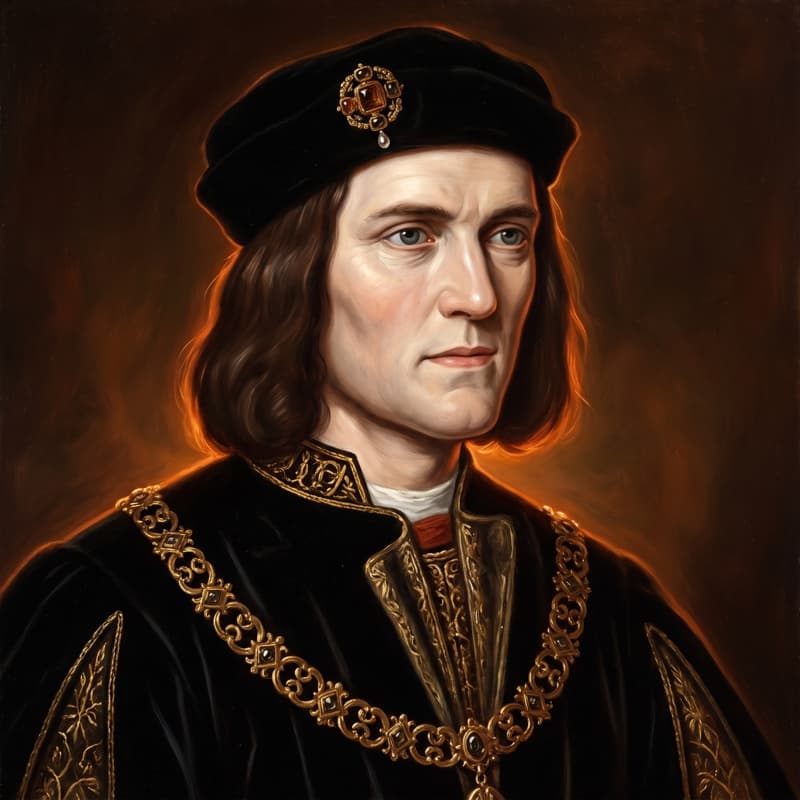
Richard III (October 2, 1452 – August 22, 1485) was king of England from 1483 until his death, the last king of the House of York and the last English monarch to die in battle. Born the youngest surviving son of Richard, Duke of York, and Cecily Neville (The National Archives), he governed the north of England for his brother Edward IV for over a decade before seizing the crown himself during the 1483 succession crisis, ruled for barely two years, and died fighting Henry Tudor at Bosworth. This biography states only what the documentary record supports, with a citation for each claim.
Birth, family, and the making of a northern lord
Richard was born on October 2, 1452, at Fotheringhay Castle in Northamptonshire, the youngest surviving son of Richard, Duke of York, and Cecily Neville. He became Duke of Gloucester in October 1461, after his brother Edward IV took the throne, and went on to acquire vast estates in the north of England, becoming the dominant regional figure there through marriage and alliance (The National Archives). On June 29, 1471, he received a grant of the castles, manors, and lordships of Middleham and Sheriff Hutton in Yorkshire and Penrith in Cumberland (University of York, Richard III: Rumour and Reality), having already fought, at eighteen, in the 1471 campaigns that restored Edward IV to the throne, including Barnet and Tewkesbury (The National Archives). In 1482 he led the English campaign that recovered Berwick-upon-Tweed from Scotland (The National Archives).
The 1483 crisis
Edward IV died in April 1483, and Richard, named Protector for the young Edward V, moved quickly to secure his position: he acted against the Woodville faction — the family of Edward IV's queen — and had Lord Hastings executed on June 13 after arresting him at a council meeting (The National Archives). The strain of those weeks survives in his own hand. A surviving letter to Sir William Stonor is, in the National Archives' words, "full of urgent news and concern for the way things had turned," reporting "much trouble and doubt" (The National Archives). Appealing to the city of York for armed support around the same time, Richard warned of the Woodvilles' "final destruction and disinheriting of you and all other inheritors," a passage preserved in multiple independent transcriptions of the June 1483 letter (Wikiquote, citing Paul Murray Kendall's Richard the Third, 1955). Parliament then settled the crown on Richard through Titulus Regius, declaring him "the true and undoubted king of this realm of England" on the grounds that Edward IV's marriage was invalid and his children therefore illegitimate (Richard III Society). He was crowned Richard III, with Anne Neville crowned queen, at Westminster Abbey on Sunday, July 6, 1483, by Thomas Bourchier, Archbishop of Canterbury (Westminster Abbey).
A reign of two years — and one Parliament
Richard's only Parliament, meeting in January 1484, passed legislation still cited as his most durable achievement: it extended bail so justices of the peace could grant it before trial and abolished the forced levies known as "benevolences," declaring that subjects "shall in no way be burdened by any such charge, exaction, or imposition called a benevolence" (Richard III Society). The same Parliament was the first whose statutes were recorded entirely in English (Richard III Society). Against that record sits the era's darkest open question: after being lodged in the Tower of London in 1483, Edward V and his younger brother disappeared from public view, and their fate is still unresolved. The National Archives states "crucial new evidence" would be needed to settle it, while the Richard III Society disputes that Richard's guilt has been proven (The National Archives; Richard III Society).
Loss, then Bosworth
Richard's personal losses compounded his political ones: his son Edward died in 1484, and his wife Anne Neville died in March 1485, leaving him without an heir as Henry Tudor prepared an invasion from exile. The armies met at Bosworth Field on August 22, 1485. Richard was unhorsed and, refusing to flee, was killed "fighting in the thickest press of his foes" — the last English king to die in battle (Bosworth Battlefield Heritage Centre). The city he had governed for over a decade recorded its grief the next day: York's civic minute of August 23, 1485, states that "King Richard late mercifully reigning upon us...was pitiously slane and murdred to the grete hevynesse of this citie" (University of York, Richard III: Rumour and Reality).
What this biography deliberately does not claim
That Shakespeare's Richard is a source for the historical one. The opening line most people know Richard by — "Now is the winter of our discontent" — belongs to a play written roughly a century after his death, spoken by a dramatic character, not the king's own words (Folger Shakespeare Library); see the quotes page for the full misattribution record.
That the Princes in the Tower question is solved. Both The National Archives and the Richard III Society treat Richard's responsibility as unresolved, not a settled verdict, and this biography follows that framing rather than asserting guilt or innocence (The National Archives; Richard III Society).
That his final resting place was always known. Richard's body was buried at Leicester's Grey Friars friary and lost for over five centuries until an August 2012 excavation, led by the University of Leicester with the Richard III Society and Leicester City Council, identified his remains on February 4, 2013 (University of Leicester); that story belongs to his death page, not this one.
The unfinished reign
A sourced biography of Richard III has to end on a genuine gap. Two years is a short reign to judge — long enough to produce a Parliament's worth of durable legal reform, not long enough to settle what happened to two boys in the Tower or what kind of king he might have become with more time. The documents show a capable, hard-pressed ruler who took the crown through a legally dressed but violently contested process; they do not show a verdict on his conscience.
Related pages
Richard III hub · his death at Bosworth · verified quotes · fact file.
Where the documents stop, the questions start — and this site hosts a conversational AI recreation of Richard III, built on the record cited above and labeled as exactly that. What the record can't answer directly — how the protectorship crisis felt from the inside, what he made of Titulus Regius as a legal argument for his own crown, whether he believed his own account of the Woodvilles — are fair questions to put to him directly.