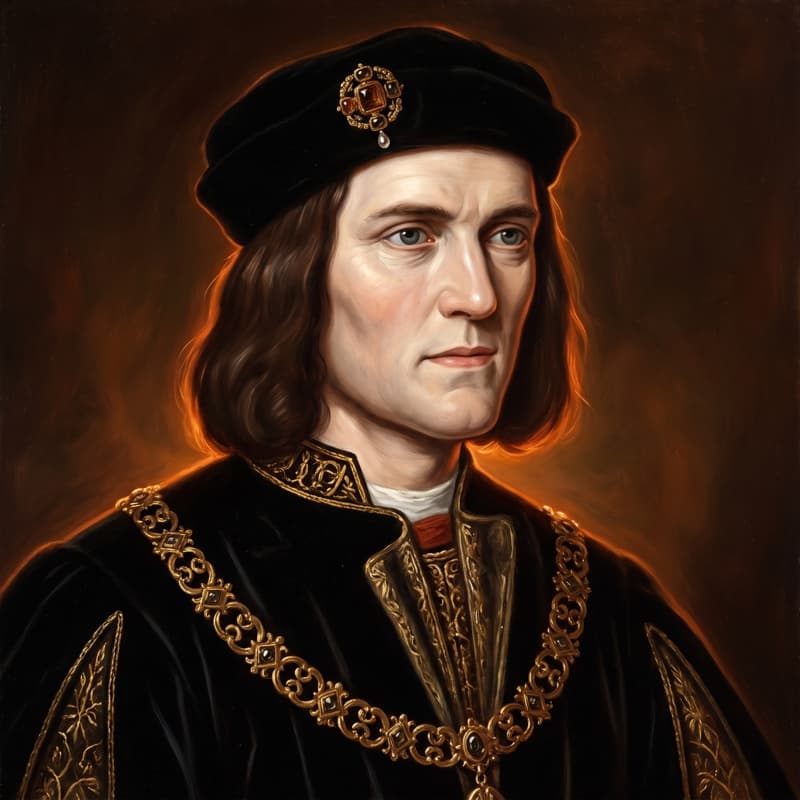
The essential Richard III facts: born October 2, 1452, at Fotheringhay Castle, youngest surviving son of Richard, Duke of York, and Cecily Neville; crowned king July 6, 1483; his one Parliament, January 1484, passed genuinely progressive law; killed at Bosworth Field August 22, 1485, the last English king to die in combat; and his remains identified beneath a Leicester car park in 2013, reinterred at Leicester Cathedral in 2015. All verified. This page flags the popular "facts" that don't survive checking, too — starting with nearly every line the public thinks Richard actually said.
The core facts, with why they matter
A soldier and northern lord before he was a king. Made Duke of Gloucester in 1461 when his brother became Edward IV, Richard fought at Barnet and Tewkesbury in 1471, at eighteen. That same year he received Middleham, Sheriff Hutton, and Penrith — his northern base — and in 1482 led the campaign that recovered Berwick-upon-Tweed from Scotland.
Protector, then king, in 1483. When Edward IV died in April 1483, Richard became Lord Protector for the boy king Edward V — and within weeks was crowned Richard III alongside Anne Neville at Westminster Abbey on July 6, 1483.
His only Parliament, January 1484, was a genuine legal reformer. It extended bail before trial, barred seizing an accused person's property before conviction, required jurors to hold real property to curb bribery, and outlawed forced "benevolences." Its statutes were also the first recorded entirely in English rather than French or Latin.
Titulus Regius, not a personal quote, settled his claim to the crown. The 1484 act named Richard "the true and undoubted king of this realm," resting the claim on Edward IV's prior precontract to Eleanor Butler, which made Edward's children illegitimate. Henry VII later had it repealed unread — it speaks for Richard's government, not his own words.
The Princes in the Tower remain an unresolved question, not a solved case. Edward V and his younger brother disappeared from view after being lodged in the Tower in 1483. The National Archives says resolving their fate would need crucial new evidence; treat any flat claim of Richard's guilt — or innocence — as advocacy, not verdict.
Killed at Bosworth, August 22, 1485. Richard died fighting rather than fleeing, the last English king to fall in battle. His own city, York, recorded its grief the next day: he was "pitiously slane and murdred to the grete hevynesse of this citie."
Found under a car park, identified beyond reasonable doubt. A targeted 2012 excavation at the former Grey Friars site in Leicester located a skeleton; DNA, genealogy, and skeletal analysis identified it as Richard's in February 2013 — severe scoliosis, battle wounds, no withered arm. Reinterred at Leicester Cathedral, March 26, 2015.
Popular "facts" that need correcting
"Now is the winter of our discontent" and "I am determined to prove a villain." Shakespeare's character speaking in Act 1, written roughly a century after Richard's death — not the historical king's words.
"A horse! A horse! My kingdom for a horse!" Invented for the Bosworth scene in Shakespeare's Richard III; no record has Richard saying anything like it.
"Off with his head! So much for Buckingham." Not even Shakespeare's line — actor Colley Cibber wrote it for his 1699 adaptation, later absorbed into modern performances, including Olivier's film.
"Shakespeare's hunchback" as medical fact. The 2012–14 skeletal study confirmed scoliosis, a sideways spinal curve — not a hunchback, and no withered arm.
Five things Richard III did
- Fought at Barnet and Tewkesbury in 1471, then governed the north from Middleham.
- Led the 1482 campaign that recovered Berwick from Scotland.
- Was crowned king at Westminster Abbey, July 6, 1483.
- Passed reforming bail, jury, and anti-benevolence laws through his only Parliament.
- Died fighting at Bosworth Field, August 22, 1485.
The fact pages can't hold him
Facts are the skeleton; the voice is the man. Our Richard — an AI recreation, labeled as what it is — can walk you through the protectorship crisis and the eve of Bosworth. Ask him about Titulus Regius, or the boys he never publicly accounted for.
More in this cluster: Richard III hub · his death · verified quotes · biography.