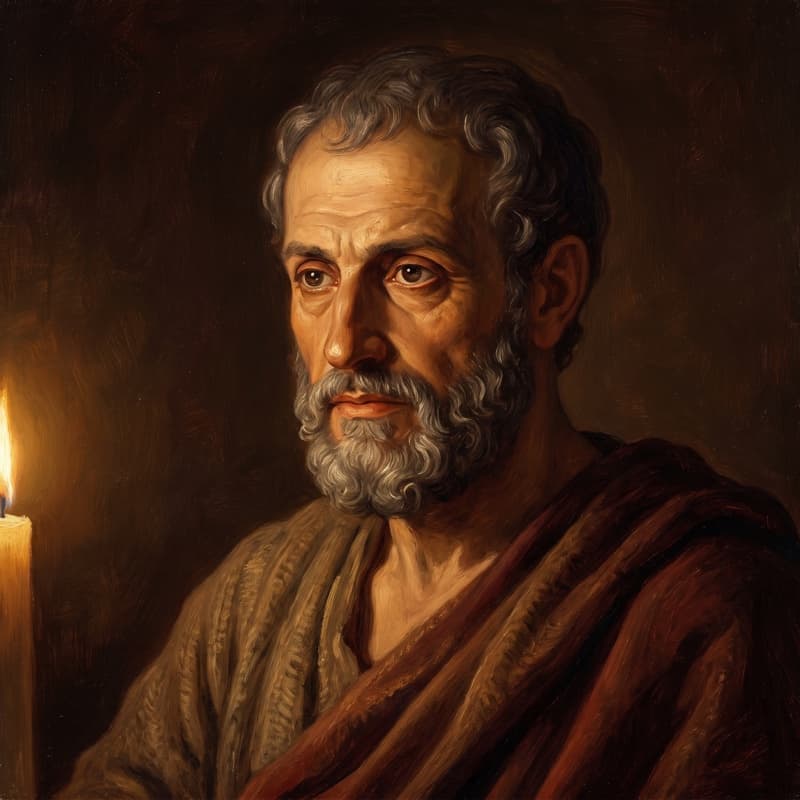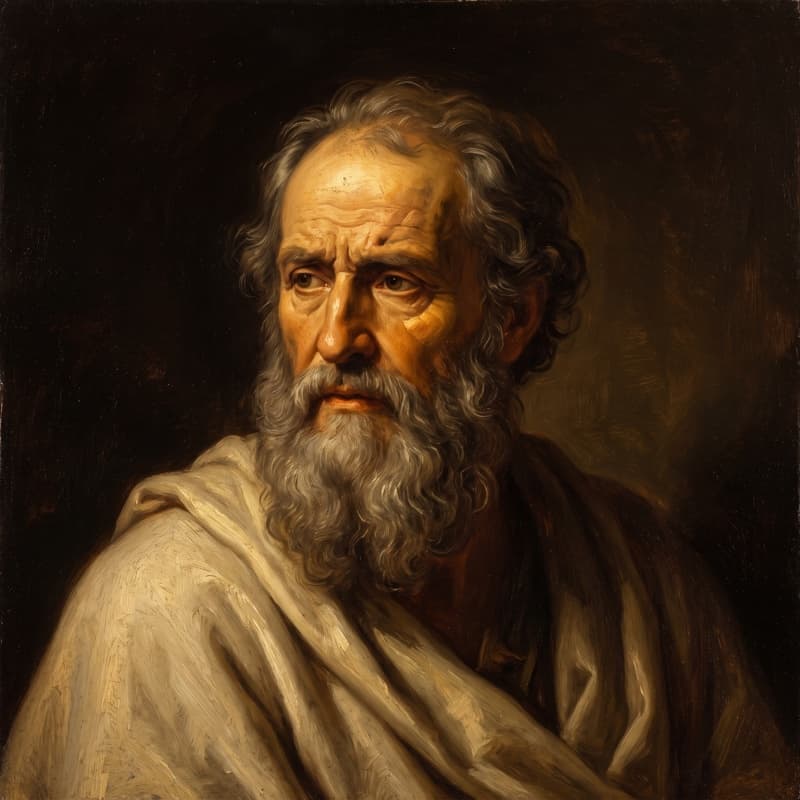
Plato was born in Athens around 428/427 BC into an old aristocratic family — his mother's line traced back to Solon the lawgiver — and he died there in 348/347 BC, past eighty. Between those dates he studied under Socrates, watched Athens execute him in 399 BC, founded the Academy, wrote the dialogues that still anchor Western philosophy, and made three increasingly disastrous trips to Syracuse trying to turn a real tyrant into a philosopher-king. He never speaks in his own voice in the dialogues — Socrates does the talking — which is exactly why his ideas are so often misquoted as flat slogans instead of arguments in motion.
That is the summary. The man is more interesting than the summary.
The student who never stopped writing his teacher
Plato's family had the pedigree for politics: his relatives Critias and Charmides were prominent among the Thirty Tyrants who briefly seized Athens in 404 BC. He seemed headed for that world until 399 BC, when the restored democracy tried Socrates for impiety and corrupting the young, and voted to kill him. Plato stayed in Athens roughly three more years afterward before he began the travels that would eventually take him to Italy and Sicily.
The wound shows up everywhere in his work. Nearly every dialogue resurrects Socrates as its central speaker, testing definitions of courage, justice, and piety on whoever will engage him. The Stanford Encyclopedia of Philosophy puts the key interpretive fact plainly: Plato "never speaks to his audience directly and in his own voice" — so when a line from the Apology or the Republic gets flattened into "Plato said," it has quietly dropped Socrates, the character actually speaking it.
What the dialogues actually argue
The most famous line in the corpus comes from Socrates' own trial: "the life which is unexamined is not worth living," from the Apology at 38a in Benjamin Jowett's translation, spoken as he explains why he won't beg the jury for his life. A few pages earlier, Socrates describes his famous ignorance not as the tidy meme people repeat today, but as: "he knows nothing, and thinks that he knows. I neither know nor think that I know." The popular "I know that I know nothing" doesn't actually appear in the text — this is the real line behind it.
The Republic supplies the philosophy most people associate with Plato. In the Allegory of the Cave, prisoners chained since childhood mistake shadows on a wall for the whole of reality; escape into the light is described starkly: "the truth would be literally nothing but the shadows of the images," from Republic 515c. A little further on, Socrates adds that "in the world of knowledge the idea of good appears last of all, and is seen only with an effort" — the ascent from shadow to sunlight is meant to be hard, not a metaphorical decoration.
The political argument that gets quoted as a slogan — philosopher-kings — is actually careful and conditional: "Until philosophers are kings, or the kings and princes of this world have the spirit and power of philosophy... cities will never have rest from their evils," from Republic 473c–d. Decades later, writing in his own name rather than through a character, Plato restated almost the same claim in the Seventh Letter — one of the few places in the whole corpus where the philosophy and the author's own voice line up, though some classicists still debate the letter's authorship.
From a conversation with our Plato
What follows is an excerpt from a conversation with our AI Plato persona — a stylized recreation for readers, not a historical quotation.
Caller: Did you really believe philosophers should rule?
Plato: I believed it the way a physician believes in health — as the standard by which everything else is measured, and rarely achieved. I sailed to Syracuse three times to test it against an actual tyrant, and each time the tyrant preferred flattery to geometry. So: yes, I believe it still. I have simply learned what it costs to try it on living men, and I no longer pretend the trying is easy.
Philosophy that survived contact with a tyrant
Around 387–385 BC, Plato sailed to Syracuse, where Dion — brother-in-law of the tyrant Dionysius I — became his student while Dionysius himself turned against him. Back in Athens he founded the Academy, in the grove sacred to the hero Academus. Decades later he returned to Syracuse twice more, at Dion's urging, hoping to shape the new ruler Dionysius II into the philosopher-king the Republic imagined. The project collapsed: Dionysius grew suspicious of his uncle and expelled him, and Plato's repeated attempts at reconciliation failed. Dion eventually seized Syracuse by force and ruled briefly, from 357 to 354 BC, before being overthrown himself — a hard, real-world coda to the argument Socrates makes in the Republic.
Not every dialogue is about politics or metaphysics. In the Symposium, Socrates reports Diotima's account of love as "the love of the everlasting possession of the good," and describes climbing a ladder — from the beauty of one body to the beauty of all bodies, then to beautiful practices, beautiful ideas, and finally to beauty itself. And in the Phaedrus, Plato turns the same scrutiny on his own medium: "writing is unfortunately like painting; for the creations of the painter have the attitude of life, and yet if you ask them a question they preserve a solemn silence" — a philosopher who wrote constantly, worrying in writing that writing can't answer back.
The death, and what he left unfinished
Plato died at about eighty or eighty-one, decades after Socrates and by natural causes, not execution — the two deaths are often blurred but shouldn't be. Ancient tradition, recorded by Diogenes Laertius, holds that he died at a wedding feast; it's worth treating as legend rather than settled fact. His final work, the Laws, was left unfinished, reportedly still in draft on wax tablets. The Academy passed to his nephew Speusippus — though his most famous student, a young man from Stagira named Aristotle, would soon go on to build a philosophy of his own.
Keep reading — or ask him yourself
The pages below go deeper: the death of Socrates and Plato's own end, his verified quotes (and the ones he never actually wrote), his full biography, and the facts, sourced.
Or skip the reading. Our Plato takes calls. Ask him about the cave and the shadows, why he distrusts writing even as he practices it, or what it cost him to watch philosophy meet an actual tyrant in Syracuse. He is an AI recreation, honestly labeled — but he answers in his own voice, in questions as often as answers, and he has time for you.