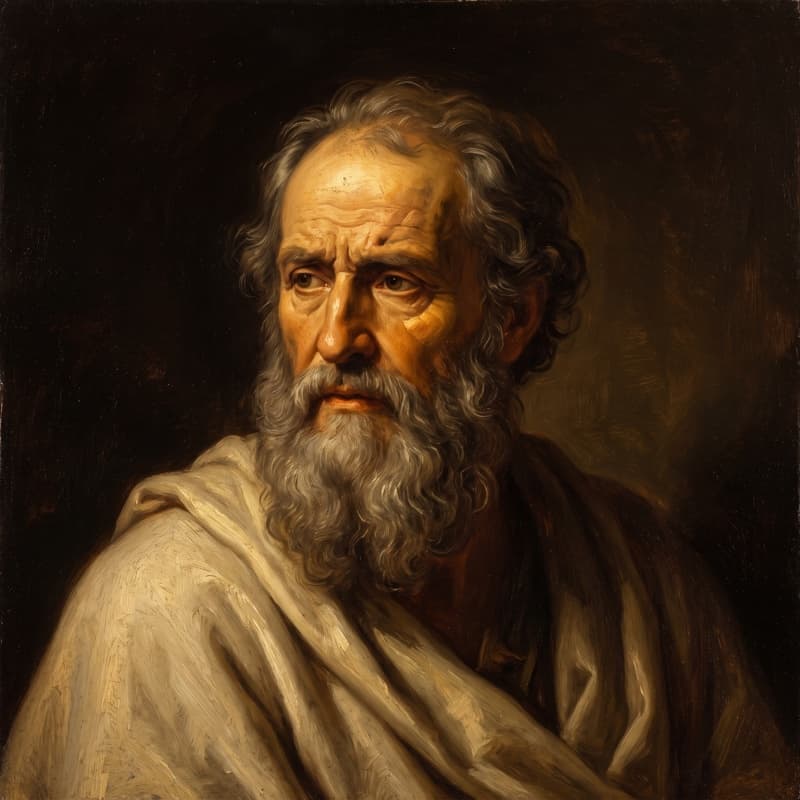
Plato died in Athens around 348 or 347 BC, at roughly eighty or eighty-one years old. He was not executed, and he was not young. That fate belonged to his teacher, Socrates, tried and put to death in 399 BC — more than fifty years before Plato's own death, in a different generation of Athenian politics entirely. Plato outlived him by decades, kept teaching at the Academy he had founded, and died there, old, among his students.
That distinction is worth making plainly, because the two deaths get run together. Here is what ancient sources actually say about each.
Not Socrates' death — a much later one
Socrates died by hemlock, condemned by an Athenian jury; Plato later dramatized the reasoning behind that choice in dialogues like the Crito, where Socrates explains why he will not simply escape prison: "Then we ought not to retaliate or render evil for evil to anyone, whatever evil we may have suffered from him." It's Socrates' argument, in the dialogue's voice, not Plato's autobiographical statement — but it's the ethical case Plato built for accepting a sentence rather than fleeing it. Plato's own death, half a century later, involved no trial and no verdict. He simply grew old.
The wedding-feast tradition
The ancient biographer Diogenes Laertius, writing centuries after the fact and drawing on an earlier source named Hermippus, records a specific and often-repeated story: that Plato died at a wedding feast, in his eighty-first year. The same account preserves a commemorative epitaph describing his death as a passage "from a wedding banquet... to that city which he had founded for himself" — a poetic way of saying he went from a celebration of new life straight into whatever came after. Treat this as ancient legend rather than settled fact. Diogenes Laertius is our source for a great deal of what gets repeated about Greek philosophers' lives, and he is not always reliable; the wedding-feast detail is the kind of vivid, tidy story that ancient biography liked to attach to a great man's end, whether or not anyone present wrote it down at the time.
A book left in draft
What is better documented is that Plato's last work, the Laws, was unfinished when he died. Diogenes Laertius reports it survived only in draft form, "written on wax tablets" — the ordinary scratch medium of the ancient world, not a finished manuscript ready for copying, and a genuinely textured detail about how the dialogue actually reached readers at all.
From a conversation with our Plato
An excerpt from a conversation with our AI Plato persona — a stylized recreation, honestly labeled; not a historical quotation. Our Plato's knowledge does not extend past his own life.
Caller: Does it bother you that your last book was never finished?
Plato: Bother is a strange word for it. Socrates spent his life arguing that the soul's real business is elsewhere, and I have had a great deal of time to test whether I believed him. A book is a solemn silence on a page, as I have said before — mine simply stopped a little earlier than most. I would rather leave an argument in wax, half-carved, than never have begun the carving.
What came after
Plato's own philosophical work as founder didn't end with his death. Ancient tradition holds that his nephew, Speusippus, took over leadership of the Academy — keeping the school he'd built running under family hands, even as the Syracuse experiment in philosopher-kings had already collapsed for good decades earlier. Socrates' death had launched Plato into fifty more years of writing and teaching. Plato's own death, quiet and old-aged by comparison, simply closed the door he'd been holding open that whole time.
More in this cluster: Plato's verified quotes · his biography · fact file · back to the Plato hub.