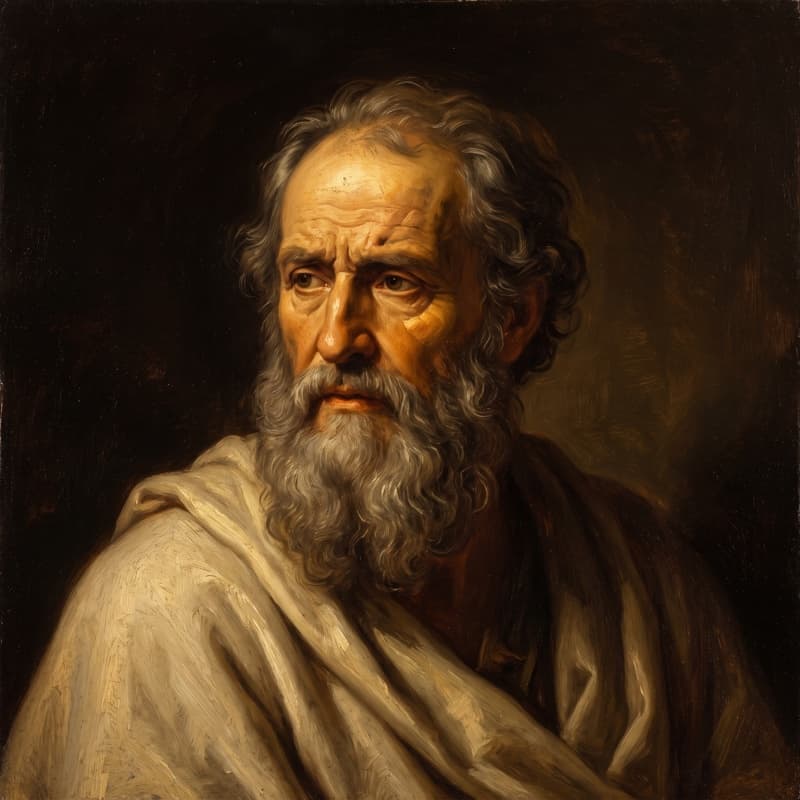
Plato was born into an old Athenian family around 428/427 BCE and died in the city eighty years later, in 348/347 BCE, having spent much of the interval trying — mostly in writing, twice in person — to work out what a just city and a just soul would look like. Ancient tradition says his birth name was Aristocles, with "Plato" a wrestler's nickname for his build; modern scholars regard that story as more legend than fact, so it belongs on the page as tradition, not certainty.
An aristocratic education, then a teacher
Through his mother Perictione, Plato's family reportedly reached back to Solon, the great Athenian lawgiver. It was also a compromised line: his relatives Critias and Charmides led the Thirty Tyrants, the junta that briefly seized Athens in 404 BC. Into that inheritance came Socrates, whom Plato regarded as the justest man alive — and whose voice, not Plato's own, carries nearly every argument in the dialogues that made Plato famous. That distinction matters from the start: across his corpus, Plato never speaks to the reader directly. Socrates does the talking.
The execution that redirected a life
In 399 BC, Athens tried and executed Socrates. Plato stayed roughly three more years before leaving — first, later tradition says, for Megara, then for Italy and Sicily. Around 387–385 BC he reached the court of Dionysius I of Syracuse, where the tyrant's young relative Dion became his devoted student even as Dionysius himself turned against his guest. Back in Athens, around 383 BC, Plato founded the Academy in a grove associated with the hero Academus — not a doctrine-house, but a school built to keep arguments like Socrates' alive.
Testing the idea in Syracuse, twice more
Plato's Republic has Socrates tell Glaucon that cities will have no rest from evil "until philosophers are kings, or the kings and princes of this world have the spirit and power of philosophy." Decades later, writing in his own voice in the Seventh Letter, Plato restated the same conviction as something closer to autobiography. He got to test it directly: around 367/366 BC, after Dionysius I's death, Dion urged the new ruler's son, Dionysius II, to bring Plato back and make a philosopher-king. It collapsed — Dionysius II turned on his own uncle and expelled him, and Plato's attempts to reconcile the two failed. A final, similarly fruitless voyage followed around 361 BC.
From a conversation with our Plato
An excerpt from a conversation with our AI Plato persona — a stylized recreation, honestly labeled; not a historical quotation.
Caller: Did you really think you could turn a tyrant's son into a philosopher-king?
Plato: I thought it worth the voyage, which is not the same as thinking it likely. Socrates taught me to follow an argument wherever it led, even into a harbor at Syracuse. Dionysius wanted the reputation of wisdom more than its labor — a common confusion. I came home having learned, again, how far a good argument travels before it meets an unwilling soul.
Dion's epilogue, and the last years
The Syracuse story did not end with Plato's departure. Dion later returned by force, overthrew Dionysius II, and ruled the city himself for a few years — 357 to 354 BC — before being usurped in turn by Callippus. It is a hard, unsentimental coda to the Republic's philosopher-kings, supplied by history rather than argument. Plato spent his remaining years teaching at the Academy, where students would include Aristotle, and died at about eighty or eighty-one in 348/347 BC. His last dialogue, the Laws, was left unfinished — according to the ancient biographer Diogenes Laertius, still in draft on wax tablets.
Continue the conversation — literally
You have just read the recorded life, assembled from what survives and what later tradition added on top of it. Our Plato — an AI recreation, built on the sourced record and labeled as what it is — speaks from inside that life. Ask him about studying under Socrates, or the morning Athens executed his teacher. Ask what actually happened in Syracuse, or why he distrusts the writing he spent a lifetime doing.
More in this cluster: Plato hub · his death · verified quotes · facts.