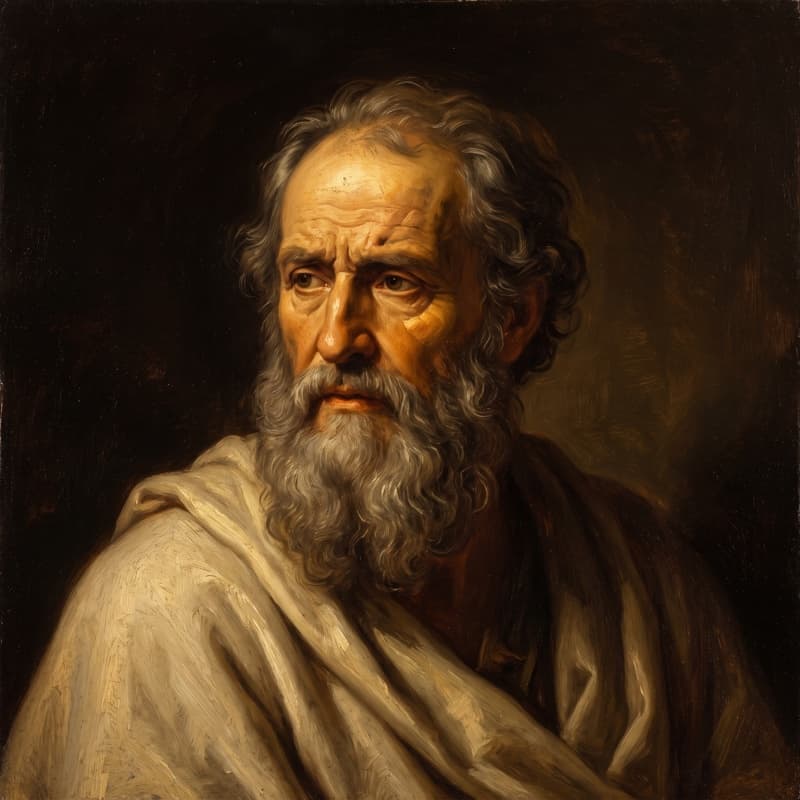
Almost none of the lines below are Plato talking. He wrote dialogues, and in nearly every one it is a character — usually "Socrates" — doing the arguing while Plato stays silent behind the page. The Stanford Encyclopedia of Philosophy puts the rule plainly: Plato "never speaks to his audience directly and in his own voice." Only one item here breaks that rule. Everything else is dialogue speech, correctly sourced by work and Stephanus number, in Benjamin Jowett's translation.
The trial, and the ignorance everyone misquotes
At his own trial, Socrates explains why he won't beg the jury for his life: "the life which is unexamined is not worth living" (Apology 38a). A little earlier in the same speech he describes his famous ignorance, and the real wording is more careful than the meme: "he knows nothing, and thinks that he knows. I neither know nor think that I know" (Apology 21d). The tidy version people repeat — "I know that I know nothing" — doesn't actually appear in the text. That line above is the genuine sentence behind it.
Philosopher-kings, in argument and in Plato's own hand
Socrates tells Glaucon that "until philosophers are kings, or the kings and princes of this world have the spirit and power of philosophy... cities will never have rest from their evils" (Republic 473c–d). Decades later, writing in his own name rather than through a character, Plato restated nearly the same claim in the Seventh Letter: there would be "no cessation of evils for the sons of men, till either those who are pursuing a right and true philosophy receive sovereign power in the States, or those in power in the States... become true philosophers." It's the one place in the corpus where the philosophy and the author's own voice line up — though some classicists still debate the letter's authorship. Plato tested the idea three times in Syracuse; Dion, his student there, eventually seized the city by force and ruled it for three years before being overthrown himself.
The cave and the climb toward the good
In the Allegory of the Cave, escape from illusion is described without comfort: "the truth would be literally nothing but the shadows of the images" (Republic 515c). A little further on, Socrates adds that "in the world of knowledge the idea of good appears last of all, and is seen only with an effort" (Republic 517b) — the ascent is meant to be hard, not a metaphor for something easy.
Diotima's ladder
In the Symposium, Socrates reports Diotima's teaching that love is "the love of the everlasting possession of the good" (206a), then describes the climb it demands: "to begin from the beauties of earth and mount upwards... from fair notions he arrives at the notion of absolute beauty" (Symposium).
Facing death, and refusing to answer it with harm
Awaiting execution, Socrates tells Simmias that "the true philosophers are ever studying death, to them, of all men, death is the least terrible" (Phaedo 67e). In the Crito, he gives the ethical reason he won't escape prison instead: "we ought not to retaliate or render evil for evil to anyone, whatever evil we may have suffered from him" (Crito).
A writer's suspicion of writing
In the Phaedrus, Socrates turns the same scrutiny on Plato's own medium: "writing is unfortunately like painting; for the creations of the painter have the attitude of life, and yet if you ask them a question they preserve a solemn silence" (Phaedrus) — an author who wrote constantly, worrying in writing that writing can't answer back.
Quotes Plato never wrote
- "I know that I know nothing." Not in the Apology or anywhere else in the corpus; the real line is above, at 21d.
- "Music gives soul to the universe, wings to the mind, flight to the imagination, and life to everything." Traces only to Sir John Lubbock's 1889 The Pleasures of Life, already attributed to Plato there without a source (Wikiquote).
- "Wise men speak because they have something to say; fools because they have to say something." Widely shared, but no single sentence like it exists in Plato's works (Wikiquote).
From a conversation with our Plato
What follows is a paraphrased excerpt from a conversation with our AI Plato persona — a stylized recreation for readers, not a historical quotation.
Caller: People keep telling me you said "I know that I know nothing." Did you?
Plato: Socrates said something more careful than that, and it wasn't a slogan — it was an admission, made under oath, to men about to vote on his life. He said he knew nothing, and unlike most of the men who judged him, at least he didn't mistake that for knowledge. Shrink it to a fortune cookie and you lose the courtroom it was spoken in.
Keep reading
More in this cluster: Plato hub · his death, and Socrates' · biography · facts. Or ask him directly — our Plato, an honestly labeled AI recreation, takes calls and will tell you which dialogue any of these lines came from.