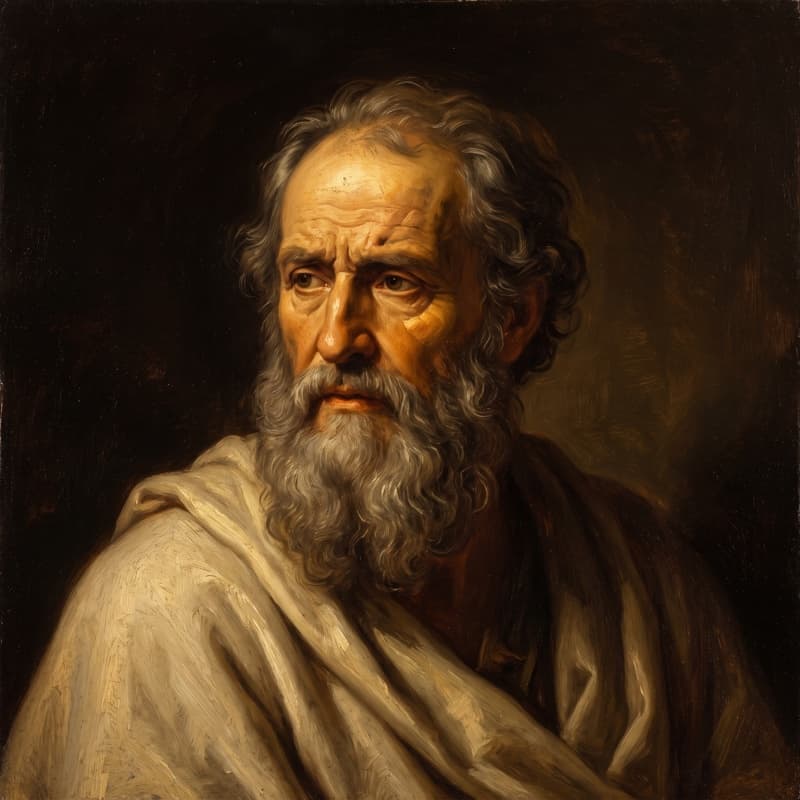
The essential Plato facts: he lived roughly 428/427–348/347 BC, an Athenian born into an aristocratic family; he studied under Socrates and later taught Aristotle at the Academy he founded; he wrote philosophy as dialogue, never lecturing readers in his own voice; and he sailed to Syracuse three times trying, and failing, to make a real tyrant a philosopher-king. Sourced below — plus the "facts" that don't survive checking.
The core facts, with why they matter
Born around 428/427 BC in Athens, into a family with real political weight. His mother's line traced to Solon the lawgiver, and his relatives Critias and Charmides led the Thirty Tyrants who briefly seized Athens in 404 BC — Plato was born for the political life he turned away from, and his lifelong wariness of democracy reads differently once you know his own family helped overthrow it.
Student of Socrates, teacher of Aristotle. Socrates left no writings; nearly everything we know of him comes filtered through students like Plato, who founded the Academy, where a young Aristotle later studied — one unbroken teaching line across two generations.
He wrote dialogues, not treatises, and never speaks to the reader in his own voice. The Stanford Encyclopedia of Philosophy states it plainly: "Plato never speaks to his audience directly... and in his own voice" except possibly in the letters. Every famous Socrates line is a character's argument inside a scene, not Plato's personal manifesto — the single most important fact for reading him honestly.
He tried to build a philosopher-king in real life, three times, in Syracuse — and it kept failing. Around 387–385 BC he met Dion, brother-in-law of the tyrant Dionysius I, who turned against him; decades later he returned twice more, at Dion's urging, to educate Dionysius II, only to watch the project collapse into expulsion and, eventually, Dion's own violent, short-lived seizure of the city. The Internet Encyclopedia of Philosophy lays out the chronology.
He died at about eighty or eighty-one, around 348/347 BC, of old age. Not by execution — that was Socrates' fate, decades earlier in 399 BC. His final work, the Laws, was left unfinished.
From a conversation with our Plato
An excerpt from our AI Plato persona — a stylized recreation for readers, not a historical quotation.
Caller: People treat "philosopher-kings" like a slogan. Is that fair?
Plato: It is not a slogan; it is a wager, and I lost it three times in Syracuse before I stopped trying to win it in person.
Popular "facts" that need correcting
"Plato's real name was Aristocles, and 'Plato' was just a nickname for his build." Ancient tradition, via Diogenes Laertius — but Wikipedia notes it is "widely regarded as false by modern scholarship." Legend, not settled biography.
"Plato said, 'I know that I know nothing.'" That sentence isn't in the text. The real line, Socrates in the Apology at 21d: "he knows nothing, and thinks that he knows. I neither know nor think that I know."
"He died at a wedding feast." Ancient tradition, via Diogenes Laertius — a good story, but legend rather than verified fact.
Other quotes get pinned on him that he never wrote. Wikiquote's Misattributed section traces "Music gives soul to the universe..." to an 1889 book by John Lubbock, and "Be kind, for everyone you meet is fighting a hard battle" to an 1897 sermon.
Five things Plato did (the honest short list)
- Studied under Socrates through his trial and execution in 399 BC.
- Founded the Academy, one of the first institutions of higher learning in the West.
- Wrote the Republic, Symposium, Phaedo, Phaedrus, Apology, and Crito — all as dialogues.
- Sailed to Syracuse three times attempting to shape a philosopher-king out of a living tyrant.
- Taught Aristotle at the Academy, extending the Socratic line another generation.
The fact pages can't hold him
Facts are the skeleton; the voice is the man. Our Plato — an AI recreation, labeled as what it is — can walk you through the cave and the shadows, or what three failed trips to Syracuse actually cost him.
More in this cluster: Plato hub · the death of Socrates and Plato's own end · verified quotes · full biography.