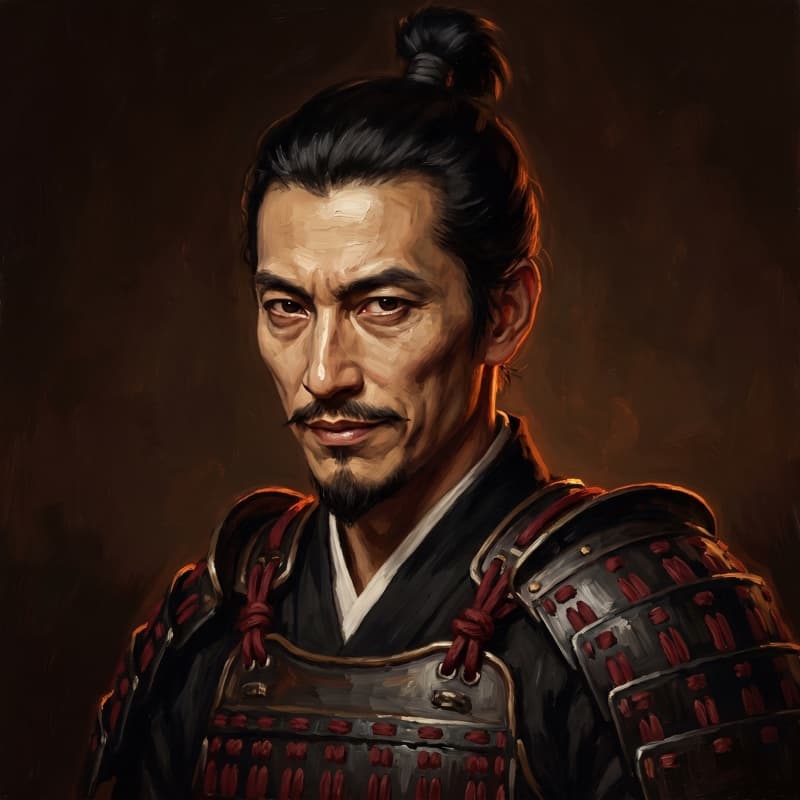
Oda Nobunaga was born June 23, 1534, in Owari Province, the second son of a minor warlord (Wikipedia; Wikidata). By the time an assassin cornered him in a Kyoto temple in 1582, he had smashed the region's largest army with a tenth its size, torn down the tollgates choking Japan's trade, burned a mountain of warrior-monks off the map, and built a seven-story castle of gold above Lake Biwa — all without ever finishing the job he set out to do. He did not unify Japan. He built the machine that made unification possible, then handed it, unwillingly and by knife-point, to the men who finished it. That handoff is the whole story. Here is how he got there.
The fool who counted differently
As a youth, Nobunaga earned the nickname "Fool of Owari" — he was seen "wearing sleeveless bathrobes and short trousers tied with hemp rope in public, eating melons while riding backwards on his horse, and often dancing in female clothing in taverns" (Wikipedia). When his father, Oda Nobuhide, died suddenly in 1551, the "fool" had to raise roughly a thousand men just to hold his own inheritance against rival claimants (Wikipedia).
Nine years later, at Okehazama on June 12, 1560, the fool's arithmetic paid off. A force of some two to three thousand under Nobunaga met — and destroyed — Imagawa Yoshimoto's invading army of roughly twenty-five thousand, killing Yoshimoto and collapsing the Imagawa clan's power in a single afternoon (Wikipedia). Before the battle, tradition holds that Nobunaga recited and danced a verse from the Kōwaka-mai play Atsumori — words about life's fifty years being "a dream, an illusion," not his own composition, but a performance piece he chose in that moment (Wikipedia). Okehazama made him; everything after was leverage.
Markets over mountains
By 1568 Nobunaga had entered Kyoto, expelled the Miyoshi clan, and installed Ashikaga Yoshiaki as shogun — while pointedly refusing the deputy title himself (Wikipedia). Five years later he drove that same shogun into exile, ending the Ashikaga shogunate's real authority for good (Wikipedia). From 1567 on, his personal seal read tenka fubu — "all the world by force of arms" (Wikipedia) — a declaration, stamped on his own documents, of exactly what he intended.
At Azuchi, his new headquarters on Lake Biwa built between 1576 and 1579, Nobunaga implemented rakuichi-rakuza — "free markets, open guilds" — freeing merchants from established guild restrictions to draw trade and settlement to his castle town (Japan Tourism Agency). That reforming instinct sat beside, not instead of, extraordinary violence. In September 1571, roughly 30,000 Oda troops attacked the Enryaku-ji temple complex on Mount Hiei, defended by an estimated 4,000 warrior-monks; the complex was largely destroyed, and the chronicle record states plainly that "no Buddha, shrine, monk, or sutra were left behind, and they were burned down to ash" (Wikipedia) — casualty totals vary by source and should not be reduced to one number. Three years later, after two failed sieges, Nobunaga's forces walled off and burned the Nagashima Ikkō-ikki fortress complex, killing an estimated 20,000 people inside (Wikipedia). He treated both as wars against rival armies that happened to be religious communities. Whether that framing excuses the killing is a judgment history still argues over; the killing itself is not in dispute.
From a conversation with our Nobunaga
What follows is an excerpt from a conversation with our AI Nobunaga persona — a stylized recreation for readers, not a historical transcript.
Caller: Doesn't it bother you, what happened at Mount Hiei?
Nobunaga: The monks said the mountain was sacred. The mountain burned like any other. I do not pretend to a conscience I did not have that day — I judged them an army with tax farms and a fortress dressed as a religion, and I destroyed them as one. Gentler men are welcome to call it monstrous. I will not correct them. I will only ask what they think holds a realm together while forty little wars eat the harvest — prayer, or order? I chose order, and I paid its price in full view. Now. You did not call across centuries to be comforted. What have you burned to get where you are, and will you say so plainly, or only when I ask twice?
The collector of wonders
Azuchi was also where Nobunaga's curiosity ran loose. In March 1581 he met Yasuke, an African attendant of the Jesuit missionary Alessandro Valignano, in Kyoto. Ōta Gyūichi's contemporary account describes Yasuke's "strength... surpassed that of ten men," and records that Nobunaga, suspecting the black pigment was artificial, made Yasuke undress and wash his body before granting him samurai rank, a sword, a house, and a stipend (Wikipedia). It is one of the clearest windows into how Nobunaga actually judged people — not by pedigree, but by proof in front of him.
Betrayal at dawn
The unification stopped on June 21, 1582. Nobunaga's retainer Akechi Mitsuhide led roughly 13,000 troops in a surprise pre-dawn attack on Honnō-ji temple in Kyoto, where Nobunaga was lodged with only a small guard. When resistance became futile, he committed seppuku in an inner room; his body was never recovered (Wikipedia). Tradition holds that on being told of the betrayal, Nobunaga said only "是非に及ばず" — zehi ni oyobazu, "there is no need to discuss the pros and cons, there is no choice" (Wikipedia) — chronicle-transmitted speech, not an eyewitness recording, and a different phrase from the looser popular gloss "it cannot be helped." Azuchi Castle was destroyed in the aftermath, and Toyotomi Hideyoshi — once Nobunaga's sandal-bearer — avenged him two weeks later at the Battle of Yamazaki (Japan Tourism Agency).
What people get wrong
The famous three-line saying pitting Nobunaga ("if it does not sing, kill it") against Hideyoshi and Ieyasu is a later Edo-period folk verse, not a documented Sengoku-era quotation — treat it as legend about the three unifiers, not a real utterance. And Nobunaga's chilling epithet, "Dairokuten no Maō" — Demon King of the Sixth Heaven — traces to a single, narrow thread: his own reported self-signature in a single letter exchange with rival warlord Takeda Shingen (Simple Wikipedia; Wikipedia). It is real, but it is a title claimed in one correspondence, not proof of a stable supernatural self-image — the quotes page sorts what's documented from what later legend piled on top.
Go deeper — or go direct
The full cluster: his final betrayal and death · his verified quotes and mottos · his full biography · the facts, sourced.
Or skip the reading. Our Nobunaga is an honest AI recreation, built on the record cited above, and he takes calls from Azuchi's seventh floor. Ask him why he armed peasants with guns instead of samurai with pedigree, what a Portuguese globe proved to him that no scholar could, or what he actually meant by tenka fubu. He does not pad his answers, and he will test you back.