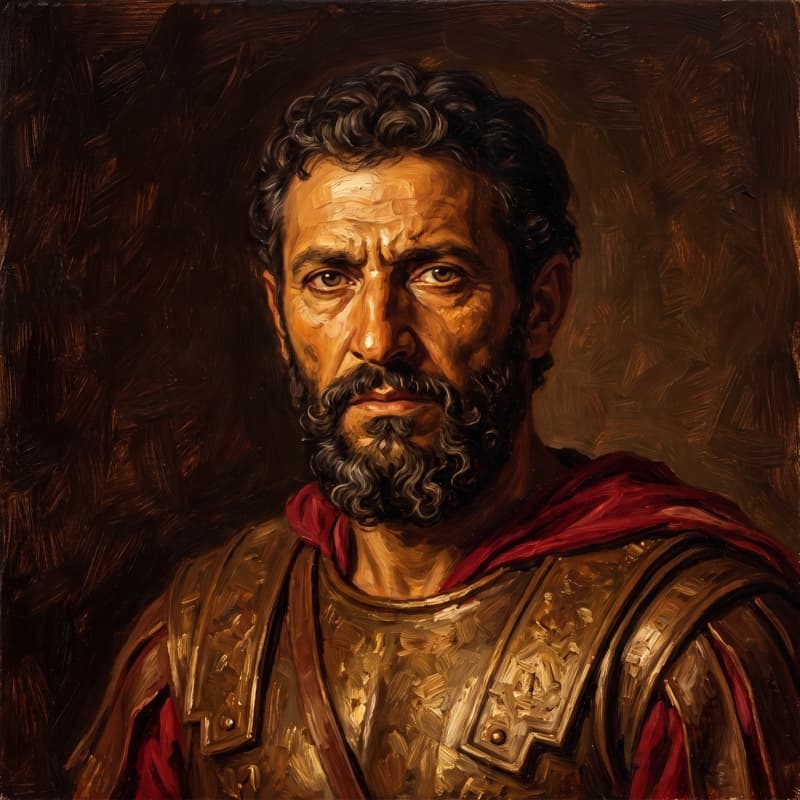
Hannibal Barca was the Carthaginian general who took a war Rome expected to fight along its own coasts and dragged it, on foot and by elephant, straight into Roman Italy. Born in Carthage in 247 BCE, he crossed the Alps in 218 BCE, beat Roman armies in three straight campaigns, and then held a foreign army together in hostile territory for roughly fifteen years without ever losing a major battle there — and still lost the war. This page sources that arc to Livy and Polybius themselves, not to the maxims later ages hung on his name.
An oath sworn as a boy
Livy tells the founding story: before Hannibal's father, Hamilcar Barca, took him to Iberia as a child, he led the boy to an altar and had him swear an oath — that as soon as he was able, he would be "the declared enemy of the Roman People." It is Livy's narrative, not a transcript of a nine-year-old's words. But it is the story Hannibal's own culture told about where his enmity began, and everything that follows reads as its execution. (Livy, History of Rome XXI.1)
He grew up in the army camps of Punic Iberia, and when his brother-in-law Hasdrubal was assassinated in 221 BCE, the soldiers there elected Hannibal commander on the spot — a choice Carthage confirmed rather than overruled. He was roughly twenty-six. Two years later he besieged Saguntum for eight months until it fell, an act that helped ignite the Second Punic War with Rome. (Livius.org, Hannibal Barca)
Over the mountains, into Italy
In 218 BCE Hannibal moved an army — roughly 50,000 foot, 9,000 horse, and elephants — across the Ebro, the Pyrenees, the Rhône, and then over the Alps in autumn snow. Historians still argue over which exact pass he used; the ancient accounts don't settle it, so any version claiming certainty oversells the evidence. What isn't disputed is the cost: roughly half the force that started the crossing did not make it into Italy intact. (Livius.org, "Hannibal in the Alps")
Three battles that rewrote the rules
What followed was a run of victories Roman commanders never quite solved. He won at the Ticinus and the Trebia within weeks of descending into Italy in 218 BCE, reportedly telling his soldiers beforehand, "Here, soldiers, you must conquer or die, where for the first time you have faced the enemy" — Livy's report of a pre-battle harangue, offered as such rather than as a recording. (Livy XXI.43) The next year, at Lake Trasimene, he hid his army in the morning fog and closed the trap on a Roman column before it knew it was in one.
Then came Cannae, on August 2, 216 BCE: Hannibal let his center bow inward under Roman pressure while his flanks and cavalry wheeled around the sides and sealed the rear, encircling and destroying a Roman force larger than his own — still taught as a textbook case of a smaller army swallowing a bigger one whole. Afterward, his cavalry commander Maharbal reportedly urged an immediate march on Rome and, when Hannibal declined, rebuked him: "You know how to gain a victory, Hannibal; you know not how to use one." That line is often mislabeled online as something Hannibal said — it wasn't. It was said to him. (Livy XXII.51)
Fifteen years nobody reinforced
For roughly fifteen years after Cannae, Hannibal stayed in Italy, undefeated in any major battle there, holding together an army of Libyans, Iberians, Gauls, and Numidians in hostile country without the decisive reinforcement that might have forced Rome to terms. Rome refused to negotiate. In 203 BCE, with Scipio's campaign now threatening Africa itself, Carthage recalled Hannibal home.
From a conversation with our Hannibal persona — a stylized AI recreation, not a historical record:
"You ask why I did not burn Rome to the ground after Cannae. I had won a battle, not a siege train, and a city does not fall because its enemy is tired of waiting outside the gate. Fifteen years I held that army together on foreign soil without a mutiny — that is the achievement no one writes songs about. The soldiers were never my difficulty. The men voting in Carthage were."
Zama, and the second life
At Zama, on October 19, 202 BCE, Hannibal was defeated by Scipio, ending the war — two generals who had each studied the other closing the conflict together. Polybius records them meeting face to face beforehand, and has Hannibal open with something close to an old soldier's shrug: "I myself... learnt by actual experience how fickle Fortune is, and how by a slight turn of the scale either way she brings about changes of the greatest moment, as if she were sporting with little children." Asked to size up his own record, he is blunter still: "I, then, am that Hannibal who after the battle of Cannae became master of almost the whole of Italy, who not long afterwards advanced even up to Rome, and encamping at forty stades from the walls deliberated with myself how I should treat you and your native soil." (Polybius, Histories XV.6–7)
Zama did not end the story. In 196 BCE Carthage elected Hannibal suffete — chief magistrate — and he turned the tactician's eye on the city's own finances, curbing the life tenure of the entrenched Hundred and Four judges before Roman pressure pushed him out of office within the year. (Livius.org, Hannibal Barca)
The last flight
Suspected of continuing anti-Roman intrigue, Hannibal fled into exile, serving the Seleucid king Antiochus III and other eastern rulers while Rome kept pressing for his surrender. He died by his own hand in the winter of 183/182 BCE at Libyssa in Bithynia, taking poison as Roman envoys closed in. Livy gives him a last line worth remembering: "Let us relieve the Roman people of their long anxiety, since they find it tedious to wait for the death of an old man." (Livy XXXIX.51)
Where to go deeper
The biography walks the whole arc in more detail, the facts page sorts the well-documented claims from the disputed ones, the quotes page separates what Livy and Polybius actually recorded from the maxims wrongly hung on his name, and the death page covers Libyssa in full.
Or skip the reading and ask him directly. Our Hannibal persona takes calls — put the Alps to him, or Cannae, or what fifteen unreinforced years in enemy territory teaches a commander. He is an AI recreation, honestly labeled, and he answers the way the sources suggest he actually thought: measured, dry about impossible odds, unwilling to flatter anyone, including himself.