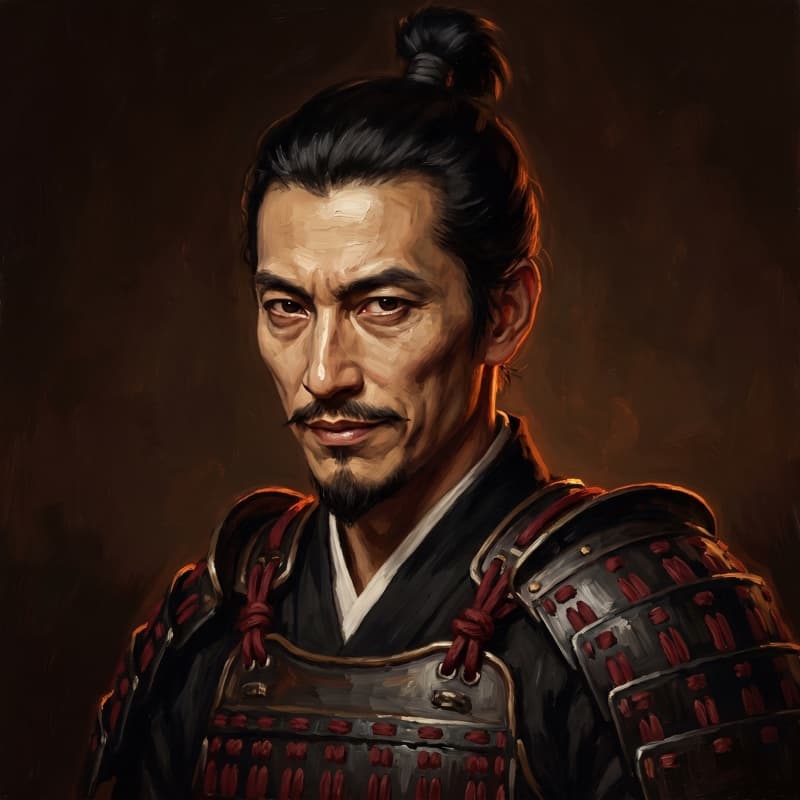
Oda Nobunaga died on June 21, 1582, in a surprise attack ordered by his own retainer, Akechi Mitsuhide, at Honnō-ji temple in Kyoto. Mitsuhide brought roughly 13,000 soldiers against a temple where Nobunaga had only about 150 men (Wikipedia, "Honnō-ji Incident"). When resistance became hopeless, Nobunaga withdrew to an inner room and committed seppuku as the temple burned; his body was never recovered from the ruins (Wikipedia, "Honnō-ji Incident").
That's the fact most searches want. The betrayal behind it, and the mystery it left, are worth the fuller telling.
Turned on from inside his own army
Nobunaga was passing through Kyoto lightly guarded, expecting to move west to reinforce his generals against the Mōri clan. Mitsuhide, one of his own senior commanders, had been ordered toward that same front — and turned his column back toward the capital instead. Wikipedia's account is blunt about the opening: Mitsuhide, "aware that Nobunaga was nearby and unprotected," took it (Wikipedia, "Oda Nobunaga"). No rival army, no reversal on a battlefield — the man who ended Nobunaga's unification campaign was a retainer trusted with troops.
"There is no need to discuss the pros and cons. There is no choice."
The chronicle tradition — recorded in Ōta Gyūichi's Shinchō Kōki — has Nobunaga answer the news of the attack with this line, rendered from the Japanese zehi ni oyobazu (Wikipedia, "Honnō-ji Incident"). Treat it as chronicle-reported speech, not a transcript taken at his side. A shorter, looser gloss — "it cannot be helped" — circulates for the same moment, but it's a different, freer translation; don't treat the two as interchangeable exact wordings.
Seppuku, and a body that was never found
Nobunaga fought back with bow, arrow, and spear before the position became untenable, then retreated to the temple's inner room and took his own life rather than be captured (Wikipedia, "Honnō-ji Incident"). The fire that followed meant Mitsuhide could never produce a body to prove the kill — a real problem for a man claiming Nobunaga's territory by right of conquest. Four months later, Hideyoshi held a funeral using a life-size wooden effigy and cremated ashes in Nobunaga's place (Wikipedia, "Honnō-ji Incident"). An unfinished unifier with no recovered remains is exactly the gap legend rushes to fill; treat confident modern accounts of his final moments beyond this as embellishment on a chronicle base, not new evidence.
From a conversation with our Oda Nobunaga
An excerpt from a conversation with our AI Nobunaga persona — a stylized recreation, clearly labeled, not a historical recording. His knowledge ends before that temple in Kyoto.
Caller: Did you see Akechi Mitsuhide's betrayal coming?
Nobunaga: No. I learned of it the way a commander learns the worst news — by the sound of the wrong army outside the wrong walls. I had sent that man west with my trust and too few questions behind it. Tenka fubu was my intention for the gates still ahead of me; the one behind me, in my own capital, I did not think to lock. That failure is mine to carry, whatever conclusion this story reached.
Azuchi burned, and an answer that took two weeks
Nobunaga's own knowledge stops at Honnō-ji, but the record continues without him. Azuchi, the castle and commercial center he had built on Lake Biwa, was destroyed in the aftermath (Japan Tourism Agency, "Omi Merchants"). Mitsuhide's claim on his territory did not last: Hideyoshi turned his army around and defeated him soon after, at Yamazaki, roughly two weeks later (Wikipedia, "Oda Nobunaga").
Why did Mitsuhide turn on him?
Historians have never settled it. Wikipedia's summary notes "no definitive conclusion has been reached" and "more than 50 theories have been proposed" (Wikipedia, "Honnō-ji Incident"). Candidates range from personal grievance over territory and treatment — a version historian Tetsuo Owada considers unreliable — to a plan to restore the Ashikaga shogunate, to the currently best-supported reading: that Mitsuhide moved to protect his ally Chōsokabe Motochika from Nobunaga's planned invasion of Shikoku. None has closed the question; the honest answer stays open.
More in this cluster: Nobunaga's verified quotes · his biography · fact file · back to the Nobunaga hub.