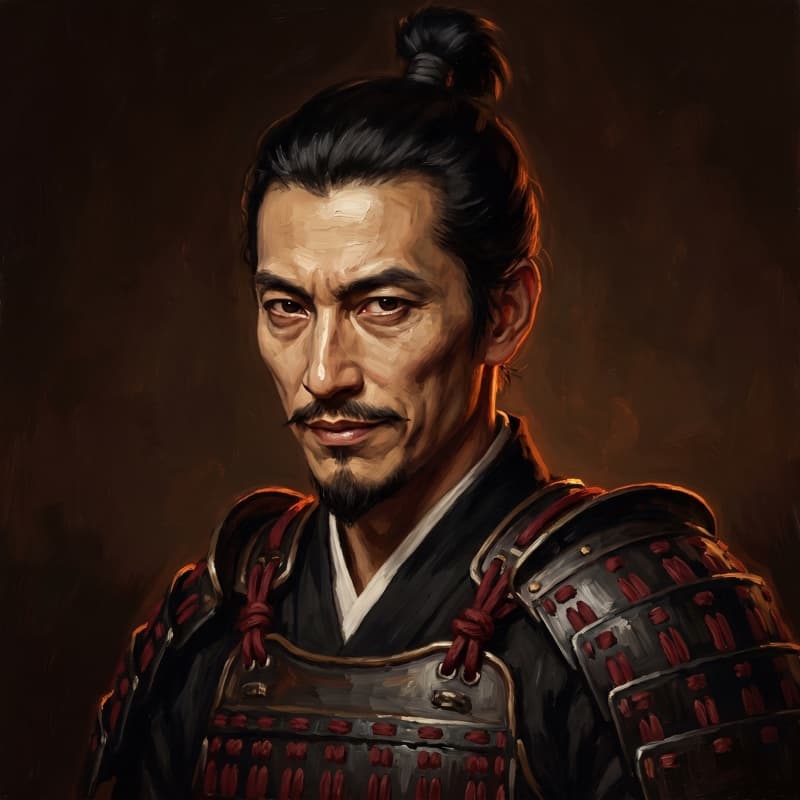
Search "Oda Nobunaga quotes" and the results are dominated by a three-line folk saying about a silent bird — a saying he never said. The documented record is thinner and stranger: a chronicle-reported last line, a four-character seal stamped on his own documents, and a mocking self-signature known from a single reported exchange of letters. Here is what can be traced to a source, and what should stay out of his mouth.
"There is no choice" — the last words (Honnō-ji, 1582)
When a retainer told Nobunaga that Akechi Mitsuhide's army had surrounded him at Honnō-ji temple, the chronicle tradition gives him one line in response:
是非に及ばず (Zehi ni oyobazu) — "There is no need to discuss the pros and cons. There is no choice."
This is chronicle-reported speech — preserved through accounts attributed to ladies-in-waiting present at the scene — not an eyewitness recording (Wikipedia). A looser English gloss, "It cannot be helped," circulates widely for the same Japanese phrase; it is not confirmed word-for-word in this record, so treat the two as related but distinct translations, not interchangeable quotes.
Tenka fubu — a seal, not a saying
After conquering Mino Province in 1567, Nobunaga adopted a personal seal:
天下布武 (Tenka fubu) — "All the world by force of arms."
He stamped it on documents and correspondence going forward, a declared ambition rather than a remark made in conversation (Wikipedia). It is the closest thing to a personal motto the record actually gives him.
Demon King of the Sixth Heaven — a title he signed himself
Around 1573, in a reported exchange of letters, Takeda Shingen signed a letter to Nobunaga as "head of the Tendai sect." Nobunaga's reply came back signed "Dairokuten no Maō Nobunaga" — 第六天魔王信長, "Nobunaga, Demon King of the Sixth Heaven" (Simple Wikipedia; Wikipedia). Read it as a signature answering a rival's own religious posturing — most likely mockery — not spoken dialogue, and not proof he believed himself literally supernatural. The whole modern "Demon King" image rests on this one narrow correspondence.
The Atsumori verse — the play's words, not his
Before the 1560 Battle of Okehazama, Nobunaga reportedly recited a passage from the Kōwaka-mai play Atsumori, on how briefly a life burns against eternity, before arming himself and riding out (Wikipedia). Those are the play's centuries-old words, performed in that moment, not a line he composed — and no single English rendering of the passage is settled enough here to present as his own verbatim quote.
What he never said
The famous saying that pits Nobunaga ("if the bird does not sing, kill it") against Toyotomi Hideyoshi ("make it sing") and Tokugawa Ieyasu ("wait for it to sing") is a later Edo-period folk verse illustrating three temperaments — not a line traced to any Sengoku-era text or to Nobunaga himself. Know it as folklore about how the era remembered him, not as something to quote as history.
From a conversation with our Nobunaga
An excerpt from a conversation with our AI Nobunaga persona — a stylized recreation, honestly labeled; not a historical quotation.
Caller: People love the line about killing the bird that won't sing. Did you really say that?
Nobunaga: No. Men needed a shape for me after I was gone, and a bird is easier to remember than a man. I never killed a bird for silence — I killed armies for standing where I meant to walk, which is a colder thing and harder to put in three lines. Ask for the seal instead: tenka fubu, all the world by force of arms. I signed that on paper, in my own hand, before witnesses who could read. Which would you rather trust — a saying invented to flatter a moral, or a mark a man put on his own documents while he was still alive to be wrong?
More in this cluster: Nobunaga hub · his death · biography · facts.