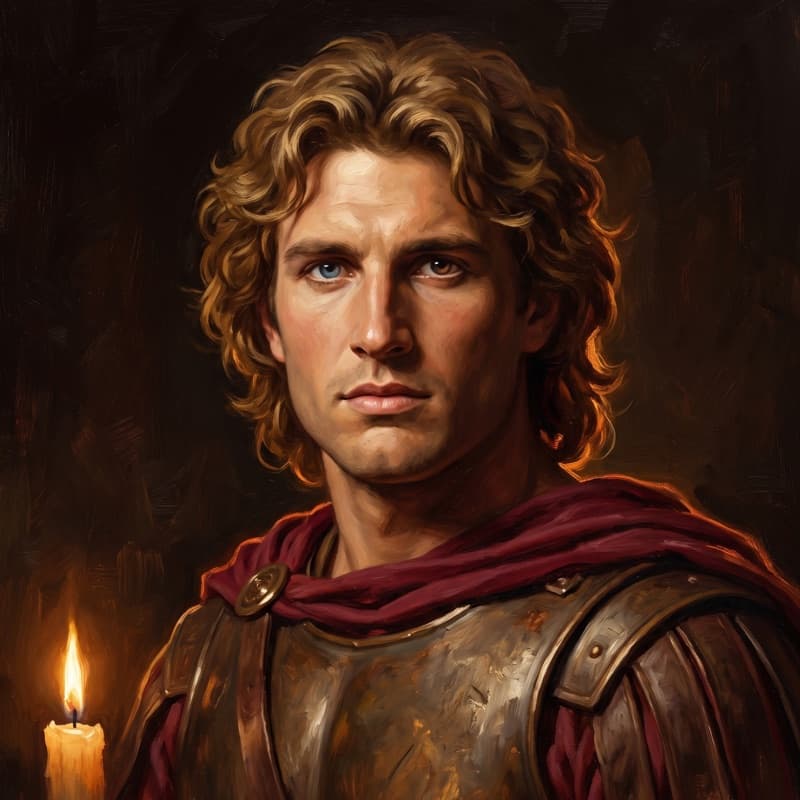
Alexander III of Macedon was born on July 20 or 21, 356 BC, in Pella, became king at about twenty after his father Philip II was assassinated in 336 BC, and spent the next eleven years leading an army from Greece to the edge of India. He defeated the Persian Empire, never lost a pitched battle, founded more than twenty cities, and died in Babylon on June 10 or 11, 323 BC, aged thirty-two, of a fever nobody has ever fully explained.
That is the legend, compressed. The record is harder than the legend — and more interesting.
The boy with the horse and the tutor
Two boyhood stories tell you most of what Macedon saw coming. The first is Bucephalus: a stallion no groom could mount, until a boy of about twelve noticed the horse was shying at its own shadow and turned him toward the sun. Plutarch says Philip wept and told his son:
"O my son, look thee out a kingdom equal to and worthy of thyself, for Macedonia is too little for thee." — Plutarch, Life of Alexander
Those are Philip's words, not Alexander's — a distinction quote collections routinely lose. The second story is the tutor. When Alexander was thirteen, Philip hired Aristotle and set up a classroom at the Temple of the Nymphs at Mieza. Plutarch reports that Alexander used to say he loved Aristotle no less than his father, "that as he had received life from the one, so the other had taught him to live well." If that sounds like a famous internet quote — "indebted to my father for living, but to my teacher for living well" — note that the polished modern version is untraceable; the Plutarch line is the real one.
What the conquest actually looked like
The campaign reads like a drumbeat: the Granicus in 334 BC, his first victory in Asia Minor; Issus in 333, where he beat Darius III's larger army; Tyre in 332; Gaugamela in 331; Persepolis in 330.
Keep your eye on Tyre, because it tells the truth about the rest. The island city refused him, so Alexander spent seven months building a causeway through open sea — an astonishing feat of engineering. Then the city fell, and his forces killed many of the inhabitants and sold the survivors into slavery. Both halves of that sentence are the history. Two years later, after a drunken feast at Persepolis, Alexander's party burned the Persian palace complex — centuries of another civilization's heritage, gone in a night. This was conquest, not adventure, and the people of Tyre, Thebes, Persepolis, and the Indian campaigns experienced it as such.
Gaugamela, on October 1, 331 BC, was the masterpiece. Outnumbered on ground Darius had flattened for scythed chariots, Alexander was urged by his general Parmenion to attack at night. Plutarch preserves the reply:
"I will not steal a victory." — Plutarch, Life of Alexander
He attacked in daylight, broke the Persian line, and was proclaimed King of Asia. Babylon and Susa opened their gates without a fight.
From a conversation with our Alexander
What follows is an excerpt from a conversation with our AI Alexander persona — a stylized recreation for readers, not a historical quotation.
Caller: Was Tyre worth it? All those people died for a wall.
Alexander: You ask it plainly — good. Tyre defied me for seven months, and I could not leave an enemy fleet at my back while Darius still breathed. So I unmade the question: if I could not reach an island, Tyre would cease to be one. That is a king's answer, and I stand by it. But you asked about the people, and I was there when the city fell. A man who tells you conquest is clean has never smelled a taken city. I wanted the world. The world was not empty. Weigh that as you like — the poets and the mothers have never agreed about me.
How did Alexander the Great die?
By 323 BC the man in Babylon was not quite the boy from Mieza. His army had mutinied at the Hyphasis River in 326, refusing to march deeper into India after the brutal battle against Porus at the Hydaspes — where Bucephalus, the horse from the story, died. His closest companion, Hephaestion, died of a fever at Ecbatana in October 324; Alexander cut his hair in mourning and had Hephaestion's physician impaled. The grief was barely half a year old when Alexander himself took fever in Babylon and died after about ten days, planning an Arabian campaign to the end. Illness or poison? Ancient writers argued and modern ones still do; the cause is genuinely unsettled. He left no clear heir, and his generals — the Diadochi — tore the empire apart in the wars that followed.
What he said, and what he never said
Almost everything Alexander "said" reaches us through Arrian and Plutarch, writing roughly four centuries after his death — so even the best-attested lines are a translator's rendering of a secondhand ancient account. The Diogenes story survives that filter beautifully: offered anything by the young king, the philosopher asked him to stop blocking the sun, and Alexander told his laughing followers that "if he were not Alexander, he would choose to be Diogenes." Meanwhile, "There is nothing impossible to him who will try" has no traceable ancient source at all, and the Gordian knot's famous sword-stroke is one version of a story Plutarch himself doubles — the other has Alexander quietly pulling a pin.
Caller: Why didn't you ever stop? You'd won everything.
Alexander: Won everything — there, you have said the thing I could never hear. The Greeks have a word, pothos: the longing that stands on every shore and asks what is across the water. It crossed the Hellespont with me at twenty-two and every river after, closer than any Companion. My soldiers wept at the Hyphasis and I raged in my tent like Achilles — but tell me truly: is there a moment in your own life you would have called enough and meant it? Name it, and I will tell you whether I believe you.
Excerpt from our AI Alexander persona — stylized, and labeled as such.
Keep reading — or ask him yourself
The pages below go deeper: his death in Babylon and the succession chaos, his verified quotes and the famous fakes, his full biography, and the facts, sourced.
Or skip the reading. Our Alexander takes calls from his map room in Babylon, spring of 323 BC. Ask him why he answered Parmenion the way he did, what he owed Aristotle, or whether Tyre still keeps him up at night. He is an AI recreation, honestly labeled — but he answers with the fire intact, and he will want to know what you are after.