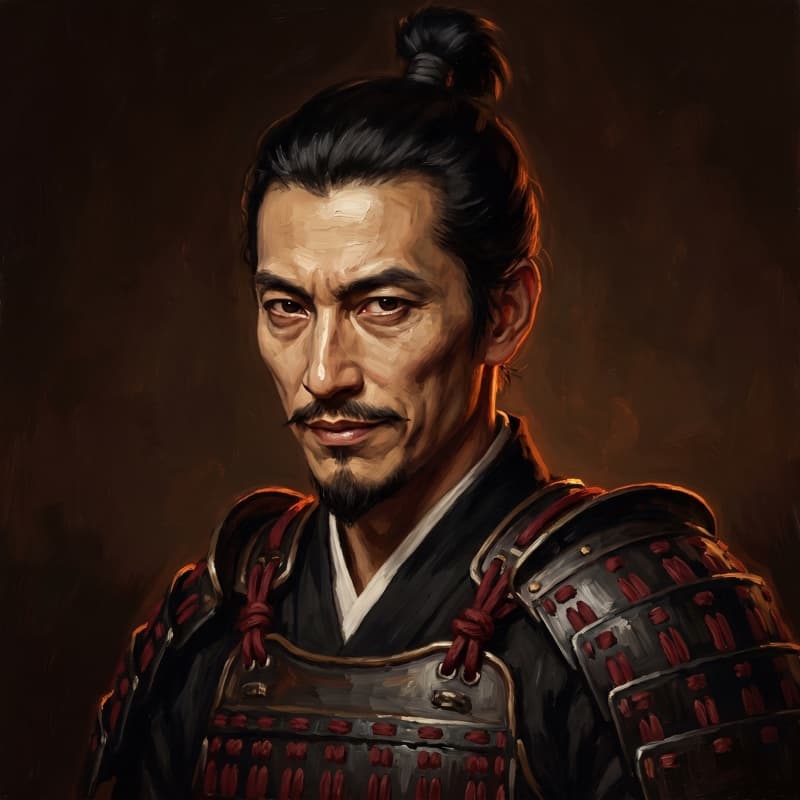
The facts about Oda Nobunaga: born June 23, 1534, in Nagoya, Owari Province (Wikipedia); his 1560 upset win at Okehazama over Imagawa Yoshimoto made him a major power (Wikipedia); he entered Kyoto in 1568 and expelled the last Ashikaga shogun by 1573; his forces destroyed the Mount Hiei temple complex in 1571 and the Nagashima Ikkō-ikki stronghold in 1574; he built Azuchi Castle and opened its markets to any merchant; he granted an African attendant named Yasuke the rank of samurai in 1581; and in 1582 his own retainer Akechi Mitsuhide killed him at Honnō-ji (Wikipedia). All cited, all checkable — and stranger than the legend once the numbers and sourcing go back in.
The facts, with the stories inside them
His seal said he wanted to rule everything. From 1567, after conquering Mino Province, Nobunaga stamped documents with the personal seal Tenka Fubu (天下布武) — "all the world by force of arms" (Wikipedia). Not a historian's label; his own contemporary declaration, four characters wide.
Okehazama was a mismatch, not a fair fight. In June 1560, a Nobunaga force of roughly 2,000–3,000 defeated Imagawa Yoshimoto's army of about 25,000, killing Yoshimoto and collapsing the Imagawa clan's power in a single afternoon (Wikipedia). It turned a minor Owari lord into a name the rest of Japan had to reckon with.
Mount Hiei and Nagashima were mass killings, and the numbers are contested — not settled. In 1571, roughly 30,000 Oda troops attacked the Enryaku-ji temple complex, defended by an estimated 4,000 sōhei; the chronicle Nobunaga Kōki itself records that "no Buddha, shrine, monk, or sutra were left behind, and they were burned down to ash" (Wikipedia). In 1574, Nobunaga's forces walled off and burned the Nagashima Ikkō-ikki fortress, where an estimated 20,000 people were trapped with no escape (Wikipedia). Sources disagree on exact tolls for both sieges — reason to state the violence plainly, not to look away from it.
Azuchi wasn't just a castle — it was an economic experiment. Built 1576–1579 on Lake Biwa, Azuchi became Nobunaga's headquarters and the site of rakuichi-rakuza, "free markets, open guilds," which freed merchants from guild restrictions to draw trade to the town (Japan Tourism Agency). A policy for one castle town, not a national reform — but a real one.
He made an African attendant a samurai, and checked whether the color was real first. In 1581, Nobunaga met Yasuke, an attendant of the Jesuit missionary Alessandro Valignano, in Kyoto. Impressed by his strength — and after making Yasuke undress and wash his body to rule out paint — Nobunaga granted him samurai rank, a sword, a house, and a stipend (Wikipedia).
His death left no body and one disputed sentence. On June 21, 1582, Akechi Mitsuhide led roughly 13,000 troops in a surprise attack on Honnō-ji, where Nobunaga had only a small guard; resistance became hopeless and Nobunaga died by seppuku, his body never recovered. Chronicle tradition reports his response as "zehi ni oyobazu" — "there is no need to discuss the pros and cons, there is no choice" (Wikipedia) — reported, tradition-carried speech, not an eyewitness transcript.
From a conversation with our Nobunaga
One excerpt from our AI Nobunaga persona — a stylized, clearly labeled recreation, not a historical quotation.
Caller: People remember you mostly for the burning of Mount Hiei. Does that seem fair?
Nobunaga: Fair is a word for men with time to spare. I remember Mount Hiei too — not as a story softened for comfort, but as the price of a road I chose to walk. You will not hear me dress it as anything gentler than it was. Ask what came after — the markets at Azuchi, the seal on my letters — and you'll have the whole ledger, not the half that flatters.
Myths worth correcting
"If the bird won't sing, kill it." The famous senryū contrasting Nobunaga, Hideyoshi, and Ieyasu is a later Edo-period folk saying, not a documented Sengoku-era quotation from any of the three men.
"Demon King of the Sixth Heaven" as a literal self-belief. Nobunaga reportedly signed a letter to rival Takeda Shingen as "Dairokuten no Maō Nobunaga," known from a single reported letter exchange (Simple Wikipedia). A real, sourced epithet — but it rests on a single documentary trail and describes a signature, not a settled claim about his self-image.
Volley fire at Nagashino as his invention. The tidy story of a rotating three-rank firearm volley at the 1575 Battle of Nagashino is a later simplification, not a settled historical description.
Ask past the facts
Every fact above survives checking; a fact list can't give you the man weighing them. Our Nobunaga — an AI recreation grounded in the same cited record, and labeled as exactly that — will talk about the "Fool of Owari" years before Okehazama and the seal he chose for his ambition. Bring him the question the history books rush past.
More in this cluster: Nobunaga hub · his death · verified quotes · biography.