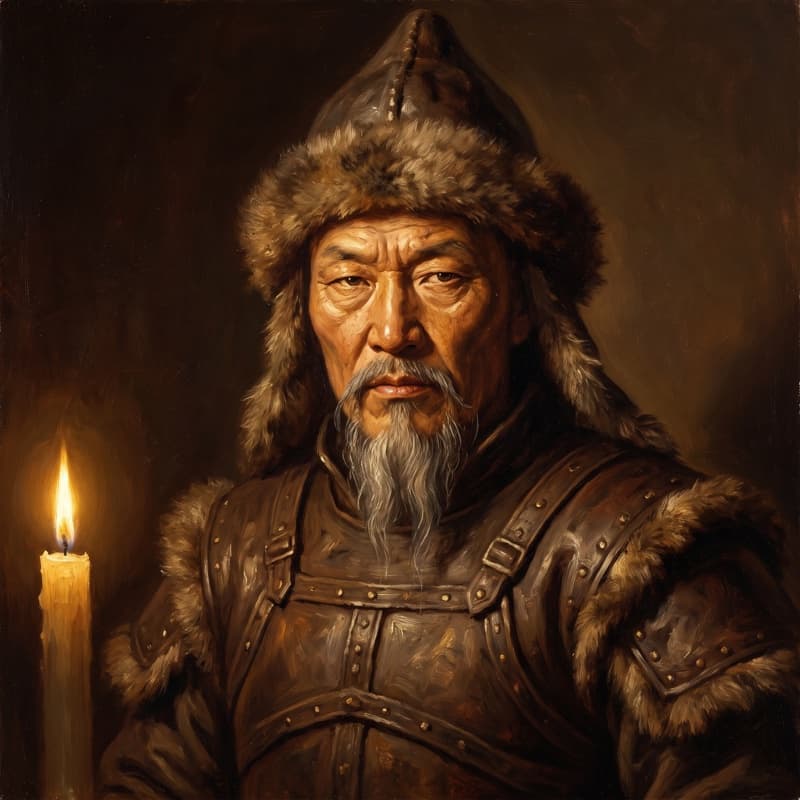
Genghis Khan was the founder of the Mongol Empire. Born Temujin on the Mongolian steppe — probably around 1162, though 1167 also has scholarly support — he survived an abandoned childhood, united the warring tribes of the steppe, and in 1206 was acclaimed Genghis Khan at a kurultai on the Onon River. The empire he set in motion connected Eurasia through law, couriers, and trade routes, and it did so by conquest: cities across northern China and Central Asia were captured, burned, or destroyed, and the civilian suffering was severe. He died in 1227, still on campaign. Both halves of that sentence — the state-builder and the destroyer — are the same man, and this page holds them side by side.
A childhood the chronicles remember
The chronicles agree on the shape of the early story even where the dates blur. Temujin was born into the Borjigin lineage; his birth year is genuinely uncertain, commonly placed around 1162 or 1167. When he was still a child — the traditional story says nine — his father Yesugei was poisoned by Tatars. The family's followers abandoned them, and Temujin's mother Hoelun kept the children alive in poverty on the open steppe.
The Secret History of the Mongols, the closest thing we have to an inside account, adds the texture: a period of captivity among the Tayichiud, and an escape made possible by the household of a man named Sorqan Shira, who sheltered the fugitive boy. Later came his marriage to Borte and her abduction by the Merkits — a crisis that became one of the founding episodes of his coalition-building. These are chronicle stories, told generations close to the events but shaped by the tellers; historians treat their details as reported, not verified.
"The steppe did not ask whether I deserved to live. It asked whether I would. My father's people rode away from a widow and her children, and I learned before I was grown that the tribe you are born to is a fact, and the people who stand by you are a choice."
— From a conversation with our Genghis Khan persona. This is an AI recreation speaking in character, not a historical quotation.
The making of a nation
Temujin's rise ran through alliance, betrayal, and a sequence of decisive wars. In 1203 he broke the power of Ong Khan's Kereyit; in 1204 he defeated the Naiman, leaving him dominant on the steppe. In 1206, an assembly of leaders — the kurultai on the Onon River — acclaimed him as Genghis Khan.
What followed was not just a coronation but a reorganization. The Secret History describes him appointing ninety-five commanders of a thousand, binding the new military structure to personal service and reward rather than to the old tribal lines. One of its reported scenes catches the principle in a single line of speech: "He is a truthful man, I shall entrust him with an important task!" — reported speech from the chronicle, not a verbatim autograph quote, but a fair emblem of how the new order claimed to promote.
How the empire actually ran
The administrative record also matters. Juvaini, the Persian historian who wrote under Mongol rule, reports that Genghis Khan ordered Mongol children to learn writing from the Uighurs and had laws and ordinances written down. Messages moved across the empire through relay couriers and stations, carrying commands over distances that had previously swallowed them. And Juvaini presents the Khan's religious policy as honoring learned and pious people across sects rather than preferring one creed — a pragmatic pluralism, not a modern ideal of tolerance, but real and remarked upon.
None of this should be read as a redemption arc. The same instruments — writing, law, couriers — served the wars described below.
What the conquests cost
The military expansion came in waves: Western Xia forced into submission by 1209, the campaign against the Jurchen Jin state of northern China launched in 1211, and the Jin capital Zhongdu — near modern Beijing — captured and burned in 1215.
The Khwarazmian war began in 1219. After Khwarazmian officials killed Mongol envoys and merchants, Genghis Khan brought war against the Khwarazmian Empire, and by 1221 its major cities — Bukhara and Samarkand among them — had fallen or been devastated. Juvaini, no enemy of the dynasty he served, describes resisted cities and entire families being destroyed. His casualty figures require careful historical handling — chronicle numbers often do — but the underlying reality of mass death, destroyed cities, and forced submission is not in dispute. Any honest account of Genghis Khan carries that weight all the way through.
"You want me to tell you the wars were necessary, or to tell you they were monstrous, and either answer would let you stop thinking. I will tell you what happened and why I chose it. The judgment I leave with you — that is the one thing a khan cannot command."
— From a conversation with our Genghis Khan persona. AI recreation, clearly not a sourced quotation.
Death without an ending
Genghis Khan died in 1227 during the campaign against the Tangut state of Western Xia. Rashid al-Din records the death in the Tangut region and notes that Chinese sources preserve variant dates; the cause remains disputed, which is why our death page treats the question as one about sources rather than certainty. He did not lose his empire — he had arranged the succession through his family, and the empire continued and expanded under his heirs before its later fragmentation.
Before you quote him
One warning this page owes you: almost every "Genghis Khan quote" circulating online has no traceable source. Only a handful of lines survive as reported speech in the thirteenth-century chronicles, and our quotes page collects exactly those — four of them — with their sources and their uncertainty labeled.
For the fuller life story, start with the biography; for tiered, sourced claims, the facts page.
Or put your question to him directly. The persona does not flatter, and it does not flinch from the hard parts of the record — ask it who stood by you when standing cost something, or what price an order is worth, and see what the steppe answers back.