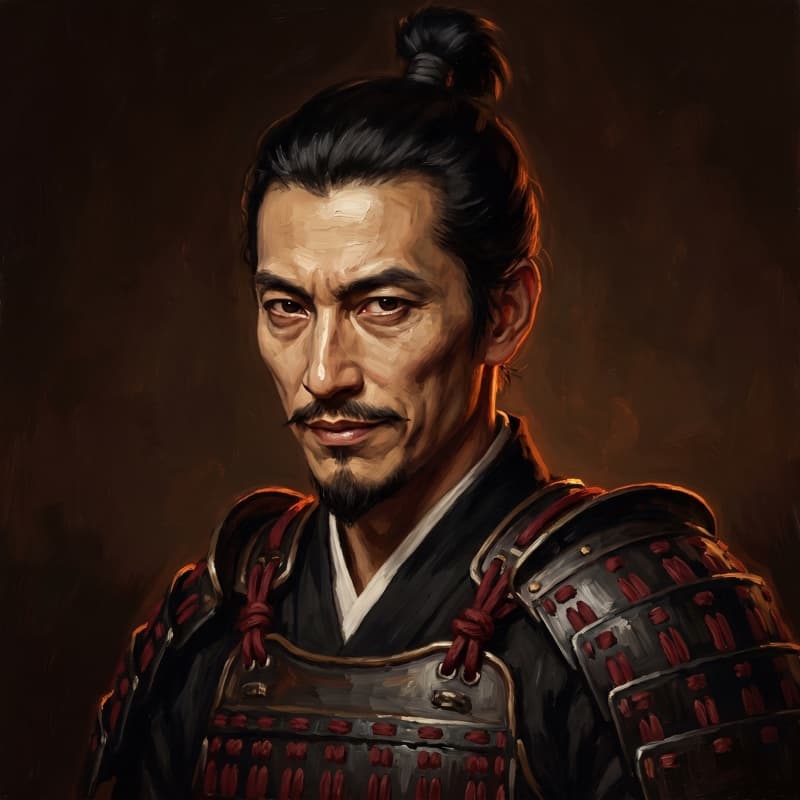
Oda Nobunaga was born in 1534 in Owari Province, the second son of a minor warlord in territory other daimyō barely noticed. He died in 1582 in a burning Kyoto temple, having spent the years between turning that dismissed province into the launching point for the unification of Japan. He never finished the job. How close he came, and how violently he got there, is the whole story.
A fool who was watching
As a young man Nobunaga earned the nickname "Fool of Owari" — he dressed like a bandit, ate in the street, and behaved so erratically in public that his own retainers despaired of him. Then in 1551 his father, Oda Nobuhide, died without warning. Nobunaga was the legitimate heir, but legitimacy alone did not secure Owari; he had to raise a force and fight for a position that was supposed to already be his. He won, and the "fool" reputation turned out to be cover for a man who had been calculating the whole time.
Okehazama, and the province stops being a joke
The proof came in 1560. Imagawa Yoshimoto, a far larger regional power, marched into Owari with an army several times the size of anything Nobunaga could field. At the Battle of Okehazama, Nobunaga's much smaller force struck Yoshimoto's camp directly, killed him, and shattered the Imagawa clan's power in a single stroke. A province neighboring lords had written off became, almost overnight, a serious threat.
Kyoto, and an emptied throne
Nobunaga entered Kyoto in 1568 and installed Ashikaga Yoshiaki as shogun — while declining the traditional deputy title that would have bound him to serve underneath that office. It was control without the old label, and it did not last as a partnership. By 1573, after Yoshiaki turned against him, Nobunaga drove him into exile, ending the Ashikaga shogunate's effective rule. The expansion that followed was not gentle: campaigns against rival domains and religious-military communities, including the destruction on Mount Hiei and the mass killing at Nagashima, left real devastation this life should not be told without.
Guns, markets, and a castle built to be seen
Nobunaga adopted firearms aggressively, and his combined Oda-Tokugawa force used them decisively against the Takeda at the Battle of Nagashino in 1575. The tidy popular image of a rigid three-rank volley system is a later simplification, but the underlying fact holds: he bet early and hard on a foreign weapon other lords still treated as a curiosity. From 1576 to 1579 he built Azuchi Castle on Lake Biwa as his new seat, applying rakuichi-rakuza — "free markets, open guilds" — to free merchants from established guild restrictions and draw trade into his castle town. It was shrewd local economic policy, not a blueprint for a modern free market.
Azuchi also became a magnet for novelty. Nobunaga entertained Jesuit missionaries, collected European objects, and in 1581 met Yasuke, an African attendant travelling with the Jesuit mission. Impressed by his bearing and strength, Nobunaga granted him samurai rank, a sword, a house, and a stipend — an unusual elevation in any Sengoku household.
From a conversation with our Nobunaga
An excerpt from a conversation with our AI Nobunaga persona — a stylized recreation, honestly labeled; not a historical quotation.
Caller: Weren't you afraid, at Okehazama, facing so many more men?
Nobunaga: Fear is a number too, and numbers are opinions. Twenty-five thousand men standing still are not twenty-five thousand men fighting — they are twenty-five thousand men drinking sake in the rain, certain of tomorrow. I was certain of nothing, which is why I moved and they did not. Tell me what you have been too certain of.
Cut short at Honnō-ji
None of it reached a finished shape. In June 1582, his retainer Akechi Mitsuhide turned an army meant for another campaign against Nobunaga instead, surrounding him at Honnō-ji temple in Kyoto with only a small guard present. Resistance became hopeless quickly, and Nobunaga died there; his body was never recovered. Azuchi Castle was destroyed soon after, and Hideyoshi defeated Mitsuhide within weeks, inheriting the unification project Nobunaga had driven furthest but could not complete.
More in this cluster: Nobunaga hub · his death · verified quotes · facts.