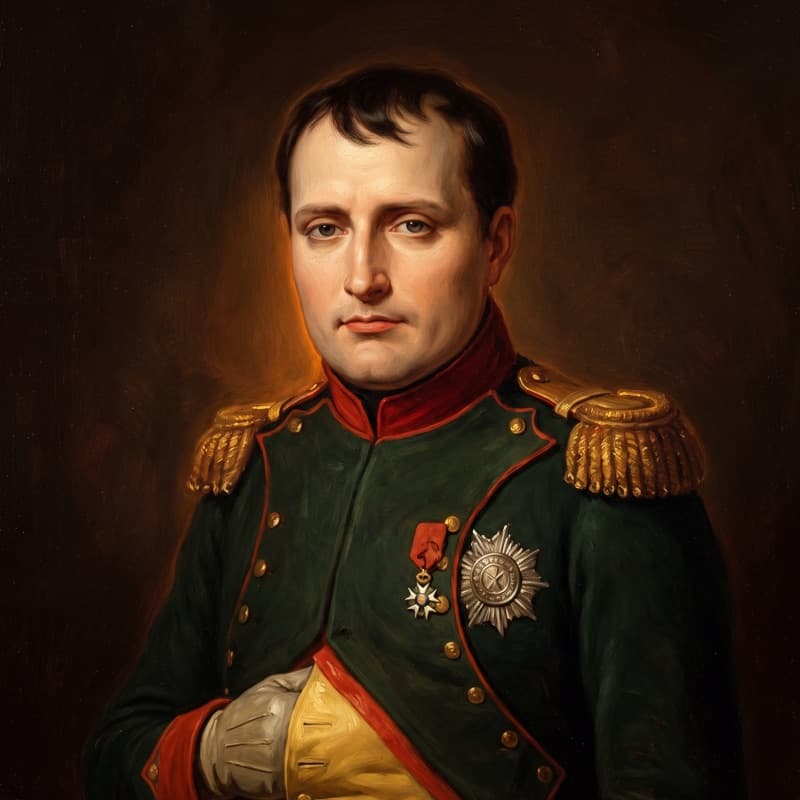
Napoleon Bonaparte was born on August 15, 1769, in Ajaccio, Corsica, and died on May 5, 1821, at Longwood House on the remote South Atlantic island of Saint Helena. In between those two dates he went from artillery officer to First Consul to self-crowned Emperor of the French, rewrote the legal foundations of a continent, and lost an empire twice — once to the Russian winter, once to a field in Belgium called Waterloo.
That is the outline. The man who fills it in is stranger, funnier, and more self-aware than the marble statue suggests.
From gunner to Emperor
Napoleon's rise ran through the French Revolutionary Wars rather than around them. He became a general in 1793 and took command of the Army of Italy in 1796, the same spring he married Joséphine de Beauharnais — the wedding was March 9, 1796, days before he left for the front. His letters to her from that campaign are startlingly unguarded for a man who would soon be dictating peace terms to emperors:
"I don't love you an atom; on the contrary, I detest you." — Letter from Verona, November 23, 1796, in Napoleon's Letters to Josephine
It reads like a quarrel, and it was one — but months earlier, from Tortona that June, he had written the opposite with equal force: "I scarcely imagine how I existed without knowing you." The Corsican general who could plan a campaign in his head kept both registers running at once.
By 1798 he was leading an army into Egypt, bringing engineers, chemists, and artists alongside the cannon to found the Institute of Egypt in Cairo — his men later unearthed the Rosetta Stone during the campaign. He won the Battle of the Pyramids on July 21, 1798, and tradition holds he told his troops that "forty centuries look down upon you" beforehand. It's a magnificent line, and it may even be close to something he said — but the phrase doesn't appear in his own dated proclamations from the campaign, and historians trace it to a secondhand memoir rather than an official bulletin. Treat it as legend-adjacent, not a transcript.
First Consul, then Emperor
On November 9, 1799 — 18 Brumaire on the revolutionary calendar — Napoleon seized power in a coup and became First Consul of the Republic. Five years later, in December 1804, he crowned himself Emperor of the French at Notre-Dame, taking the crown rather than waiting for the Pope to place it on his head. The following year's proclamation to his army after the Battle of Austerlitz — fought on December 2, 1805, the first anniversary of that coronation — still reads like a man who knew exactly what he had built:
"Soldiers: I am satisfied with you. In the Battle of Austerlitz you have justified all that I expected from your intrepidity." — Proclamation to the Grande Armée, December 3, 1805
Austerlitz is usually remembered as his masterpiece: he deliberately weakened his own right flank to bait the Austro-Russian attack, then broke the enemy center on the Pratzen Heights once they'd committed. But the empire he built was as much administrative as military. He personally presided over sessions of the Council of State drafting what became the Napoleonic Code — a single body of civil law meant to apply to all Frenchmen regardless of birth, replacing a patchwork of feudal privilege. Historians generally treat the Code, not any single battle, as his most durable legacy.
From a conversation with our Napoleon persona
What follows is an excerpt from a conversation with our AI Napoleon persona — a stylized recreation for readers, not a historical quotation.
Caller: Everyone remembers your battles. Why do you keep bringing up the Code instead?
Napoleon: Because cannon rust and armies scatter, but a law, well written, outlives the man who signed it. Waterloo will erase the memory of forty victories — I know this, I have made my peace with it. What it cannot erase is a code that told a farmer's son his talent, not his father's name, would decide his career. Ask me about Austerlitz and I will tell you about a fog and a hill. Ask me about the Code and I will tell you what actually survived me.
The words attributed to him — and the ones he never said
Not everything credited to Napoleon is genuine. A 1813 letter to General Le Marois, written from Dresden, really does contain the root of a famous line — "'That is not possible,' you write to me: that is not French" — but the punchier poster version, "Impossible is a word to be found only in the dictionary of fools," doesn't appear in his verified correspondence. Similarly, "It was worse than a crime, it was a blunder," often pinned on him regarding the execution of the Duc d'Enghien, was traced by researchers to Antoine Boulay de la Meurthe and Joseph Fouché decades before Napoleon ever got credit for it — an 1844 misattribution, most likely via Ralph Waldo Emerson.
Even Napoleon's own honesty about myth-making is quotable. In conversation with Emmanuel de Las Cases during his exile, recorded in the Mémorial de Sainte-Hélène, he mused:
"What then is, generally speaking, the truth of history? A fable agreed upon." — Mémorial de Sainte-Hélène, cited in Quote Investigator
He was quoting someone else's line approvingly, not coining it — but it's a remarkable thing for the great myth-builder of the age to say out loud.
The fall, and what it didn't undo
The invasion of Russia in 1812 ended in catastrophic retreat that winter. Defeat followed at Leipzig in October 1813, and by April 1814, with coalition forces in Paris, Napoleon abdicated and was exiled to Elba. He escaped within a year for the Hundred Days, returning to power on March 20, 1815, only to be defeated at Waterloo on June 18 and abdicate a second time four days later. The British shipped him to Saint Helena, where he spent his final years dictating memoirs to Las Cases before his death on May 5, 1821.
None of it touched the Code. It still governs, in modified form, the legal systems of France and a wide swath of countries it once influenced by conquest — the one conquest that outlasted the man who ordered it.
Keep reading — or ask him yourself
Go deeper into his rise from Corsica to Emperor, his fall and exile on Saint Helena, his verified quotes — and the famous ones he never said, and the facts, sourced.
Or skip the reading and call him. Ask our Napoleon what he actually thought of the Duc d'Enghien affair, how he'd run a modern negotiation, or what the view from the Pratzen Heights taught him about seizing an opening. He is an AI recreation, honestly labeled — but he answers fast, argues back, and has never once apologized for a war he thought was justified.