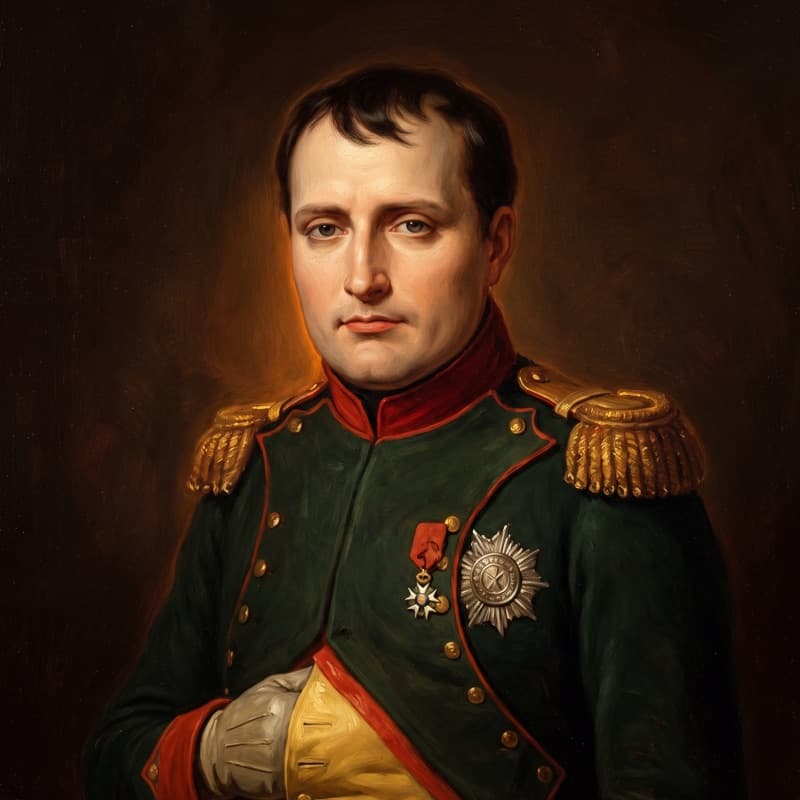
Napoleon Bonaparte's most reliably sourced lines come from two places: proclamations dictated for an army, and private letters he never expected anyone else to read. Around them sits a long list of maxims the internet loves to hand him — most unsupported by any primary document. Here is the verified record first, then the quotes he never actually said.
1805: The voice of command
The morning after the Battle of Austerlitz, Napoleon addressed the Grande Armée directly:
"Soldiers: I am satisfied with you. In the Battle of Austerlitz you have justified all that I expected from your intrepidity."
It is the register he used in public — plain, declarative, built to be read aloud to men who had just won an empire's decisive battle in four hours.
1796: The private Napoleon
A very different voice survives in his letters to Joséphine, written during the Italian campaign in the same year they married:
"I am nothing without you. I scarcely imagine how I existed without knowing you." (June 15)
"Ever since I left you, I have been sad. I am only happy when by your side." (July 17)
"I don't love you an atom; on the contrary, I detest you." (November 23 — half a joke, aimed at a wife slow to write back)
"For my part, to love you only, to make you happy, to do nothing which may vex you, that is the object and goal of my life." (November 28)
Read in order, the sequence swings from devotion to mock fury and back inside eight months — a young general still capable of jealousy and doubt.
1813: "That is not French"
To a subordinate who wrote back that an order couldn't be carried out, Napoleon replied from Dresden:
"'That is not possible,' you write to me: that is not French."
That is the documented sentence. The poster version — "Impossible is a word to be found only in the dictionary of fools" — is not in this letter or any other primary source found for this page; treat it as a later embellishment, not the real wording.
1816: A fable agreed upon
In exile on Saint Helena, recorded by his companion Emmanuel de Las Cases:
"What then is, generally speaking, the truth of history? A fable agreed upon."
Napoleon offered this as something "very ingeniously remarked" by someone else, not his own coinage — a rare moment of a famous man declining credit for his best line.
Attributed, but disputed
Two lines are widely repeated but not solidly documented. "Soldiers, from the summit of these pyramids forty centuries look down upon you" appears in popular accounts of the 1798 Egyptian campaign, but not in the dated bulletins from the battle itself — historians trace it to a secondhand memoir, not an official address. The Saint Helena line "my true glory is not to have won forty battles… what will live eternally is my Civil Code" is quoted everywhere, but no page-cited edition of the Las Cases memoirs has turned up to confirm it. Both may echo something he said; neither is a verified verbatim quotation.
Quotes Napoleon never actually said
- "It was worse than a crime, it was a blunder." Said about executing the Duc d'Enghien — but the phrase traces to Antoine Boulay de la Meurthe (credited by 1807), then Joseph Fouché, who claimed it himself. Napoleon wasn't credited until 1844, via a mistaken attribution by Ralph Waldo Emerson (Quote Investigator).
- "An army marches on its stomach." The earliest solid attribution goes to Frederick the Great, documented by Thomas Carlyle in 1858; the Napoleon version likely comes from an 1860 book that printed both men's sayings side by side (Quote Investigator).
- "Never interrupt your enemy when he is making a mistake." An 1836 account has him say something similar during an 1805 battle, in different words — the tidy modern maxim looks like a later polish job, not a transcript (Quote Investigator).
- "A leader is a dealer in hope." Common on quote-aggregator sites, with no primary letter, bulletin, or Las Cases entry behind it — unconfirmed.
More in this cluster: Napoleon hub · his death · biography · facts.