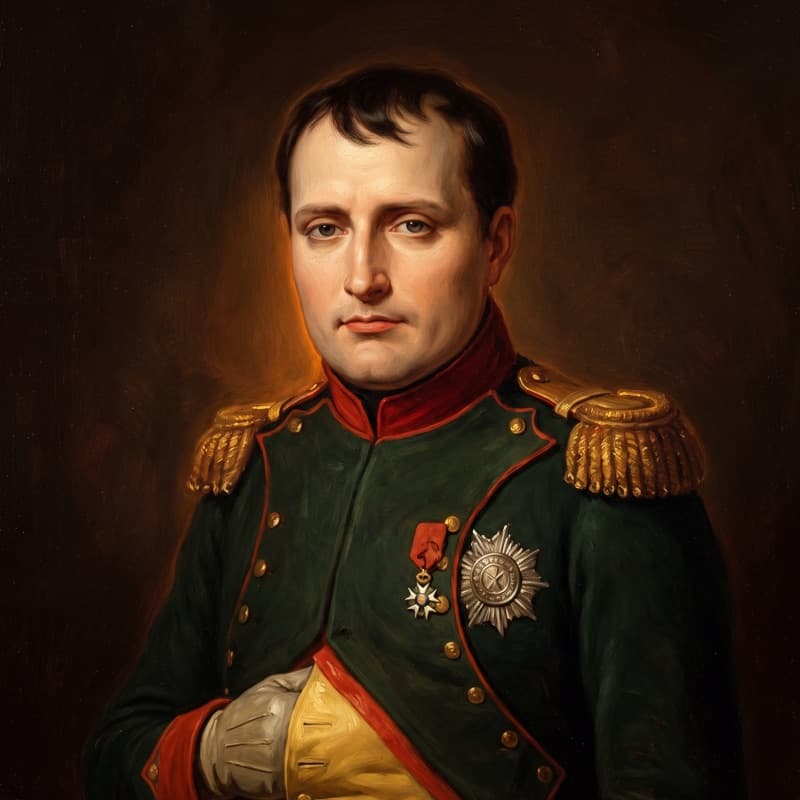
Every Napoleon fact on this page is checked against a primary document or an institutional source — Wikipedia's sourced biography, the Napoleon Series' archive of his speeches and physical descriptions, and the digitized Napoleonica correspondence — with each citation shown inline. Short version: born August 15, 1769, in Ajaccio, Corsica; took command of the Army of Italy in 1796; seized power in the Coup of 18 Brumaire in 1799; crowned himself Emperor in December 1804; won at Austerlitz in 1805; lost catastrophically in Russia in 1812 and decisively at Leipzig in 1813; abdicated twice, the second time after Waterloo in 1815; died in exile on Saint Helena, May 5, 1821. Details below, then two claims that circulate as fact but aren't.
Ten verified facts
- Born August 15, 1769, in Ajaccio, Corsica (Wikipedia).
- Took command of the Army of Italy in January 1796, the campaign that first made him famous (Wikipedia).
- Married Joséphine de Beauharnais on March 9, 1796, in a civil ceremony, days before leaving to lead the Italian campaign (Wikipedia).
- Won the Battle of the Pyramids on July 21, 1798, during the French expedition to Egypt (Wikipedia).
- Seized power in the Coup of 18 Brumaire — November 9, 1799 — becoming First Consul of the French Republic (Coup of 18 Brumaire, Wikipedia).
- Crowned himself Emperor of the French in December 1804, and defeated the combined Austrian and Russian armies at the Battle of Austerlitz on December 2, 1805 (Wikipedia; proclamation to the Grande Armée, Napoleon Series).
- Divorced Joséphine and married Archduchess Marie Louise of Austria — the civil wedding was held on April 1, 1810 — and their son, styled King of Rome, was born March 20, 1811 (Marie Louise, Duchess of Parma, Wikipedia).
- Invaded Russia in the summer of 1812; the campaign ended in a catastrophic winter retreat (Wikipedia).
- Decisively defeated at the Battle of Leipzig, October 16–19, 1813, then abdicated in April 1814 and was exiled to Elba; he returned for the Hundred Days (March 20–June 22, 1815), lost at Waterloo on June 18, 1815, and was exiled a second time to Saint Helena, where he died on May 5, 1821 (Wikipedia).
- His most enduring legacy is institutional, not military: the legal and administrative reforms he enacted in France and Western Europe, above all the Napoleonic Code, outlasted the empire itself (Wikipedia).
Two circulating claims, corrected
"Napoleon was famously short." No reliable account supports the cartoon image. A period medical description gives five feet two inches in French measure — about five feet six inches in English measure — while an English undertaker's measurement after his death put him at five feet seven inches; the confusion comes from French and English measurement units of the era not being the same size, not from Napoleon actually being small (physical description, Napoleon Series).
"Impossible is a word to be found only in the dictionary of fools." This poster-ready line is not what Napoleon wrote. In a real, dated letter to General Le Marois from Dresden on July 9, 1813, he wrote: "'It is not possible,' you wrote to me: that is not French!" — a documented sentiment, but different wording from the version that circulates today (Correspondance générale de Napoléon Bonaparte, Napoleonica).
Frequently asked, quickly answered
When did Napoleon become Emperor? December 1804, a little over a year before his decisive victory at Austerlitz (Wikipedia).
Was Napoleon really short? No — largely a caricature; period measurements put him around average height once the units are converted correctly (Napoleon Series).
What happened after Waterloo? A second abdication, then exile by the British to Saint Helena, where he remained until his death in 1821 (Wikipedia).
Did Napoleon say "impossible is not French"? A version of it, yes, in a documented 1813 letter — but not the "dictionary of fools" phrasing quoted today (Napoleonica).
Related pages
Napoleon hub · his death · verified quotes · biography.
For questions a fact list can't settle — how the Code mattered to him next to the wars, what the Italian campaign felt like at twenty-six — this site hosts a conversational AI recreation of Napoleon, grounded in the sources above and labeled plainly as an AI persona. The facts are here; the voice is a conversation away.