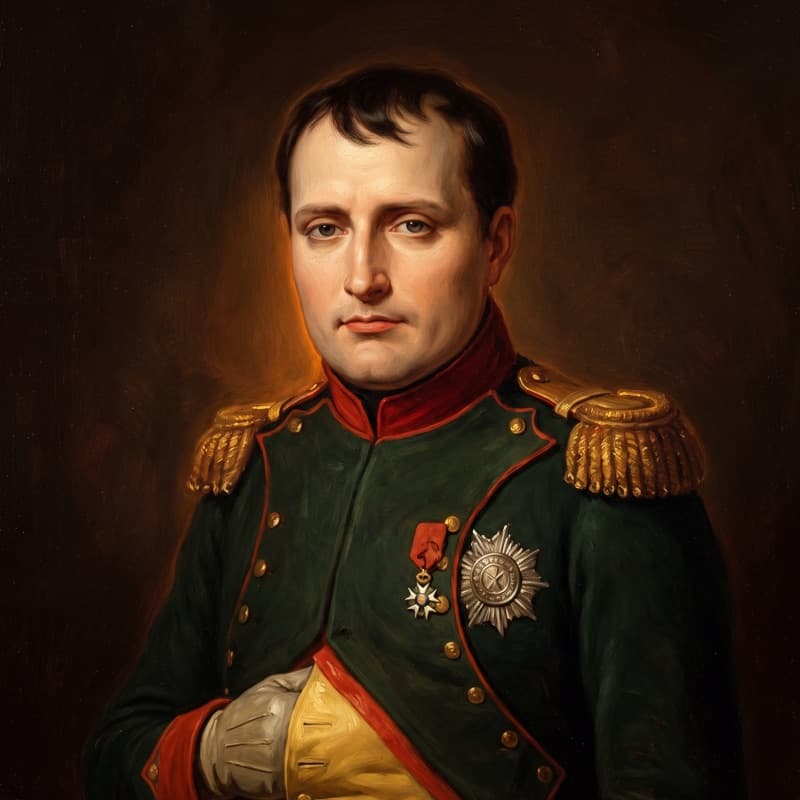
Napoleon Bonaparte was born on August 15, 1769, in Ajaccio, Corsica. He died on May 5, 1821, in exile on the remote South Atlantic island of Saint Helena — between those two points, a career that took a Corsican-born officer to command of the Grande Armée, the throne of an Empire, and a body of law that outlasted the throne itself.
The temptation is to read the life as a straight climb, engineered from the start. The record reads more like a man who kept reaching for the next command, and got it, again and again, until reaching became an empire's problem.
The young general
By 1796 Napoleon commanded the Army of Italy. On March 9 that year he married Joséphine de Beauharnais and left almost at once for the front — the first of a rapid sequence of letters back to her that reads nothing like a conqueror's correspondence. "I am nothing without you," he wrote from Tortona that June. The letters swing between devotion and jealousy: from Verona that November, "I don't love you an atom; on the contrary, I detest you," and days later from Milan, "to love you only, to make you happy... that is the object and goal of my life." It is a private register almost nobody associates with the public man.
In 1798 he led the French expedition to Egypt, winning the Battle of the Pyramids that July — the campaign that produced the famous line about forty centuries looking down from the pyramids, a story more often told than verified, since it survives only in secondhand memoir rather than an official proclamation.
First Consul, then Emperor
On 18 Brumaire — November 9, 1799 — Napoleon seized power in a coup and became First Consul. Five years later, in December 1804, he crowned himself Emperor of the French at Notre-Dame. On December 2, 1805 — the first anniversary of that coronation — he defeated the combined Austrian and Russian armies at Austerlitz, telling his soldiers afterward, "I am satisfied with you." It was the peak of the military legend. The more durable achievement was administrative: the Napoleonic Code, a body of civil law meant to apply uniformly across France, is the piece of the empire historians most often point to as still standing.
Dynasty, decline, and a famous refusal to hear "no"
In 1810 he divorced Joséphine and married Archduchess Marie Louise of Austria; their son, styled King of Rome, was born in March 1811. A Dresden letter that July, to a general who'd said something couldn't be done, captured the temperament that had carried him this far: "'That is not possible,' you write to me: that is not French." By then the 1812 Russian invasion had already cost him an army in retreat, and that October he was beaten at Leipzig. He abdicated in April 1814 and was exiled to Elba.
Waterloo and Saint Helena
He escaped Elba for the Hundred Days, March 20 to June 22, 1815, ending in defeat at Waterloo on June 18 and a second, final exile to Saint Helena. There, in conversation recorded by Emmanuel de Las Cases, he offered a line almost too self-aware for a man who'd spent two decades writing his own legend: "What then is, generally speaking, the truth of history? A fable agreed upon." He died on the island on May 5, 1821.
From a conversation with our Napoleon
An excerpt from a conversation with our AI Napoleon persona — a stylized recreation, honestly labeled; not a historical recording.
Caller: Do you regret Russia?
Napoleon: Regret is a soldier's luxury; I was a general, a colder trade. I built an empire on speed and certainty — the retreat from Moscow was the one campaign where neither served me. A man learns more from the campaign that ruins him than the ten that make him. I survived it. That was not the same as answering for it.
Continue the conversation — literally
You have just read the recorded life. Our Napoleon — an AI recreation, built on the sourced record and labeled as what it is — speaks from inside it. Ask about the letters to Joséphine, why the Code mattered more to him than Austerlitz, or what six years on Saint Helena felt like with nothing left to command.
More in this cluster: Napoleon hub · his death · verified quotes · facts.