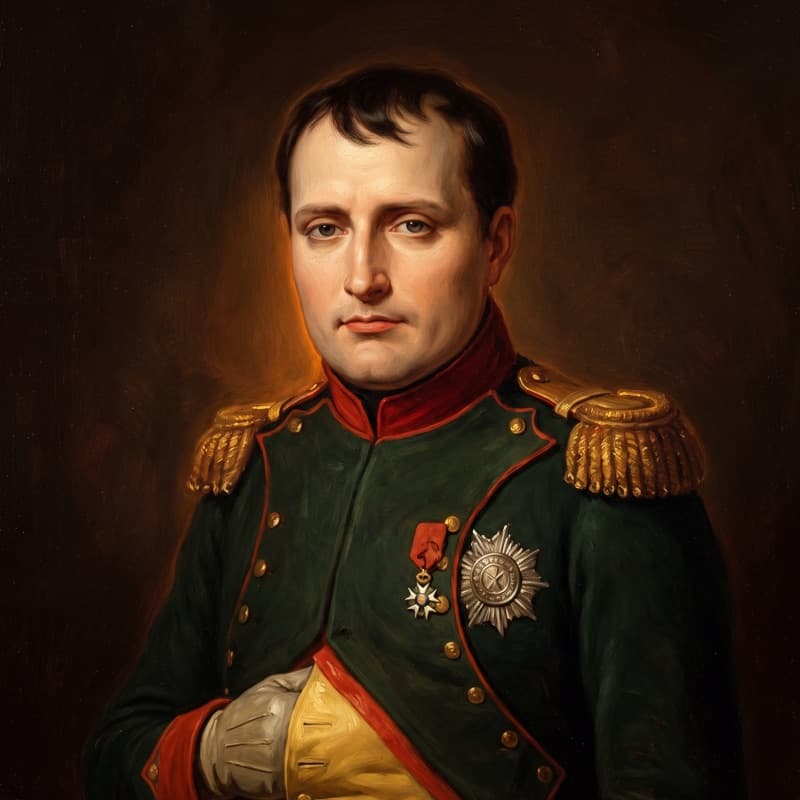
Napoleon Bonaparte died on May 5, 1821, at Longwood House on the remote South Atlantic island of Saint Helena, where the British had held him in exile since 1815 (Wikipedia). He was 51. This page reconstructs the six years between his final defeat and his death, and corrects the points where the popular story drifts from the record.
From Waterloo to a British island
Napoleon's Hundred Days ended with defeat at the Battle of Waterloo and a second abdication on June 22, 1815, closing a reign that had resumed only that March (Wikipedia). The victorious coalition did not return him to Elba, his first exile. This time the British moved him much farther: to Saint Helena, a remote island in the South Atlantic, thousands of miles from Europe and any route back to it (Wikipedia).
Longwood House and the years of confinement
Napoleon spent his final years confined at Longwood House on Saint Helena under British guard. It was there, in conversation with a companion in exile, Emmanuel de Las Cases, that Napoleon offered one of his more self-aware reflections, recorded in Las Cases' Mémorial de Sainte-Hélène under a November 1816 entry: "What then is, generally speaking, the truth of history? A fable agreed upon" (Quote Investigator). Tellingly, he introduced the line as something "very ingeniously remarked" by someone else rather than claiming it as his own — the saying traces further back, to the French writer Fontenelle in 1724, and Napoleon was endorsing an existing observation, not coining it.
Exile-era Saint Helena talk also produced the line, often quoted today, that his "true glory" was not his forty battles but his Civil Code. It is a good encapsulation of how Napoleon wanted to be remembered, but no primary-source page or volume citation confirms he said it in those exact words, so it belongs with the legend rather than the documented record.
The essentials
- Final defeat: Battle of Waterloo, June 18, 1815
- Second abdication: June 22, 1815
- Exile: Saint Helena, a remote British-held island in the South Atlantic
- Place of death: Longwood House, Saint Helena
- Date of death: May 5, 1821, at age 51 (Wikipedia)
Correcting a myth: "Napoleon was short"
He wasn't, at least not for his era. A period medical description of Napoleon gives five feet two inches in French measure — roughly five feet six inches in English measure — and a separate English measurement taken after death put him at five feet seven inches (The Napoleon Series). The "short" caricature comes largely from British wartime propaganda and from confusing French and English units of the period, which were not the same size. By the standards of early-19th-century Frenchmen, Napoleon was about average height.
What the exile left unfinished
Saint Helena is where the emperor became, by necessity, a memoirist — dictating, reflecting, and shaping how history would read him, with no army left to argue the point by force. The institutions he had already built in France, above all the Civil Code, kept operating and spreading with or without him. He died still insisting those reforms, not the battles, would be what lasted.
Related pages
Napoleon hub · verified quotes and misattributions · biography · fact file.
This site also offers a conversational AI recreation of Napoleon, built on the same cited record. His knowledge ends before Saint Helena — so he can't tell you about his own exile, but he can tell you everything that led to it: the campaigns, the coronation, the Code he was already certain would outlast him. You can put the question to him directly.